198 17-bit Wallace-tree POPCNT with shift-register input
198 : 17-bit Wallace-tree POPCNT with shift-register input
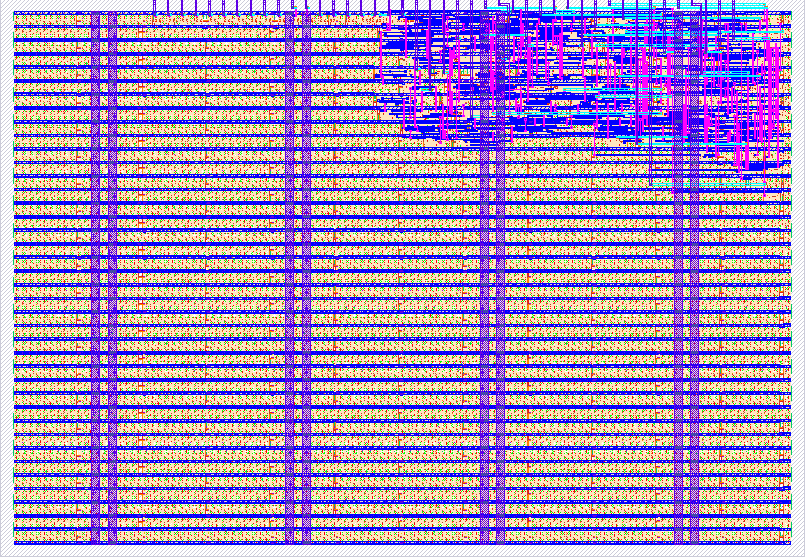
- Author: Rao M. Ghayas Udin , Namra Mazhar
- Description: A sequentially loaded 17-bit Wallace-tree population counter using 16-bit parallel loading and one serial input bit
- GitHub repository
- Open in 3D viewer
- Open in Tiny Tapeout Explorer
- Clock: 100000000 Hz
17-bit Wallace-Tree POPCNT with Parallel/Serial Input Loading
Overview
This Tiny Tapeout project implements a 17-bit population counter (POPCNT) using a Wallace-tree compressor architecture.
The arithmetic core accepts 17 independent logical input bits and produces a 5-bit binary output equal to the number of asserted input bits.
Because the Tiny Tapeout interface provides 16 physical input-capable data pins, the design uses a two-cycle input-loading scheme to provide independent control of all 17 logical POPCNT inputs.
Architecture
The design contains:
- a 17-bit input register,
- a four-state control FSM,
- a combinational 17-bit Wallace-tree POPCNT core,
- a 5-bit registered result.
The Wallace-tree core explicitly contains:
- 12
sky130_fd_sc_hd__fa_1full adders, - 3
sky130_fd_sc_hd__ha_1half adders.
The 15 arithmetic cells are marked with synthesis keep attributes.
Input Protocol
Cycle 1 - Parallel Load
Sixteen input bits are captured simultaneously:
ui_in[7:0]->i0-i7uio_in[7:0]->i8-i15
These values are stored in data_reg[15:0].
Cycle 2 - Serial Load
ui_in[0] is reused to capture the seventeenth logical input:
ui_in[0]->i16
The original value of i0 is not affected because it was already stored
in data_reg[0] during the parallel-load cycle.
Therefore all 17 logical POPCNT inputs remain independently controllable.
Cycle 3 - Result Capture
The stored 17-bit word is evaluated by the Wallace-tree POPCNT.
The resulting population count is captured into the 5-bit result register.
The result appears on:
uo_out[0]= P0uo_out[1]= P1uo_out[2]= P2uo_out[3]= P3uo_out[4]= P4
uo_out[7:5] are driven low.
FSM
Following reset, the controller progresses through:
LOAD_PARALLELLOAD_SERIALCAPTUREHOLD
The output remains valid in HOLD until reset starts a new transaction.
Clock Target
The target clock frequency is 300 MHz.
The physical-design clock constraint is:
3.333 ns
The RTL Cocotb simulation uses:
3334 ps
The 1 ps difference allows the simulation clock to be represented cleanly by the simulator.
RTL simulation verifies functional behavior. The achievable physical clock frequency must be determined from post-route static timing analysis.
Exhaustive Functional Verification
The complete logical 17-bit input space has been tested.
Number of possible input combinations:
2^17 = 131072
Equivalently:
65536 parallel input patterns x 2 serial-bit values = 131072
For each combination, the hardware output is compared against the expected software population count.
RTL result:
131072 / 131072 combinations passed
Tiny Tapeout Interface
Parallel Inputs
ui_in[7:0]= D0-D7uio_in[7:0]= D8-D15
Serial Input
During the serial-load cycle:
ui_in[0]= D16
Outputs
uo_out[4:0]= 5-bit population countuo_out[7:5]= 0
The bidirectional Tiny Tapeout pins are configured as inputs by driving
uio_oe low.
Physical Verification
Final timing, area, power, DRC, LVS, routing, and post-layout cell-count results are determined from the ASIC implementation flow.
IO
| # | Input | Output | Bidirectional |
|---|---|---|---|
| 0 | D0 / SERIAL_D16 | P0 | D8 |
| 1 | D1 | P1 | D9 |
| 2 | D2 | P2 | D10 |
| 3 | D3 | P3 | D11 |
| 4 | D4 | P4 | D12 |
| 5 | D5 | D13 | |
| 6 | D6 | D14 | |
| 7 | D7 | D15 |