718 Crypto-Agile NTT Butterfly (ML-KEM / ML-DSA / FN-DSA)
718 : Crypto-Agile NTT Butterfly (ML-KEM / ML-DSA / FN-DSA)
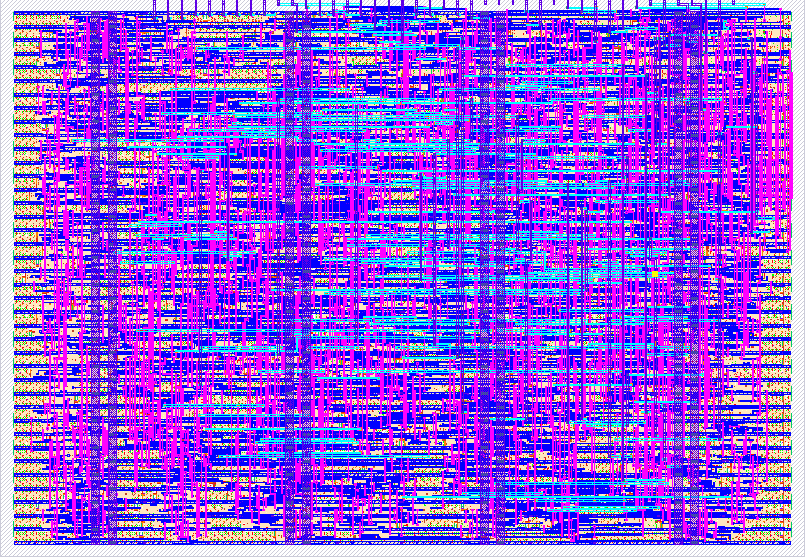
- Author: H Vinayaka, Abu Arshian , Shylashree N, RV College of Engineering
- Description: Bit-serial Montgomery NTT butterfly shared across all three NIST PQC moduli
- GitHub repository
- Open in 3D viewer
- Open in Tiny Tapeout Explorer
- Clock: 28000000 Hz
Credits
We gratefully acknowledge the Center of Excellence (CoE) in Integrated Circuits and Systems (ICAS) and the Department of Electronics and Communication Engineering (ECE) for providing the necessary resources and guidance.
Special thanks to Dr. H V Ravish Aradhya (HoD - ECE), Dr. K R Usha Rani (Associate Dean - PG), Dr. K. S. Geetha (Vice Principal) and Dr. K. N. Subramanya (Principal) for their constant encouragement and support in facilitating this Tiny Tapeout SKY26C submission.
How it works
This is a crypto-agile Number Theoretic Transform (NTT) butterfly unit that supports the moduli of all three NIST post-quantum cryptography standards from a single shared datapath:
SCHEME |
Standard | Scheme | q | k (loop iterations) |
|---|---|---|---|---|
00 |
FIPS 203 | ML-KEM (Kyber) | 3329 | 12 |
01 |
FIPS 206 | FN-DSA (Falcon) | 12289 | 14 |
1x |
FIPS 204 | ML-DSA (Dilithium) | 8380417 | 23 |
The unit computes one Cooley–Tukey butterfly:
t = b · w · 2^-k  mod q      (Montgomery product)
u = (a + t)       mod q
v = (a - t)       mod q
Why this fits in one tile
The usual way to build a multi-scheme NTT unit is to instantiate a parallel multiplier plus a separate reducer per scheme (Barrett, Plantard, or a Solinas-style shift-add chain for each q) and mux between them. That does not fit in a 1×1 tile.
Instead this design uses a radix-2 bit-serial Montgomery multiplier. Montgomery reduction is valid for any odd modulus, so scheme agility costs only:
- a constant mux selecting
q, and - a different terminal value for the iteration counter.
There is no per-scheme reduction hardware at all. Each iteration is
m   = S[0] ^ (w[i] & b[0])          // q is odd, so q[0] = 1
S  <- (S + w[i]·b + m·q) >> 1
with the loop invariant S < 2q (verified exhaustively in the golden model), so the accumulator
is 24 bits and the three-operand sum is 25 bits.
One adder for everything
A single 25-bit three-operand adder is time-shared across the whole computation through input muxes. The FSM walks through:
| State | opX |
opY |
opZ |
Result |
|---|---|---|---|---|
MUL (k×) |
S | w[i] ? b : 0 |
m ? q : 0 |
S <- sum >> 1 |
RED |
S | ~q |
1 | t = S - q if no borrow |
SUB1 |
a | ~t |
1 | v <- a - t, latch borrow |
SUB2 |
v | borrow ? q : 0 |
0 | v corrected |
ADD1 |
a | t | 0 | u <- a + t |
ADD2 |
u | ~q |
1 | u = u - q if no borrow |
Loading and unloading also share hardware: the operand registers form one byte shift chain
DIN -> w -> b -> a -> DOUT, and because the unload path happens to need the identical
inter-register connections as the load path, they cost one set of muxes between them.
Latency is k + 5 cycles: 17 for ML-KEM, 19 for FN-DSA, 28 for ML-DSA. Smaller-modulus schemes are genuinely faster, since the loop length tracks the modulus.
How to test
w must be supplied in the Montgomery domain, i.e. load w · 2^k mod q rather than w.
This is standard for Montgomery-based NTT implementations, where twiddle tables are stored
pre-scaled. test/golden_model.py provides to_mont(w, q, k).
All values are 24 bits, sent most-significant byte first.
- Reset with
rst_nlow for a few cycles. - Drive
SCHEMEonuio[4:3]and hold it for the whole transaction. - Load 9 bytes. For each byte: put it on
ui_in, raiseSHIFT(uio[0]), clock once. Order isa[23:16] a[15:8] a[7:0] b[23:16] b[15:8] b[7:0] wm[23:16] wm[15:8] wm[7:0]. - Start. Lower
SHIFT, raiseSTART(uio[1]), clock once, lowerSTART. - Wait for
DONE(uio[5]) to go high.BUSY(uio[6]) is high while computing. - Unload 6 bytes. Read
uo_out, then pulseSHIFTand read again, five times. The stream isu[23:16] u[15:8] u[7:0] v[23:16] v[15:8] v[7:0].
SCHEME may be changed freely between transactions with no reset in between — this is
exercised directly by test_scheme_switch_without_reset.
Worked example (ML-KEM, q = 3329)
a = 2384,  b = 2534,  w = 710
wm = 710 · 2^12 mod 3329 = 1943
->  t = 1480,  u = 535,  v = 904
External hardware
None. The design is driven entirely over the dedicated and bidirectional TT pins; a Raspberry Pi
Pico running the standard tt-micropython-firmware, or the TT commander UI, is sufficient.
IO
| # | Input | Output | Bidirectional |
|---|---|---|---|
| 0 | DIN0 | DOUT0 | SHIFT (in) |
| 1 | DIN1 | DOUT1 | START (in) |
| 2 | DIN2 | DOUT2 | |
| 3 | DIN3 | DOUT3 | SCHEME0 (in) |
| 4 | DIN4 | DOUT4 | SCHEME1 (in) |
| 5 | DIN5 | DOUT5 | DONE (out) |
| 6 | DIN6 | DOUT6 | BUSY (out) |
| 7 | DIN7 | DOUT7 |