810 UNDIP ANN Accelerator (SPI + bring-up self-test)
810 : UNDIP ANN Accelerator (SPI + bring-up self-test)
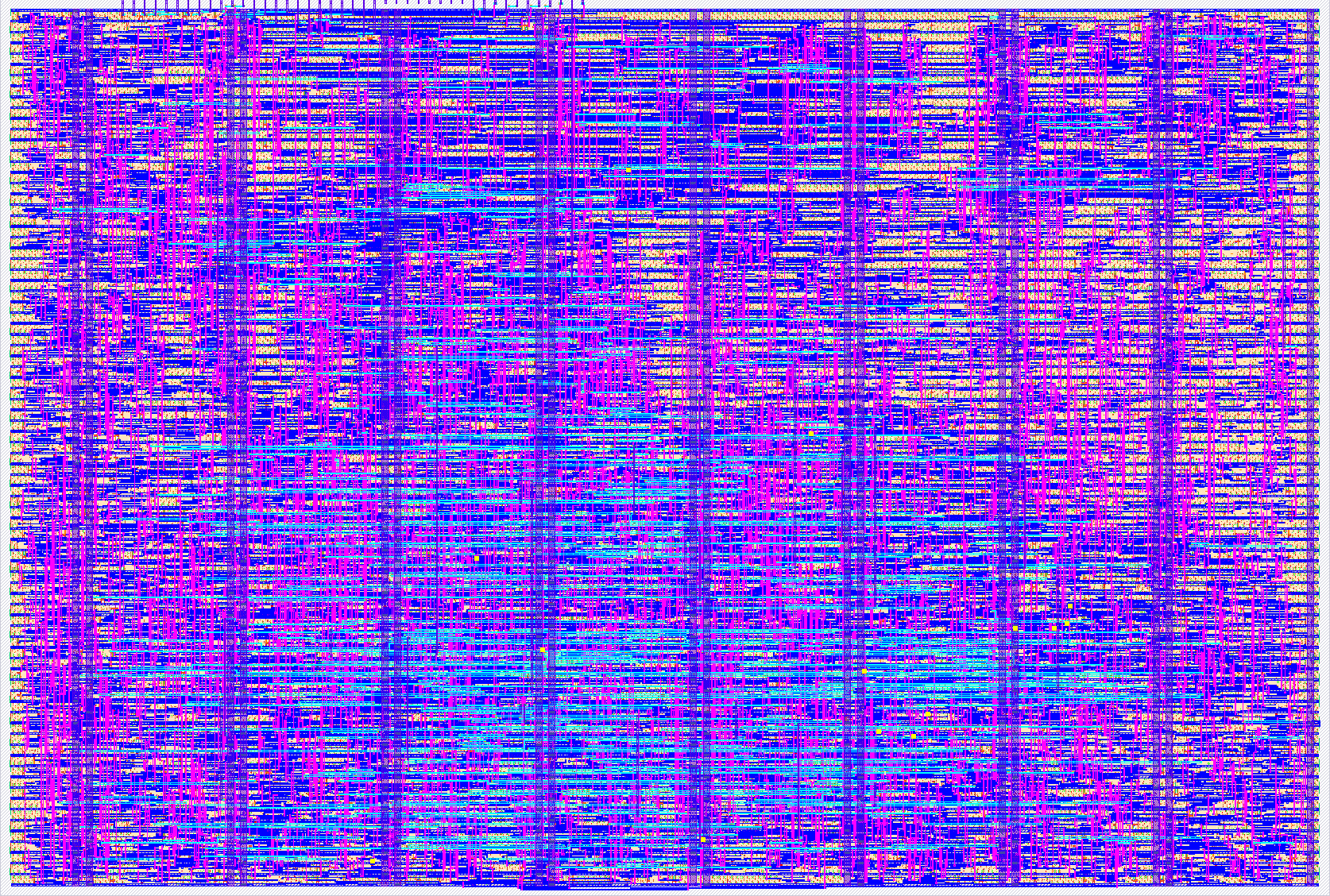
- Author: Muhammad Ardi Saputro; Dr. Munawar Agus Riyadi
- Description: Feedforward ANN accelerator (4-5-1 topology, Q6.10 activation, Q4.4 weight) with SPI interface, weight-load separated from input-load, and bring-up modes (heartbeat/loopback/self-test) via a mode-select pin
- GitHub repository
- Open in 3D viewer
- Open in Tiny Tapeout Explorer
- Clock: 10000000 Hz
How it works
This project is a small feedforward artificial neural network (ANN) accelerator with topology 4 -> 5 -> 1 (4 inputs, 5 hidden neurons, 1 output neuron), implemented as a fixed-point digital ASIC and controlled over an SPI-like interface.
Numeric format. Activations use Q6.10 fixed-point (16-bit, 10 fractional
bits). Weights and biases use Q4.4 fixed-point (8-bit, 4 fractional bits).
The output neuron produces a raw sigmoid value in Q6.10 (e.g. 0x0200 =
0.5); thresholding is left to the host.
Datapath. A single shared multiply-accumulate processing element (pe)
and a single shared activation-function unit (af, a ROM-based sigmoid
approximation) are time-multiplexed across all 6 neurons by a small FSM
inside the ann module. This keeps the design small at the cost of taking
several clock cycles per inference (roughly a few dozen cycles for the full
4-5-1 network, dominated by the number of MAC steps per neuron).
SPI interface. Two internal AXI4-Stream-like modules (spi_to_axis_deserializer
and axis_to_spi_serializer) bridge a 3-wire SPI-style protocol (cs_n,
sclk, mosi on the input side, a single miso output) to the ANN core. A
write transaction shifts in one or more 24-bit frames (1 tlast bit + 7
reserved bits + 16 data bits) while cs_n is held low; a read transaction
shifts out one 16-bit result MSB-first once the ANN core has finished
computing.
Weight/bias persistence (separating "load weights" from "run inference"). The first word of every write transaction is a header word:
- bits
[2:0]:num_inputs(1-4) - bit
[3]:load_weights-- 1 means this transaction also carries the full 16-word block of 31 packed weight/bias values (2 values per word, 8-bit each) right after the 4 activation words, exactly like a normal "configure" transaction. 0 means this transaction carries only the 4 activation words; the wrapper reuses whatever weights/biases were loaded by the most recentload_weights=1transaction. This means day-to-day inference only requires sending 5 words (header + 4 activations) instead of 21, and weights don't need to be resent unless you actually want to change them.
Bring-up / self-test modes. Two bits on ui_in[4:3] select one of four
modes, independent of the SPI protocol above:
00NORMAL -- the SPI/ANN behaviour described above.uo_out[7:1]additionally mirrors the 7 MSBs of the last computed result continuously (no protocol needed), so a scope/logic analyzer can sanity-check that a computation happened without decoding SPI.01HEARTBEAT -- a free-running counter togglesuo_out[1], provingclk/rst_n/basic logic are alive without touching the SPI/ANN datapath at all.10LOOPBACK --uo_out[7:1]directly echoesui_in[7:1], proving the physical I/O pins are wired correctly, independent of any internal logic.11SELFTEST -- runs one computation through the realanndatapath with a fixed all-zero golden vector (weights=0, activations=0), which deterministically produces0x0200(af(0), i.e. sigmoid(0) = 0.5).uo_out[1]pulsesself_test_doneanduo_out[2]reportsself_test_pass. This lets a bring-up engineer verify the chip is functionally alive post-fabrication without needing to supply any real weights, biases, or inputs. Note: this specific vector only exercises the FSM sequencing, ROM addressing, and done/handshake logic -- it does not exercise non-zero multiply/shift/saturation arithmetic, which is instead covered by the numeric regression vectors in the testbench.
uio_out[5] (weights_loaded) is a persistent status flag, visible in any
mode, that is set the first time a load_weights=1 transaction completes
and is only cleared by reset -- so a host can check whether valid weights
have ever been loaded before trusting a NORMAL-mode inference result.
How to test
A minimal bring-up sequence, usable without any host software or real weights:
- Hold
rst_nlow, then release it, withena=1. - Set
ui_in[4:3] = 01(HEARTBEAT).uo_out[1]should toggle slowly over time -- this alone proves the clock and reset are working. - Set
ui_in[4:3] = 10(LOOPBACK) and drive various patterns onui_in[7:5].uo_out[7:1]should echoui_in[7:1]exactly. - Set
ui_in[4:3] = 11(SELFTEST) and wait a short time.uo_out[1](self_test_done) should go high, anduo_out[2](self_test_pass) should read 1. - Set
ui_in[4:3] = 00(NORMAL) to run a real SPI transaction:- Pull
cs_n(ui_in[0]) low. - Shift in a 24-bit header frame MSB-first on
mosi(ui_in[2]), clocked bysclk(ui_in[1]): bit23 = tlast (0 for the header), bits[22:16] = 0, bits[3] =load_weights(1 to also send weights), bits[2:0] =num_inputs. - Shift in 4 activation words (Q6.10), then, if
load_weights=1, 16 more words packing the 31 Q4.4 weight/bias values 2-per-word (seeann_axis_wrapper.vfor the exact index order). Raisetlast(bit23) on the final word of the transaction. - Raise
cs_nhigh to close the write phase. - Poll
misowhilecs_nis high: it reflects the wrapper's "ready for next write" status, which only goes high again once the computation has finished and the result has been handed to the serializer. - Once ready, pull
cs_nlow again and clock out 16 bits onmiso(MSB-first) to read the Q6.10 result. - To run another inference re-using the same weights, repeat the write
phase with a header whose
load_weightsbit is 0 and only 4 activation words.
- Pull
A full, self-checking testbench (test/tb_undip_ann_tt-style for local
Vivado/Icarus simulation, plus test/test.py for the cocotb-based CI gate
level test) exercises all four modes above plus a numeric regression: a
hand-derived, simulator-verified vector (in0=1.0, w_h0=1.0,
pe1000=1.0, all else 0) that must produce exactly 0x029E, followed by
two weight-reuse transactions that prove stored weights are actually being
reused (not just replaying a stale output).
External hardware
None required for basic bring-up (all four modes are testable directly via
the demo board's DIP switches / RP2040). For real inference, any SPI-capable
host (e.g. a microcontroller) can drive cs_n/sclk/mosi and read
miso.
IO
| # | Input | Output | Bidirectional |
|---|---|---|---|
| 0 | SPI CS_N (active low) | SPI MISO (normal mode) / 0 (other modes) | debug: axis_tvalid (deserializer->ann), active in normal mode only |
| 1 | SPI SCLK | ann result bit15 (normal) / heartbeat toggle / echo ui[1] (loopback) / self_test_done (selftest) | debug: axis_tready, active in normal mode only |
| 2 | SPI MOSI | ann result bit14 (normal) / 0 / echo ui[2] (loopback) / self_test_pass (selftest) | debug: axis_tlast, active in normal mode only |
| 3 | mode select bit 0 | ann result bit13 (normal) / 0 / echo ui[3] (loopback) / 0 (selftest) | debug: m_axis_tvalid (ann->serializer), active in normal mode only |
| 4 | mode select bit 1 (00=normal,01=heartbeat,10=loopback,11=selftest) | ann result bit12 (normal) / 0 / echo ui[4] (loopback) / 0 (selftest) | debug: m_axis_tready, active in normal mode only |
| 5 | reserved / loopback echo source | ann result bit11 (normal) / 0 / echo ui[5] (loopback) / 0 (selftest) | status: weights_loaded (active in all modes, 1 = weight/bias loaded at least once since reset) |
| 6 | reserved / loopback echo source | ann result bit10 (normal) / 0 / echo ui[6] (loopback) / 0 (selftest) | reserved |
| 7 | reserved / loopback echo source | ann result bit9 (normal) / 0 / echo ui[7] (loopback) / 0 (selftest) | reserved |