321 Neural Compute Core (V0.15)
321 : Neural Compute Core (V0.15)
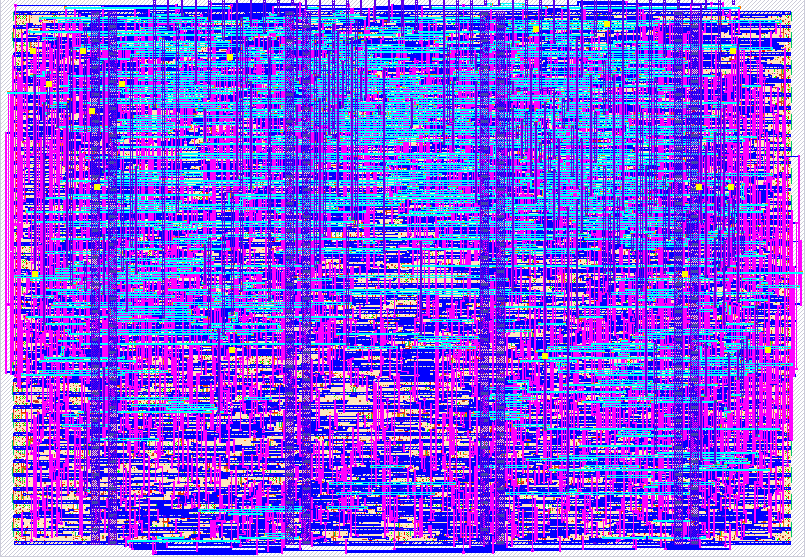
- Author: Felix Cheng
- Description: Pipelined 50 MHz byte-stream int8 MAC engine on a single tile: single int32 accumulator, streaming vector-MAC (MACV), a toggle-able WIDE-input mode (WMACV, 2x throughput, time-shares the debug pins), saturating accumulator, and a SPILL opcode reading the raw int32 accumulator out (host does bias/requant/activation). MISR self-test + serial debug — a hardware MAC core for a compiler/MLIR co-design stack
- GitHub repository
- Open in 3D viewer
- Open in Tiny Tapeout Explorer
- Clock: 50000000 Hz
How it works
This is V0.15 of a programmable neural compute core — deliberately the smallest architecture
that still gives a compiler/MLIR backend a real lowering target. It is a pipelined (50 MHz)
byte-stream int8 multiply-accumulate (MAC) engine with a small instruction set, a single
int32 accumulator, saturating accumulation, and a SPILL opcode that reads the raw
int32 accumulator out. The requantization tail (bias, downscale-shift, saturate, ReLU) is
output-only math, so it is offloaded to the host in software — what stays on-chip is the
interesting hardware: the pipelined MAC, the accumulator, the streaming MACV primitive,
the spill path, a self-test, and a debug interface.
ISA (V0.15)
Instructions and their operands are streamed in one byte per clock over ui_in (gated by
IN_VALID). All accumulating ops target the single accumulator ACC:
| Opcode | Name | Operands | Effect |
|---|---|---|---|
0x00 |
NOP |
— | nothing |
0x01 |
LOAD_ACT |
1 byte (int8) | activation register = operand |
0x02 |
LOAD_W |
1 byte (int8) | weight register = operand |
0x03 |
MAC |
— | ACC += act * weight (saturating int32) |
0x04 |
MACV |
N, then 2N bytes |
ACC += Σ actᵢ·wᵢ (streaming dot product) |
0x05 |
CLRACC |
— | ACC = 0 |
0x06 |
SPILL |
— | emit raw int32 ACC as 4 LE bytes over OUT_VALID; fold into MISR |
0x07 |
HALT |
— | stop; assert DONE |
0x08 |
WMACV |
N |
wide streaming MAC (see below): N host-clocked cycles of ACC += act·w, activation on ui_in ∥ weight on uio, 1 MAC/cycle |
| other | — | — | illegal instruction: assert ERROR, DONE |
MACV is the primary compiler lowering target: a quantized linear/conv reduction tiles down to a
sequence of MACV ops. One output neuron is MACV …; SPILL; the host applies the bias + requant +
activation to the spilled accumulator, and tiles additional output channels by re-issuing MACV.
(An earlier version had a 2-entry accumulator file + SEL_ACC; byte-level accounting showed that
without a broadcast-MAC instruction it couldn't beat host re-streaming over the pin interface, so it
was cut — see JOURNEY.md.)
Wide-input mode (WMACV). Normally input is one byte/clock over ui_in, so a MAC (activation +
weight) takes 2 clocks. WMACV N runs a wide burst: for N host-clocked cycles the uio pins
are reconfigured as inputs and carry the weight byte while ui_in carries the activation — one
MAC per clock, 2× the throughput of MACV. Before and after the burst, uio reverts to its normal
role (control in / status out / debug), so wide mode and the debug port time-share the same pins —
you never need both at once (debug is a bring-up activity, wide is a production run). The 2× is only
realized with a host that can actually push 16 bits/clock (e.g. an RP2040 PIO + DMA driver); a simple
byte-at-a-time driver leaves the chip feed-limited either way. BUSY is asserted for the burst.
Host-side requant. The requantized int8 never re-enters the datapath — requant is purely output
framing. Since SPILL exposes the raw int32 accumulator, the host does the tail in software:
out = ReLU?( sat8( (acc + bias + 2^(shift-1)) >> shift ) ). This keeps the barrel shifter, bias
register, and requant pipeline off the (area-constrained) chip. The MAC is pipelined (the
accumulator commits one cycle after the multiply), and SPILL streams its 4 bytes over OUT_VALID.
Self-test signature (MISR). Every SPILL output byte is folded into a 16-bit MISR (Galois LFSR,
poly x¹⁶+x¹⁵+x¹³+x⁴), readable via the debug interface. Running a known program yields a fixed
signature, so post-fabrication bring-up is a single read-and-compare against the golden value.
Long reductions (SPILL)
The accumulator is int32, so one accumulation holds up to ~131K max-magnitude products before it
saturates (and sets the sticky overflow flag) — so tiling is rare in practice; SPILL remains as the
backup path for extremely large reductions. To tile: accumulate a chunk, issue SPILL to read
the raw int32 partial sum (4 little-endian bytes over four OUT_VALID pulses; SPILL reads the
accumulator out directly and stalls further input for those 4 cycles, asserting BUSY, so wait for
the 4 pulses before the next instruction),
CLRACC, and repeat — then sum the raw int32 partials on the
host (exact, since they are not requantized) and do the final requant. So the accumulator width is
a chunk size, not a ceiling: arbitrary layer sizes work via host-side reconstruction.
Debug interface
Assert DBG_EN and place a register address on ui_in[3:0] to read internal state back on
uo_out (combinational, non-intrusive — reading never advances the machine). Real-time
OUT_VALID/DONE/BUSY/ERROR are also on the uio_out pins. The register map:
| Addr | Register | Contents |
|---|---|---|
0x0 |
PC |
opcodes accepted (wraps at 256) |
0x1 |
CUR_INSTR |
current opcode byte |
0x2 |
STATE |
FSM state (see below) |
0x4–0x6 |
ACC[7:0]…ACC[23:16] |
int32 accumulator, little-endian (byte 0 = LSB) |
0x7 |
ACC[31:24] |
accumulator high byte (int32) |
0x8 |
ACT_REG |
activation register (int8) |
0x9 |
W_REG |
weight register (int8) |
0xA |
OUT_REG |
latest SPILL byte |
0xB |
STATUS |
[5:0] = sticky status flags ([7:6] = 0) |
0xC |
CYC |
cycles since execution started (wraps) |
0xE |
SIG[7:0] |
MISR self-test signature, low byte |
0xF |
SIG[15:8] |
MISR self-test signature, high byte |
| other | — | unused (0x3, 0xD read 0x00) |
Status byte (0xB): bits [5:0] are sticky flags — [0] illegal-instruction,
[1] arithmetic-overflow, [2] pipeline-error (reserved, always 0), [3] output-generated,
[4] execution-started, [5] execution-finished. Bits [7:6] read 0.
FSM state (0x2): 0 FETCH, 1 LDACT, 2 LDW, 3 MACV_N, 4 MACV_A, 5 MACV_W,
6 HALT, 7 ERR.
Post-fabrication bring-up (self-test)
The MISR at 0xE/0xF turns bring-up into a single read-and-compare. Drive this canonical
self-test program (one byte per clock, IN_VALID high, from reset); each SPILL emits the raw
int32 accumulator over OUT_VALID, and every spilled byte folds into the MISR:
# opcode stream (hex)                 ; effect
04 03  02 03 04 05 01 01  06          ; MACV·3 [(2,3),(4,5),(1,1)] -> acc = 27, SPILL   (narrow path)
05                                    ; CLRACC -> acc = 0
08 02  (10,10) (1,1)  06              ; WMACV·2 wide -> acc = 101, SPILL                (wide path)
07                                    ; HALT
The WMACV·2 step is driven wide: after 08 02, clock 2 cycles with the activation on ui_in and
the weight on uio — (10,10) then (1,1) — so the self-test exercises both the narrow and the
wide datapaths in one pass. Expected golden end-state:
| Register | Addr | Golden value |
|---|---|---|
STATUS |
0xB |
0x38 (output-generated, started, finished) |
SIG |
0xF,0xE |
0x0EA8 |
A matching 0x0EA8 exercises the decoder, the pipelined Booth MAC, the accumulator, both the
narrow and wide operand paths, the SPILL path, and the MISR in a single pass — so a defect in either
datapath changes the signature. This exact program and signature are asserted against the golden model
in test/test.py::test_misr_selftest, so they stay in lock-step with the RTL.
How to test
The design ships with a layered cocotb testbench (test/) checked against a golden Python
reference model (test/neural_core_model.py): directed tests for every opcode, signed
arithmetic, saturation, streaming MACV, pipeline/BUSY behavior, illegal instructions,
edge-operand sweeps through both multiply paths, and the debug interface — plus a randomized
differential test that runs many random programs through both the RTL and the model and asserts
cycle-free architectural agreement. The radix-4 Booth multiplier (booth_mult8) additionally has an
exhaustive standalone test — all 65 536 signed input pairs vs. a*b (make -f Makefile.booth).
cd test
pip install -r requirements.txt
make                     # chip-level suite (36 tests)
make -f Makefile.booth   # exhaustive Booth multiplier (65 536 pairs)
External hardware
None required. Drive the pins from a microcontroller or the RP2040 on the TT carrier board:
present instruction/operand bytes on ui_in with IN_VALID high, read results on uo_out
when OUT_VALID pulses, and use DBG_EN + ui_in[3:0] to inspect internal state.
Behavior at the range limits
Pinned by directed tests:
- Accumulator overflow saturates. If accumulation would exceed the int32 range,
ACCclamps toINT32_MAX/INT32_MIN(rather than wrapping) and the stickyarithmetic_overflowbit (STATUS[1]) is set. For reductions beyond the ~131K-product int32 budget, tile them withSPILL+CLRACCand sum the raw partials on the host. Pinned bytest_accumulator_overflowandtest_spill_reconstruct_long_reduction.
IO
| # | Input | Output | Bidirectional |
|---|---|---|---|
| 0 | IN_D0 / DBG_A0 | OUT_D0 | IN_VALID (in) / W0 (wide) |
| 1 | IN_D1 / DBG_A1 | OUT_D1 | DBG_EN (in) / W1 (wide) |
| 2 | IN_D2 / DBG_A2 | OUT_D2 | OUT_VALID (out) / W2 (wide) |
| 3 | IN_D3 / DBG_A3 | OUT_D3 | DONE (out) / W3 (wide) |
| 4 | IN_D4 | OUT_D4 | BUSY (out) / W4 (wide) |
| 5 | IN_D5 | OUT_D5 | ERROR (out) / W5 (wide) |
| 6 | IN_D6 | OUT_D6 | W6 (wide weight) |
| 7 | IN_D7 | OUT_D7 | W7 (wide weight) |