291 Bloom Filter Membership Tester
291 : Bloom Filter Membership Tester
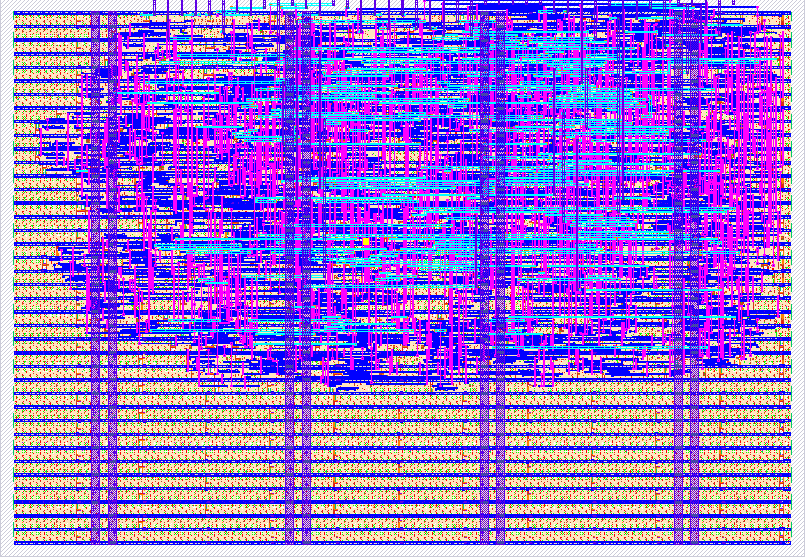
- Author: Manasvi Bhat K, Vaishnavi Karpur, Shylashree N, RV College of Engineering
- Description: Probabilistic set membership tester: 64-bit array, 2 XOR-fold hash functions, insert and query operations with zero false negatives
- GitHub repository
- Open in 3D viewer
- Open in Tiny Tapeout Explorer
- Clock: 10000000 Hz
Credits
We gratefully acknowledge the Center of Excellence (CoE) in Integrated Circuits and Systems (ICAS) and the Department of Electronics and Communication Engineering (ECE) for providing the necessary resources and guidance.
Special thanks to Dr. H V Ravish Aradhya (HoD - ECE), Dr. K R Usha Rani (Associate Dean - PG), Dr. K. S. Geetha (Vice Principal) and Dr. K. N. Subramanya (Principal) for their constant encouragement and support in facilitating this Tiny Tapeout SKY26C submission.
How it works
A Bloom filter is a probabilistic data structure that answers set membership queries in constant time and constant space. It has an asymmetric guarantee: a negative answer is always correct, while a positive answer may be wrong. It never produces a false negative, but it can produce a false positive.
This design implements a Bloom filter with a 64-bit array and k = 2 hash functions, operating on 8-bit input values.
Measured results
The two hash functions are perfectly uniform: each of the 64 array indices has exactly four preimages among the 256 possible inputs. The pair map x -> (h1(x), h2(x)) is injective — all 256 inputs produce a distinct index pair — so no two values ever write the same two bits.
Exhaustive simulation over all 256 input values, after inserting 12 distinct values, gives zero false negatives and 17 false positives out of 244 non-members, a rate of 0.070. The theoretical prediction for m=64, k=2, n=12 is 0.098. The measured rate is slightly lower, consistent with the injectivity property, which the standard formula does not account for since it assumes independent random hashes.
The design synthesises to 660 standard cells at 38.4% tile utilisation in sky130A, including 71 flip-flops (64 array bits plus 7 for control).
Hash functions
Two independent indices are derived from the 8-bit input x by XOR-folding
the upper bits down into a 6-bit index (6 bits addresses all 64 array
positions):
h1 = x[5:0] ^ {x[7:6], 4'b0000}
r  = {x[4:0], x[7:5]}          // rotate left by 3 (wiring only, no gates)
h2 = r[5:0] ^ {r[7:6], 4'b0000}
These are deliberately not cryptographic hashes. A Bloom filter only requires that its hash functions distribute inputs reasonably evenly and independently of one another; it does not require collision resistance against an adversary. XOR-folds satisfy this at a cost of four XOR gates total, which is what makes the design fit in a single tile. This is a stated simplification, not an oversight.
Operations
Insert sets the bits at positions h1 and h2 to 1. Bits are never
cleared except by a full reset, so the array is monotonic.
Query returns the logical AND of the bits at h1 and h2. If either bit
is 0, the value was definitely never inserted. If both are 1, the value was
possibly inserted — or two other insertions happened to set those same bits,
which is a false positive.
Why there are no false negatives
Insertion only ever sets bits, and query only reads the same two positions that insertion wrote. Once a value is inserted, its two bits are 1 and cannot return to 0 without a reset, so a subsequent query for that value must return
- This is a structural property of the design, and it is verified exhaustively in simulation over all 256 possible input values.
Architecture
- 64 flip-flops holding the bit array
- Two combinational hash-index generators
- Two 6-to-64 decoders for the insert path
- Two 64-to-1 multiplexers for the query path
- A three-state control FSM (IDLE, EXEC, DONE) with rising-edge detection on the strobe input. An operation completes three clock cycles after the strobe edge, signalled by a one-cycle pulse on VALID.
How to test
Reset the design by driving rst_n low for at least one clock cycle. This
clears all 64 array bits to 0.
To perform an operation:
- Place the 8-bit value on
ui_in[7:0]. - Set
uio_in[0]to select the mode: 1 for insert, 0 for query. - Drive
uio_in[1]from 0 to 1 to strobe the operation. The rising edge starts it. - Wait for
uo_out[1](VALID) to pulse high for one clock cycle. - On a query, read the answer on
uo_out[0]: 1 means possibly present, 0 means definitely absent. - Return
uio_in[1]to 0 before starting the next operation.
uo_out[7:2] continuously exposes one of the two computed hash indices for
debugging. uio_in[2] selects which: 0 shows h1, 1 shows h2.
An operation takes three clock cycles from the strobe edge. Do not read
RESULT before VALID pulses.
Suggested test sequence
Insert the values 0x10, 0x25, and 0x7F. Query each of them and confirm every answer is 1 — any 0 here would be a false negative and indicate a design fault. Then query values that were not inserted. Most should return 0; a small number will return 1, and those are the expected false positives.
Sweeping all 256 possible input values after a known set of insertions lets you measure the empirical false-positive rate and compare it against the theoretical prediction p = (1 - e^(-kn/m))^k, where k = 2, m = 64, and n is the number of distinct values inserted.
External hardware
None. The design uses only the standard Tiny Tapeout inputs and outputs and can be driven entirely from the demo board.
IO
| # | Input | Output | Bidirectional |
|---|---|---|---|
| 0 | DATA0 | RESULT | MODE |
| 1 | DATA1 | VALID | STROBE |
| 2 | DATA2 | HASH_IDX0 | DBG_SEL |
| 3 | DATA3 | HASH_IDX1 | |
| 4 | DATA4 | HASH_IDX2 | |
| 5 | DATA5 | HASH_IDX3 | |
| 6 | DATA6 | HASH_IDX4 | |
| 7 | DATA7 | HASH_IDX5 |