710 RTFCE - Reconfigurable Temporal Fault/Constraint Engine
710 : RTFCE - Reconfigurable Temporal Fault/Constraint Engine
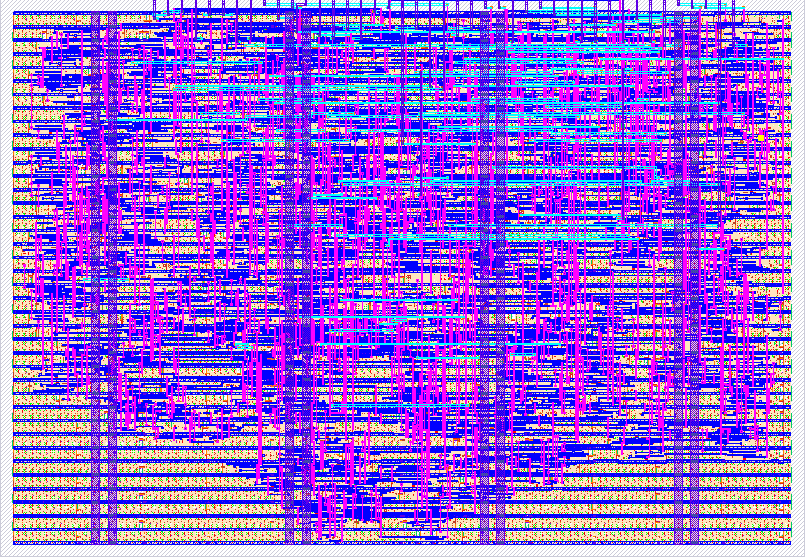
- Author: Preetham Madhukar, Tejasvi Mallaiah, Shylashree N, RV College of Engineering
- Description: Multi-context temporal latency monitor (PASS/EARLY/TIMEOUT + near-miss diagnostic) with shared classification datapath via selectable fixed-priority/round-robin arbitration
- GitHub repository
- Open in 3D viewer
- Open in Tiny Tapeout Explorer
- Clock: 50000000 Hz
Credits
We gratefully acknowledge the Center of Excellence (CoE) in Integrated Circuits and Systems (ICAS) and the Department of Electronics and Communication Engineering (ECE) for providing the necessary resources and guidance.
Special thanks to Dr. H V Ravish Aradhya (HoD - ECE), Dr. K R Usha Rani (Associate Dean - PG), Dr. K. S. Geetha (Vice Principal) and Dr. K. N. Subramanya (Principal) for their constant encouragement and support in facilitating this Tiny Tapeout SKY26C submission.
How it works
RTFCE (Reconfigurable Temporal Fault/Constraint Engine) is a multi-context temporal latency monitor. It watches for configurable start and end events on a shared 2-bit event bus, measures the number of clock cycles between them per context, and classifies each measurement as PASS, EARLY, or TIMEOUT against independently configurable minimum and maximum latency bounds.
The design supports three fully independent monitoring contexts. Each context keeps its own timer, its own armed/idle state, and its own configuration (start event, end event, min latency, max latency, enable) -- so up to three temporal relationships can be tracked simultaneously without interfering with each other.
Rather than duplicating the classification logic three times, RTFCE shares a single classification datapath across all three contexts via an arbiter. When multiple contexts finish measuring in the same clock cycle, the arbiter serializes access to the shared classifier one context per cycle -- but the latency value each context reports is captured and frozen the instant its end event is detected, so the arbitration delay can never change the reported result. This project physically measures the area/timing tradeoff of that sharing strategy against a fully-duplicated baseline (documented in the project repository).
Two selectable arbitration policies are implemented: fixed-priority (Context 0 > 1 > 2) and round-robin (fair rotation among pending contexts), switchable via a configuration register.
The classifier also reports a near-miss diagnostic: a result is flagged as "near miss" if the measured latency landed within 2 cycles of either boundary (approaching a timeout, or barely avoiding one), surfaced on a dedicated output bit -- useful as an early warning that a monitored relationship is close to violating its constraint even when it technically passed.
How to test
The design uses ui_in for event and configuration control, uio_in/uio_out as a
bidirectional configuration data bus, and uo_out as the always-active result/status bus.
Configuring a context (write a 13-bit descriptor as two 8-bit transactions):
- Drive
uio_inwith the config byte, setui_in[5:4]to the target context (0-2), setui_in[3]to select byte 0 or byte 1, setui_in[1]=1 (config mode) andui_in[2]=0 (write), then pulseui_in[0](strobe) high for one clock cycle. - Byte 0:
[7:6]=start_event,[5:4]=end_event,[3:0]=min_latency. - Byte 1:
[7]=enable,[3:0]=max_latency. - Event codes:
00=REQ,01=ACK,10=DATA,11=DONE.
Triggering a measurement:
- Set
ui_in[1]=0 (normal mode),ui_in[7:6]to the event code, pulseui_in[0](strobe) for one cycle to signal the start event. - Wait the desired number of clock cycles.
- Pulse the end event the same way.
- Watch
uo_out[4](result_valid) -- when it pulses high for one cycle:uo_out[1:0]is the result (00=PASS, 01=EARLY, 10=TIMEOUT),uo_out[3:2]is the context ID that completed,uo_out[6]is a fault flag (set on TIMEOUT), anduo_out[7]is the near-miss diagnostic.
Selecting arbitration policy: write to context select 3 (the "global" address), byte 0,
with uio_in[0] = 0 for fixed-priority or 1 for round-robin.
Reading back configuration or status: same as writing, but with ui_in[2]=1 (read); the
requested byte appears on uio_out one clock cycle later. Reading context select 3 returns
the running success/fault counters instead of a context's configuration.
A full cocotb regression exercising every scenario described above (configuration, PASS/EARLY/
TIMEOUT classification including boundary cases, multi-context arbitration under both policies,
and the near-miss diagnostic) is included in test/test.py and runs automatically via CI on
every commit.
External hardware
None. This design only uses the standard Tiny Tapeout dedicated and bidirectional I/O pins.
IO
| # | Input | Output | Bidirectional |
|---|---|---|---|
| 0 | strobe (event strobe / cfg strobe) | result[0] | cfg_data[0] |
| 1 | cfg_mode (0=normal, 1=config) | result[1] | cfg_data[1] |
| 2 | cfg_rw (0=write, 1=read) | context_id[0] | cfg_data[2] |
| 3 | cfg_byte_sel | context_id[1] | cfg_data[3] |
| 4 | addr_sel[0] | result_valid | cfg_data[4] |
| 5 | addr_sel[1] | busy | cfg_data[5] |
| 6 | event_code[0] | fault | cfg_data[6] |
| 7 | event_code[1] | reserved | cfg_data[7] |