549 The Fed Model (F1/F2)
549 : The Fed Model (F1/F2)
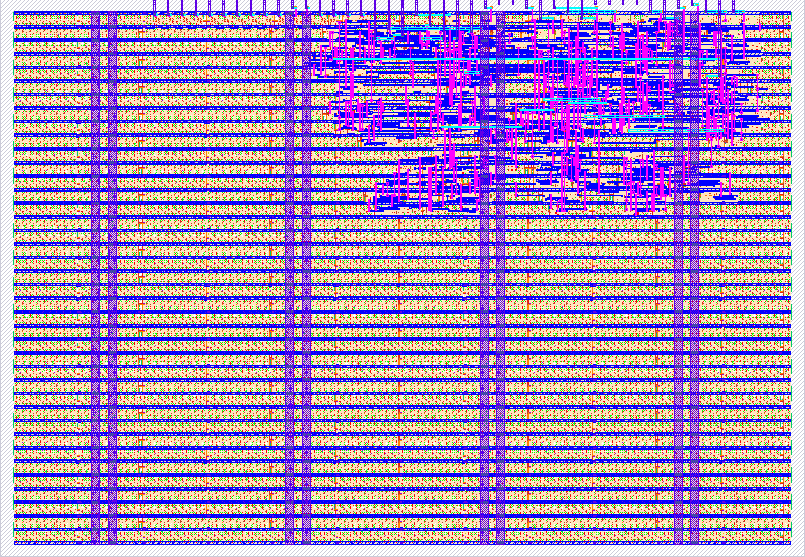
- Author: Shaun M. Rowles
- Description: A Fed rate-cycle risk model in silicon: count the cuts, exit at the threshold, stay out 12 months, stay invested through tightening. A trend-gate pin selects the 2006 original (F1) or the trend-gated revision (F2)
- GitHub repository
- Open in 3D viewer
- Open in Tiny Tapeout Explorer
- Clock: 0 Hz
How it works
This chip is a risk-management model the author built in the mid-2000s and ran through two decades of institutional practice, cast in silicon. The rule is deliberately simple: count the Federal Reserve's rate cuts. Easing cycles that go deep usually mean something is breaking. When the cut count reaches a threshold, step out of the market. Stay invested through tightening cycles, which have historically been rising-market regimes.
The chip advances on discrete events, not wall time — one event per clock edge: a CUT strobe when the Fed cuts, a HIKE strobe when it raises, and a MONTH strobe that drives the internal clocks. The easing cycle resets on any hike or after twelve months of Fed inaction.
It carries three generations of the same model, selectable at runtime:
- F1, the 2006 original (
F2_MODElow): the production state machine, ported from the recovered WatchPoint workbook spec and graded bit-exact in study P4 (PREREG_P4_F1_TRUE_SPEC_2026-08-05). Three states. ARMED: the cycle's first cut anchors an 18-month clock; the fourth cut steps out, unconditionally. RISKOFF: a hike exits immediately and re-arms (the 1983/1985 fix — three-month lockouts instead of twelve); otherwise the machine returns to the market 18 months after the cycle start — the first cut, not the trigger (the 2001/2020 fix) — into NEUTRAL: invested, but the trigger is disarmed and further cuts are ignored (the 1991/2003/2008 structural rule) until the next hike re-arms it. The workbook's 18 × (365/12)-day clock is abstracted to 18MONTHstrobes from the cycle-start cut. - The optimized variant: load
N = 6through theLOAD_Nstrobe. - F2, the validated revision (
F2_MODEhigh): the cut window (cutsNthroughN+2of a live cycle) only arms; the exit fires only when theTREND_OKpin is also low (price below its 10-month average), and each qualifying cut restarts a twelve-month stay-out. The revision exists because the unconditional trigger's exits in 1982 and 1984 were soft-landing false positives, while 2001, 2008, and 2020 — where the trend had broken — were the real events. (F1's own hike-exit cut those two false positives to three months each; F2 avoids them entirely.)
The top output bit is the call: INVESTED, high or low. The remaining outputs expose the arming state (uo[6]: F2's cut window, F1's ARMED state — low in NEUTRAL), the stay-out state, whether an easing cycle is alive, and the running cut count, so the model's entire internal reasoning is observable on the pins.
How to test
- Reset with
rst_nlow: the chip comes up INVESTED (uo[7]high), ARMED (uo[6]high), threshold 4, F1 mode. - Pulse
uio[0](CUT) three times: still invested. Pulse a fourth:uo[7]drops — the model has stepped out,uo[5](OUT_STATE) is high. - Pulse
uio[2](MONTH) eighteen times (the cuts above came back-to-back, so the cycle-start clock has its full run left): the chip goes NEUTRAL — invested again (uo[7]high) but disarmed (uo[6]low). Pulse CUT any number of times: nothing fires. Pulseuio[1](HIKE) once: re-armed (uo[6]high). - Alternatively, from OUT_STATE pulse HIKE immediately: the chip re-enters and re-arms on the spot — the 1983/1985 behavior.
- Hold
uio[4](F2_MODE) anduio[3](TREND_OK) high and pulse six cuts: the chip stays invested the whole way — the window arms (uo[6]) but a healthy trend is never honored. DropTREND_OKand pulse one more cut inside the window: out. Twelve MONTH pulses later it resumes. - Pulse HIKE any number of times in any state: the count resets and the chip stays invested through tightening.
- Load the optimized threshold: put 6 on
ui[3:0], pulseuio[7](LOAD_N); now the exit needs six cuts.
The cocotb suite in test/ runs all of these, the seven graded easing-cycle episodes from the P4 ledger (1983, 1985, 1989–94, 2001–04, 2008–15, 2020–22, and the live 2024 cycle) as directed tests, plus a 1,500-event random soak, all against a bit-exact Python reference model. Nothing depends on clock speed.
External hardware
None required. Any way to drive the strobe pins works (the Tiny Tapeout demo board is sufficient). In its intended desk installation, a tiny daily script feeds real FOMC actions and a trend bit, and the INVESTED pin drives an LED.
IO
| # | Input | Output | Bidirectional |
|---|---|---|---|
| 0 | N0 (cut-threshold value for LOAD_N strobe) | CUT_COUNT0 (cuts this easing cycle) | CUT (strobe: the Fed cut rates) |
| 1 | N1 | CUT_COUNT1 | HIKE (strobe: the Fed raised rates) |
| 2 | N2 | CUT_COUNT2 | MONTH (strobe: one month passed) |
| 3 | N3 (4 = 2006 original, 6 = optimized variant) | CUT_COUNT3 | TREND_OK (level: price above its 10-month average) |
| 4 | CYCLE_ALIVE (easing cycle in progress) | F2_MODE (level: 1 = trend-gated F2, 0 = 2006 original F1) | |
| 5 | OUT_STATE (serving the 12-month stay-out) | ||
| 6 | WINDOW_ARMED (inside cuts N..N+2) | ||
| 7 | INVESTED (the call: 1 = in the market) | LOAD_N (strobe: latch ui as cut threshold) |