34 leanSilicon LSC-1 Micro arithmetic kernel
34 : leanSilicon LSC-1 Micro arithmetic kernel
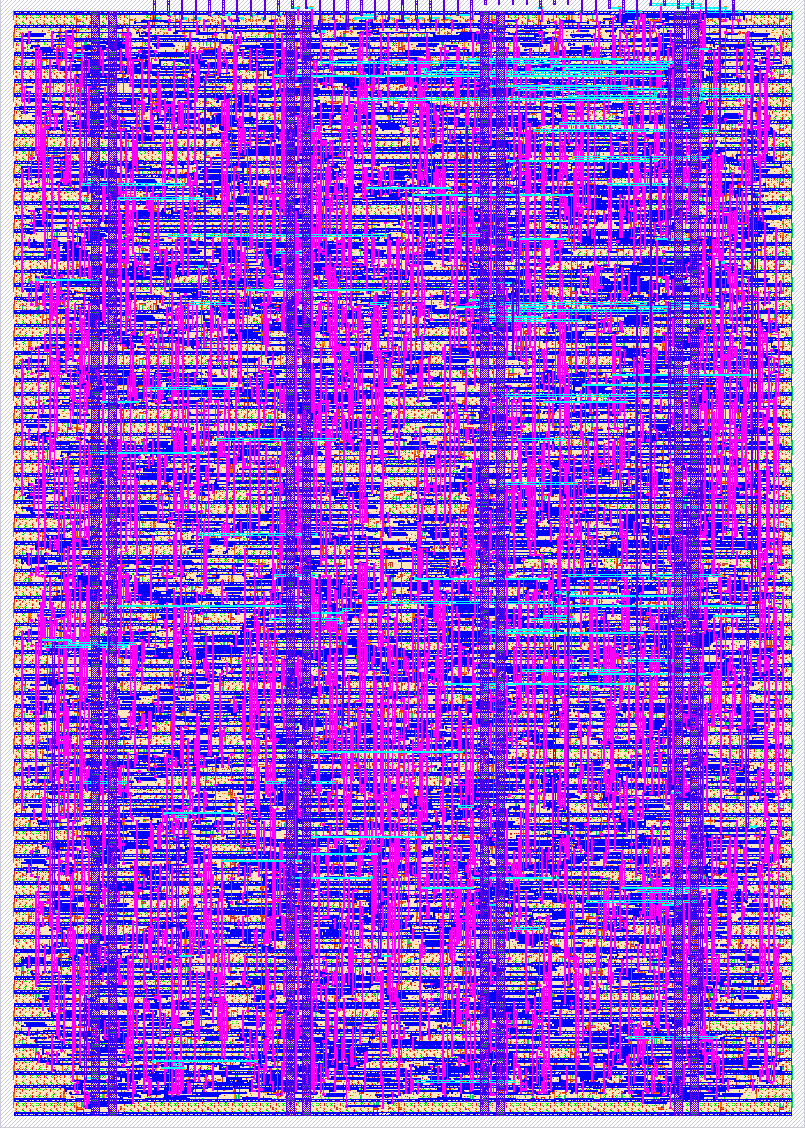
- Author: LFG Labs
- Description: LSC-1 Micro (LSC-1u): reduced Tiny Tapeout arithmetic sub-core of LSC-1, not LSC-2.
- GitHub repository
- Open in 3D viewer
- Open in Tiny Tapeout Explorer
- Clock: 25000000 Hz
LSC-1µ arithmetic kernel
LSC-1µ (also written LSC-1u in source names) is a compact Tiny Tapeout arithmetic sub-core for a deliberately reduced part of LSC-1. It performs SET, XOR, and multiplication in GF(2^128) over a byte-serial interface. It is clocked at the 25 MHz declared project clock.
This chip is not full LSC-1. It omits memory, instruction fetch, DEREF, JUMP, BLAKE3, witness handling, and commit tracking. A host must implement those omitted functions and turn any suitable work into the micro-operations described below.
How it works
ui_in[7:0] supplies request bytes and uo_out[7:0] supplies response bytes.
An input byte is accepted on a rising clock edge only when rst_n, RX_VALID,
and RX_READY are all high. The sender must keep the request byte stable while
RX_VALID is high and RX_READY is low. A response byte is accepted only
when rst_n, TX_VALID, and TX_READY are all high; the core keeps the
response byte stable while it is stalled. No request or response transfer
commits on an edge with rst_n=0.
First send one opcode, then its fixed-size payload. There is no packet framing, length field, delimiter, or CRC in this interface.
| Opcode | Request payload, least-significant byte first | Response |
|---|---|---|
0x01 XOR |
A0, B0, ..., A15, B15 |
A XOR B, 16 bytes |
0x02 MUL |
A0, ..., A15, B0, ..., B15 |
A x B, 16 bytes |
0x03 SET |
V0, ..., V15 |
V, 16 bytes |
Values use least-significant-byte-first ordering. MUL uses GF(2^128) with
polynomial x^128 + x^7 + x^2 + x + 1 (reduction constant 0x87). SET
copies its value unchanged, and XOR is bitwise. An unsupported opcode returns
one 0xe0 byte and asserts FAULT until that byte is accepted. Before
sending another command, accept that response with TX_READY, or reset or
deselect the core to abort it.
BUSY is high while the enabled core has work or a response pending. One
DONE_PULSE is emitted when the final response byte is accepted. rst_n is a
synchronous active-low reset: it cancels partial work, clears outputs and
fault state, and returns the core to opcode acceptance. ena=0 similarly
synchronously aborts partial work and additionally drives the wrapper outputs
and output enables low; no transfer is accepted while the design is disabled.
How to test
Hold ena=1, assert rst_n=0 for a clock edge, then deassert it. Present an
opcode on ui_in[7:0] with RX_VALID=1 and wait for RX_READY=1 at a rising
edge. Send each payload byte in the table order, observing the same handshake.
For every response byte, wait for TX_VALID=1, sample uo_out[7:0], and
raise TX_READY=1 for a rising edge. To introduce request stalls, deassert
RX_VALID; to stall a response, withhold TX_READY. Data must remain stable
during a stalled valid transfer.
SET and XOR stream their response while their payload is being accepted. Drain
each response byte before sending the next SET byte or next XOR A/B pair;
otherwise the core deasserts RX_READY and waits. MUL instead accepts all
thirty-two payload bytes before presenting its sixteen response bytes.
For a simple SET check, send 0x03 followed by sixteen chosen bytes and
verify that the sixteen response bytes match in the same order. For XOR, send
0x01 and alternating A/B bytes, then verify each output byte is the XOR of
its pair. For MUL, send 0x02, all sixteen A bytes, then all sixteen B bytes,
and compare the result against host-side GF(2^128) arithmetic using the stated
polynomial and byte order. FAULT plus an 0xe0 response checks unsupported
opcode handling.
External hardware
The Tiny Tapeout interface requires a 25 MHz clock, synchronous active-low
reset (rst_n), and chip enable (ena). Connect request data to ui[7:0]
and read response data from uo[7:0]. The bidirectional pins are used as
follows:
| Pin | Direction | Meaning |
|---|---|---|
uio[0] |
input | RX_VALID |
uio[1] |
output | RX_READY |
uio[2] |
output | TX_VALID |
uio[3] |
input | TX_READY |
uio[4] |
output | BUSY |
uio[5] |
output | FAULT |
uio[6] |
reserved input | Ignored |
uio[7] |
output | DONE_PULSE |
Use a controller, FPGA, or microcontroller that can honor the ready/valid handshakes. No external memory, packet engine, or BLAKE3 hardware is connected to this kernel; if those full-LSC-1 capabilities are needed, they remain host responsibilities.
IO
| # | Input | Output | Bidirectional |
|---|---|---|---|
| 0 | REQUEST_BYTE[0] | RESPONSE_BYTE[0] | RX_VALID |
| 1 | REQUEST_BYTE[1] | RESPONSE_BYTE[1] | RX_READY |
| 2 | REQUEST_BYTE[2] | RESPONSE_BYTE[2] | TX_VALID |
| 3 | REQUEST_BYTE[3] | RESPONSE_BYTE[3] | TX_READY |
| 4 | REQUEST_BYTE[4] | RESPONSE_BYTE[4] | BUSY |
| 5 | REQUEST_BYTE[5] | RESPONSE_BYTE[5] | FAULT |
| 6 | REQUEST_BYTE[6] | RESPONSE_BYTE[6] | RESERVED |
| 7 | REQUEST_BYTE[7] | RESPONSE_BYTE[7] | DONE_PULSE |