303 Fault-Aware Constant-Time FO Backend for ML-KEM
303 : Fault-Aware Constant-Time FO Backend for ML-KEM
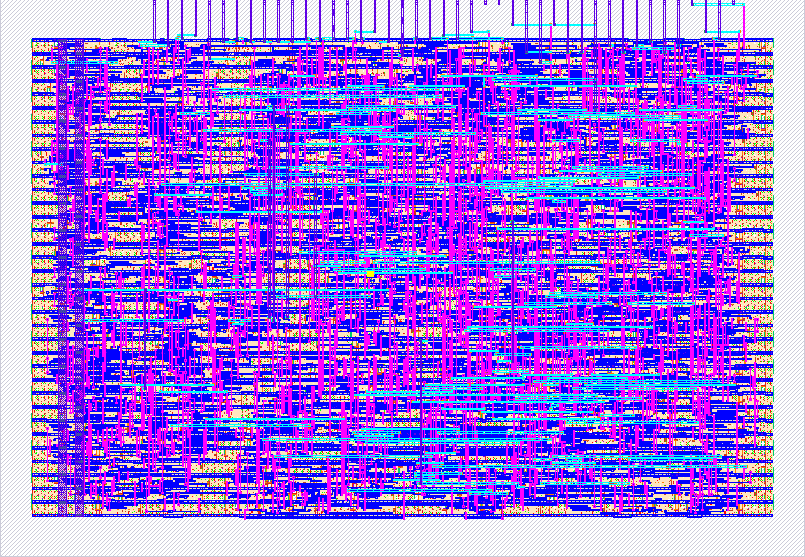
- Author: Yashwanth M ,Vijay Sudarshan B, Shylashree N, RV College of Engineering
- Description: Divider-free ML-KEM ciphertext codec and Fujisaki-Okamoto integrity checker for ML-KEM-512/768/1024
- GitHub repository
- Open in 3D viewer
- Open in Tiny Tapeout Explorer
- Clock: 40000000 Hz
Credits
We gratefully acknowledge the Center of Excellence (CoE) in Integrated Circuits and Systems (ICAS) and the Department of Electronics and Communication Engineering (ECE) for providing the necessary resources and guidance.
Special thanks to Dr. H V Ravish Aradhya (HoD–ECE), Dr. K R Usha Rani (Associate Dean–PG), Dr. K. S. Geetha (Vice Principal), and Dr. K. N. Subramanya (Principal) for their constant encouragement and support in facilitating this Tiny Tapeout SKY26C submission.
How it works
This project implements a streaming ML-KEM (Kyber) coefficient field-operation engine. It supports all three
standard parameter sets -- ML-KEM-512, ML-KEM-768 and ML-KEM-1024 -- selected at start time via the param
bits on uio_in.
The design has two operating phases, selected by the phase bit on uio_in at start:
- phase = 0 (decompression / output): the host streams ciphertext bytes in. The engine unpacks each
bit-packed coefficient (
du-bit width for the firstc1_lencoefficients,dv-bit width for the remainder), decompresses it via a bit-serial repeated-doubling accumulator, and streams the decompressed 12-bit value back out as two bytes per coefficient. - phase = 1 (auxiliary-reference verification): the host streams ciphertext bytes in as before, but for
every unpacked coefficient the engine also requests a 12-bit auxiliary reference value from the host
(
S_RXA), recompresses it via the same bit-serial engine, and compares the result against the coefficient taken directly from the ciphertext stream. A running (sticky) mismatch flag accumulates across all coefficients.
When the expected coefficient count for the selected parameter set has been consumed, the design enters
S_DONE and reports a 2-bit status on uo_out[1:0]:
uo_out[0](MATCH) -- set if phase 1 ran and no mismatch was ever detected.uo_out[1](FAULT) -- set if the number of coefficients processed did not match the expected total for the selected parameter set (a framing/length error), also mirrored onuio_out[7].
uio_out[6] (busy) is high whenever the design is actively unpacking, decompressing, comparing, or has
output pending.
Byte protocol (uio_in)
| Bit | Name | Meaning |
|---|---|---|
| 0 | wr |
Strobe: latch ui_in as the next input byte |
| 1 | start |
Strobe: begin a new transaction (also latches phase and param) |
| 2 | rd |
Strobe: advance to the next pending output byte |
| 3 | phase |
0 = decompress/output, 1 = auxiliary-reference verify |
| 5:4 | param |
0 = ML-KEM-512, 1 = ML-KEM-768, 2 = ML-KEM-1024 |
All strobes are rising-edge, single-cycle pulses (assert for one clock, then deassert).
How to test
- Assert
start(withphase/paramset as desired) for one clock cycle. - Feed ciphertext bytes one at a time: wait until
busy(uio_out[6]) allows a write, present the byte onui_in, and pulsewr. - Phase 1 only: whenever the design requests it, supply the 12-bit auxiliary reference coefficient for
the coefficient currently being processed, two bytes low-then-high-nibble, each written with a
wrpulse. - Phase 0 only: whenever output is pending, pulse
rdto read each of the two output bytes per coefficient (low byte first, then the high nibble). - After the last ciphertext byte, wait for
busyto deassert with the design inS_DONE; read theMATCH/FAULTresult fromuo_out[1:0].
The test/test.py cocotb suite exercises all three parameter sets, boundary-position tamper injection
(phase 1), and full decompression-output verification against a Python golden model (phase 0). Run with:
cd test
make -B
External hardware
None. This project is a pure digital logic block; it communicates only over the standard Tiny Tapeout
ui_in/uo_out/uio_* pins and needs no external hardware to operate.
IO
| # | Input | Output | Bidirectional |
|---|---|---|---|
| 0 | DIN0 | DOUT0 / MATCH | WR |
| 1 | DIN1 | DOUT1 / FAULT | START |
| 2 | DIN2 | DOUT2 | RD |
| 3 | DIN3 | DOUT3 | PHASE |
| 4 | DIN4 | DOUT4 | PARAM0 |
| 5 | DIN5 | DOUT5 | PARAM1 |
| 6 | DIN6 | DOUT6 | BUSY |
| 7 | DIN7 | DOUT7 | FAULT |