495 FP4 Sparse Mini-TPU
495 : FP4 Sparse Mini-TPU
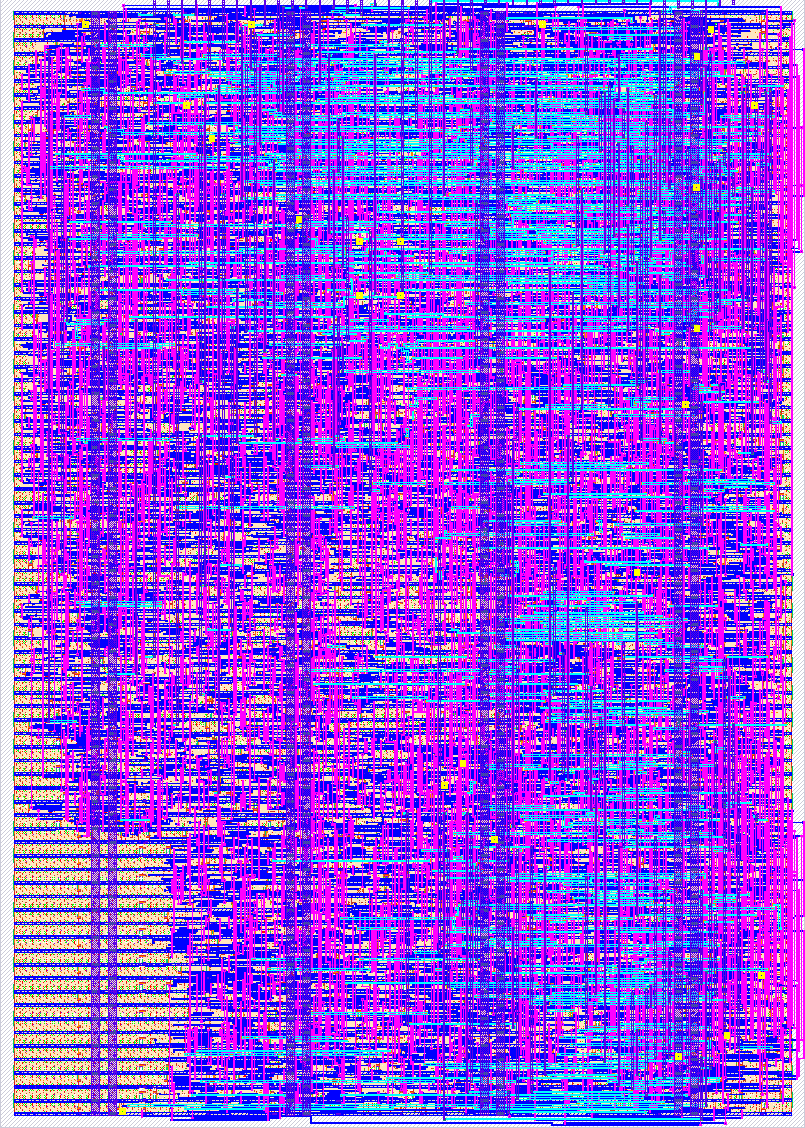
- Author: Kashif Rasul
- Description: One time-multiplexed PE computes a 3x3 output tile with 1:2-sparse E2M1 weights and INT8 activations, without a hardware multiplier. Dense E2M1-weight mode runs at half the sparse contraction rate; NVFP4/MXFP4 weight payloads require host-side activation quantization and scale handling.
- GitHub repository
- Open in 3D viewer
- Open in Tiny Tapeout Explorer
- Clock: 10000000 Hz
How it works
A mini TPU that computes C = A x W with INT8 activations and 1:2
structurally sparse E2M1 weights — the 4-bit floating-point element type
shared by NVFP4 (NVIDIA Blackwell) and MXFP4. It combines the two numerics
levers from Roune's AI-chip design argument in one datapath: structured
sparsity along the contraction axis and a 4-bit float element — with
higher-precision INT8 activations, the side that is hardest to quantize.
The math runs on one time-multiplexed processing element, not a
spatial array: a SPI-driven design is completely SPI-bound (the 36 operand
instructions require at least 3456 clk cycles at SCLK <= clk/6), so a RUN's compute latency is
practically free no matter how many outputs share one PE. The original
3x3 systolic array spent 58% of its flip-flops and most of its
combinational logic on 9-way spatial parallelism that bought nothing;
serializing to one PE — reused across all 9 outputs, ~45 cycles per RUN,
still about 1.3% of the SPI load time — cut chip area ~47% and dropped the
design from a 2x2 to a 1x2 tile.
There is no hardware multiplier anywhere: every E2M1 magnitude
(0, 1, 2, 3, 4, 6, 8, 12 in the x2 integer domain) is (1 or 3) << shift,
so a product is one conditional add (the 3x), one shift, and one
conditional negate:
prod = ± (act [+ act << 1]) << shift
The sparse weight format
Each 5-bit weight code {select, e2m1[3:0]} covers two consecutive
contraction steps (k = 2j and k = 2j+1): the E2M1 value sits at
k = 2j + select, the other position is zero — 1:2 structured sparsity,
the 1:2 analog of NVIDIA's 2:4. The select bit muxes which INT8 activation
of a pair enters the shift-add, so an 8-bit mux does the work of a second
"multiplier" and every cycle advances two contraction steps: an 8-deep dot
product in the time a dense array does 4, with weights stored at 2.5 bits
per dense position. Two sparse RUNs cover exactly one NVFP4 16-element
block (four cover an MXFP4 32-block), so host-side block scaling aligns
with no padding.
Results are exact 14-bit signed integers (max |C| = 6144). Block scaling
happens on the host during dequantization: scale each block's partial sum
before adding it to other blocks, C = sum_b((D_b / 2) * partial_b).
This makes the chip element-level format-agnostic: apply E4M3 scales per 16-element block
(+ FP32 tensor scale) for NVFP4 semantics, or E8M0 power-of-two scales
per 32-element block for MXFP4. The exact accumulators let the host
apply per-block scales (including four-over-six adaptive scaling and
per-token activation scales) to bit-exact partial sums.
Second mode: dense E2M1 x INT8
The RUN instruction's d flag switches to dense operation: each code's
E2M1 nibble is a weight for ONE contraction step (K = 4, half throughput,
select bit ignored, only even activation elements participate) — the same
trade NVIDIA makes running dense on 2:4-sparse tensor cores. This is plain
dense FP4-weight x INT8-activation matmul. E2M1 checkpoint weights can be
streamed after the host quantizes activations to INT8 and handles all block
and tensor scales; it is not native FP4-activation execution.
SPI protocol follows the proven reference mini-TPU
(MILOUDIAS/IEEE_ttsky_mini_tpu_spi),
which this chip's original 3x3 array also ported its systolic control
from; a (row, col, step) sequencer replaced the skewed wavefront when
the array serialized to one PE (see REPORT.md). Both operand streams
still change every RUN step (real dot products, not a shortcut). Activation
functions are host-side: they are only correct after cross-tile
partial-sum accumulation and bias, which happen on the host anyway.
Instruction set (16 bits, sent LSB-first over SPI)
| Instruction | Format (binary) | Description |
|---|---|---|
LOAD A |
10 0 rr eee aaaaaaaa |
INT8 activation byte a into row r (0-2), element e (0-7) |
LOAD B |
10 1 cc 0jj 000swwww |
Weight code {select s, E2M1 w} into column c (0-2), pair slot j (0-3) |
RUN |
01 d 0000000000000 |
Clear accumulators, run all 9 outputs on one PE (~45 cycles); d=0 sparse (K=8), d=1 dense E2M1 (K=4) |
STORE |
11 b rr cc 000000000 |
Drive byte b (0 = acc[7:0], 1 = acc[13:8]) of C[r][c] on uo_out |
The system clock is 10 MHz and SCLK must be at most clk/6 (about 1.67 MHz).
MOSI, CS, and SCLK pass through synchronizers and the receiver runs entirely
in the system-clock domain; raw SCLK is not an internal clock. Keep CS high
for at least four system-clock cycles between frames. The ready pin
(uio[1]) stays high when a RUN completes and clears when the next RUN is
accepted, so a polling host cannot miss it. Instructions received while RUN
is busy are ignored. Alternatively, wait ~45+ clock cycles. The SPI is
receive-only: all results are read via STORE on uo_out, from a small
result memory that holds all 9 outputs until the next RUN overwrites them
(the same "any output, any time" contract the old per-PE accumulators
offered).
E2M1 weight encoding (element type of NVFP4 and MXFP4)
| Code | Value | x2 integer | Code | Value | x2 integer | |
|---|---|---|---|---|---|---|
| 0000 | +0.0 | 0 | 1000 | -0.0 | 0 | |
| 0001 | +0.5 | 1 | 1001 | -0.5 | -1 | |
| 0010 | +1.0 | 2 | 1010 | -1.0 | -2 | |
| 0011 | +1.5 | 3 | 1011 | -1.5 | -3 | |
| 0100 | +2.0 | 4 | 1100 | -2.0 | -4 | |
| 0101 | +3.0 | 6 | 1101 | -3.0 | -6 | |
| 0110 | +4.0 | 8 | 1110 | -4.0 | -8 | |
| 0111 | +6.0 | 12 | 1111 | -6.0 | -12 |
How to test
Run the cocotb testbench:
cd test
make -B
The suite drives the SPI interface exactly like an external host and checks
the full C = A x W result against an independent golden model (E2M1
and sparse-code decode from first principles, then a plain matrix multiply).
It includes select-bit routing, both modes with per-RUN mode latching,
negative-zero handling, a non-degeneracy test (equal-sum activation
matrices must produce different results), exact accumulator limits,
accumulator-clear checks, every partial SPI-frame length, reset mid-frame,
maximum-rate SPI, sticky ready, and randomized full-coverage trials. An
exhaustive PE test covers all 16,384 input/mode combinations. It also checks
that partial sums from blocks
with different scales are dequantized before being combined.
External hardware
None required. Any SPI-capable host (e.g. the demo board's RP2040) drives
MOSI/CS/SCLK and reads result bytes on uo_out. Operand memories do not reset
to save area, so the host must load every operand used before the first RUN.
IO
| # | Input | Output | Bidirectional |
|---|---|---|---|
| 0 | SPI MOSI | result bit 0 | |
| 1 | SPI CS (active low) | result bit 1 | ready (sticky until next RUN) |
| 2 | SPI SCLK | result bit 2 | |
| 3 | result bit 3 | ||
| 4 | result bit 4 | ||
| 5 | result bit 5 | ||
| 6 | result bit 6 | ||
| 7 | result bit 7 |