583 CORDIC-1
583 : CORDIC-1
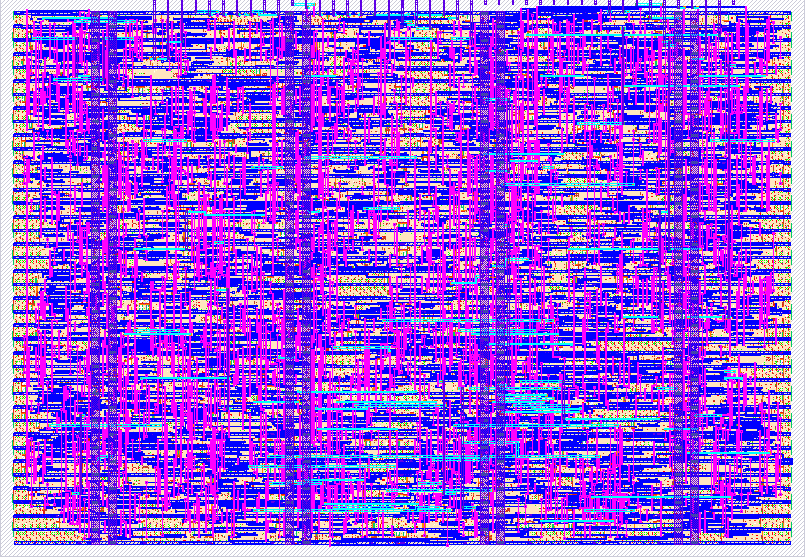
- Author: Joonatan Alanampa
- Description: Standalone sine generator - bit-serial CORDIC DDS, one tile
- GitHub repository
- Open in 3D viewer
- Open in Tiny Tapeout Explorer
- Clock: 25000000 Hz
How it works
CORDIC-1 is a standalone sine generator in one TinyTapeout tile — a self-playing instrument with no bus, no host, and no software. Select it, release reset, and it plays.
Inside: a bit-serial CORDIC engine — x, y, z as 20-bit shift
registers circulating LSB-first through three 1-bit full adders, sine
from nothing but shifts and adds. Every conversion takes a constant
359 clocks regardless of input (data-independent timing = zero
phase-correlated sample jitter), giving ~69.6k conversions/s at 25 MHz.
The engine is verified exhaustively (all 65,536 input angles against
reference math, worst error 5 LSB of Q1.15), its output stream is
FFT-verified (worst harmonic −65 dBc), and its control path is
formally proven (SymbiYosys k-induction, formal/): from any
reachable state under any input sequence the schedule invariants hold,
capture lands provably at cycle 357 every time, and done pulses
exactly once per operation.
A 20-bit DDS phase accumulator sweeps it continuously, and a
first-order sigma-delta modulator streams the result: sine on uo[7] (exactly where the
TT Audio Pmod listens). An RC low-pass (1 kOhm + 100 nF) — or the Audio
Pmod — turns it into a clean analog wave. uo[6] carries a phase-locked
square wave at the same frequency: a scope trigger, and the classic
sine-vs-square timbre comparison on the other ear.
Frequency is set live by ui[6:0]:
| code | output |
|---|---|
| 0 (power-on default) | 440 Hz — concert A wake-up tone |
| 1..126 | code x ~68 Hz (~68 Hz .. ~8.6 kHz) |
| 127 | ~2 Hz breathe mode: the LED bar visibly waves |
uo[5:1] show the live sine level as an offset-binary LED bar, and uo[0] blinks a ~1.5 Hz heartbeat — proof of life visible with nothing attached at all.
How to test
Power on, select the design, release reset: the heartbeat LED blinks and the level bar shimmers immediately — with headphones on the Audio Pmod you hear concert A. Scope the RC-filtered uo[7]: a 440 Hz sine. Change ui[6:0]: the pitch follows, ~68 Hz per step. Set all ones (127): the LED bar breathes a slow visible wave. Trigger the scope from the uo[6] square: the sine stands rock still — they are phase-locked.
PPA
From the hardening run's signoff reports (SkyWater 130 nm, nominal corner tt/25C/1.80V): area 1 tile (167x108 um, ~0.018 mm^2), 921 standard cells at 74.0% utilization. Performance: ships at 25 MHz, timing-clean at 50 MHz across all corners, nominal Fmax ~115 MHz; ~69.6k sine conversions/s at a constant, formally proven 359-cycle period. Power: ~0.56 mW estimated at 25 MHz (OpenSTA statistical estimate; leakage only 7.8 nW — essentially all power is useful switching).
External hardware
None required (heartbeat + LED bar work bare). For analog output: an RC low-pass on uo[7]/uo[6], or the Tiny Tapeout Audio Pmod (it listens on uo[7]). DIP switches or the demo board's inputs for ui[6:0].
IO
| # | Input | Output | Bidirectional |
|---|---|---|---|
| 0 | FREQ0 | HEARTBEAT | |
| 1 | FREQ1 | LEVEL0 | |
| 2 | FREQ2 | LEVEL1 | |
| 3 | FREQ3 | LEVEL2 | |
| 4 | FREQ4 | LEVEL3 | |
| 5 | FREQ5 | LEVEL4 | |
| 6 | FREQ6 | SQUARE sync | |
| 7 | SINE sigma-delta (Audio Pmod) |