463 [email protected]

463 : [email protected]

Design render

tt_um_galaguna_NanoSys_fit: A minimal implementation for Nano-120 CPU (designed at Universidad Autonoma Metropolitana)

CPU features:

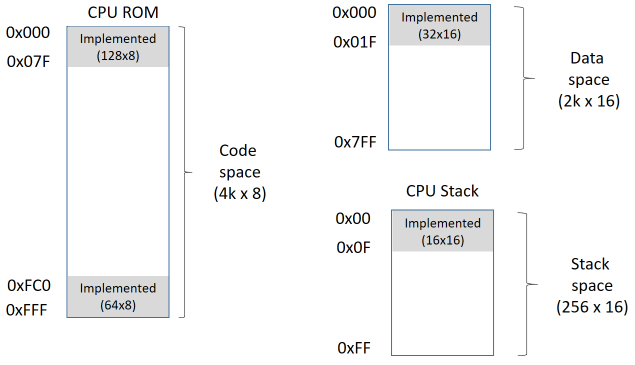
  • 12-bit Instruction Pointer (only 192 ROM bytes, for code space, are implemented)
  • 11-bit Data Pointer (only 32 RAM words, for data space, are implemented)
  • 8-bit Stack Pointer (only 16 stack words are implemented)
  • Direct and indirect addressing operation
  • ALU with 16-bit operands and 32-bit result
  • 120 instructions
  • Dedicated I/O busses to communicate with generic peripherals
  • Interrupt capability
  • SPI interface to program the code space and access the data space
  • Configurable operating speed

How it works

A simple architecture for practical implementation of a central processing unit (CPU) is proposed as teaching resource, to experiment and verify the fundamental concepts of a simple computer architecture with its instruction set (in this case, 120 instructions). In this project, a foundry test is implemented with minimal memory resources. A block diagram for the proposed architecture is presented in the following figure:
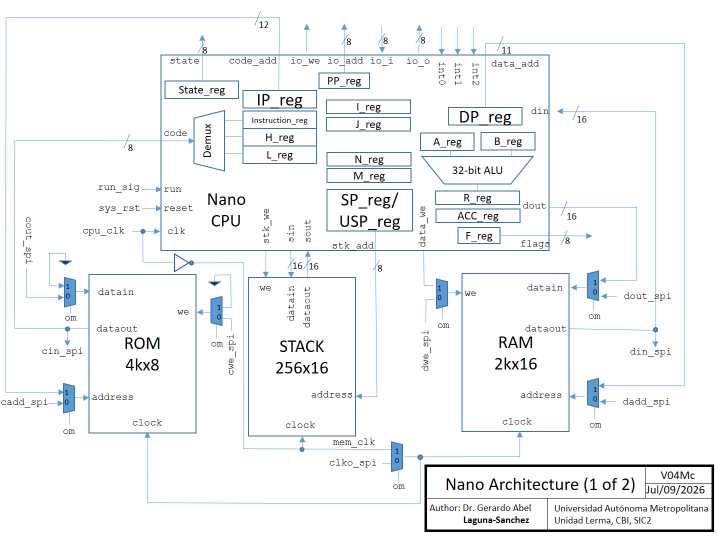
Figure-1

The auxiliary modules are presented in the following figure:
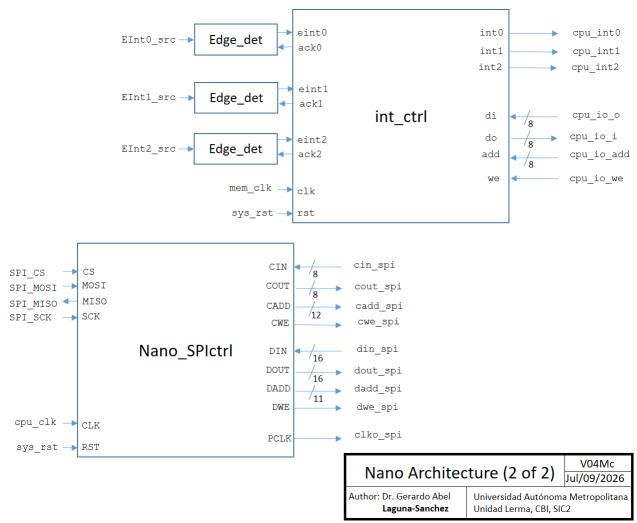
Figure-2

To enable user access to both code and data memory spaces, before and after the execution of any program, the processing system includes a slave SPI communication block. The multiplexors are controlled by MODE signal to set the operation mode (programming/execution). Additionally, RUN signal is dedicated to start the code execution.

In practice, to work with the input and output ports of the Tiny Tapeout template, the entire system (with minimal memory) has been packaged in the Nano_sys_4Tiny module, which is represented schematically below:
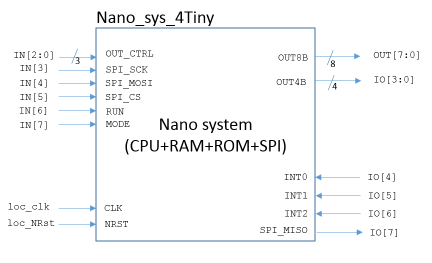
Figure-3

In the Nano_sys_4Tiny module, the input bus OUT_CTRL is used to select the internal signal buses that will be available at the output ports OUT8B and OUT4B, according to the following table:
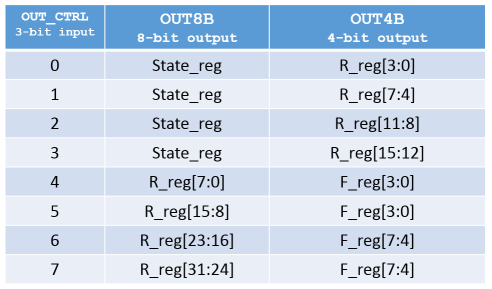
Figure-4

For mor details, see the HDL code Nano_mcsys_4Tiny_fit.v.

Architectural overview

The proposed CPU uses a Harvard architecture in which program, data and IO are accessed from separate busses. The data word size is 16 bits while the code word size is 8 bits. The 16-bit ALU is a general-purpose arithmetic and logic unit and its result is always stored in the 32-bit R register. The arithmetic instructions affect the values of the following flags:

  • Z16: 16-bit Zero / Equal
  • N16: 16-bit negative / Less tan
  • O16: 16-bit overflow
  • CO16: 16-bit catastrophic overflow
  • Z32: 32-bit Zero
  • N32: 32-bit negative
  • O32: 32-bit overflow
  • CO32: 32-bit catastrophic overflow Z16, N16, O16 and CO16 flags are set based on the 16 least significant bits of R register, while Z32, N32, O32 and CO32 flags are set based on the whole R register. The catastrophic overflow is set when the result sign does not correspond with the expected. The logic instructions only affect the Z16 and Z32 flags.

The architecture includes the following registers:

  • State register: To track the CPU micro-states
  • IP register: 12-bit Instruction Pointer, to access the code space
  • DP register: 11-bit Data Pointer, to access the data space
  • SP register: 8-bit Stack Pointer, to access the stack space by means PUSH and POP instructions
  • USP register: 8-bit User Stack Pointer, to access the stack space in a random way
  • PP register: 8-bit Peripheral Pointer, to access the I/O space
  • A and B registers: Generic 16-bit operand registers
  • R register: Generic 32-bit result register
  • Acc register: 32-bit result register for CUM and MAC instructions
  • I and J registers: 16-bit counting registers for iteration loops
  • N and M registers: 16-bit target count registers for iteration loops Additionally, the architecture includes the following internal registers that are not directly accessible by the user:
  • F register: 8-bit Flags register
  • Instruction, H and L registers: 8-bit registers, used at instruction decode process to store op code and parameters values In this foundry implementation (with Tiny Tapeout initiative), due to physical space restrictions, the available memory resources are the following:
  • 192 ROM bytes
  • 32 RAM words
  • 16 stack words

Figure-5

Program memory organization

The CPU has 12-bit instruction pointer capable of addressing a 4k x 8 program. The reset vector is at 0x000, while the interrupt vectors are at 0xFF7, 0xFFA and 0xFFD, for Int2, Int1 and Int0, respectively.
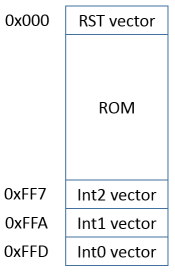
Figure-6

Stack

The CPU can address a 256- level deep x 16-bit wide stack. The PUSH instruction first stores the data and later increment de SP. The POP instruction first decrements de SP and later restore the data. The user can access the stack space by means PUSH/POP instructions or with data transfers by means the USP pointer. The CALL instruction automatically pushes the IP in the stack and the RET instruction pops it to continue the program Flow. In the case of an interruption, if it is detected while running a program, the system automatically pushes the IP, R and F registers, while RETI instruction pops all these.

I/O interface

The CPU provides dedicated buses to access generic peripherals by means IN and OUT instructions. The user can add a required peripheral with this interface. In the current implementation, it has been reserved the first two locations of I/O space, i.e. 0x00 and 0x01, to control the 3 available interrupts.

Interrupts

The CPU has 3 external sources of interrupt, denoted as Int0, Int1 and Int2. The highest priority is assigned to Int0, while the lowest priority is assigned to Int2. If it is enabled, an interruption can be served while a program is executed, but also if the CPU is at stop status. When the interrupt service is required while a program is executed, it implies the usual context saving process. On the other hand, when the interrupt service is required while a program is stopped, it does not save the context. The registers to control these interrupts are mapped in the first two locations of the I/O space:

  • IE register: Interrupt Enable register, mapped at 0x00 of I/O space
  • IF register: Interrupt Flags register, mapped at 0x01 of I/O space
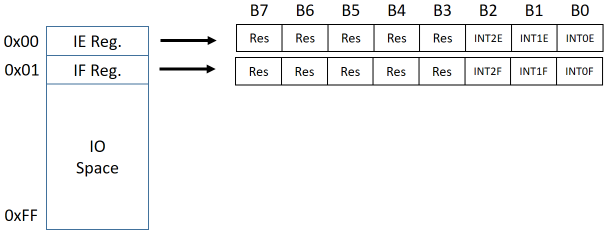
Figure-7

To enable an interruption, it is necessary to set the corresponding bit in IE register. When an interruption is enabled and it occurs (a positive edge is detected in the interrupt pin), the system automatically set the corresponding interruption flag in IF register and no other interrupt can be attended. Then, when the interrupt service routine finishes its task, before RETI instruction, the interrupt flag must be cleaned.

Instruction set

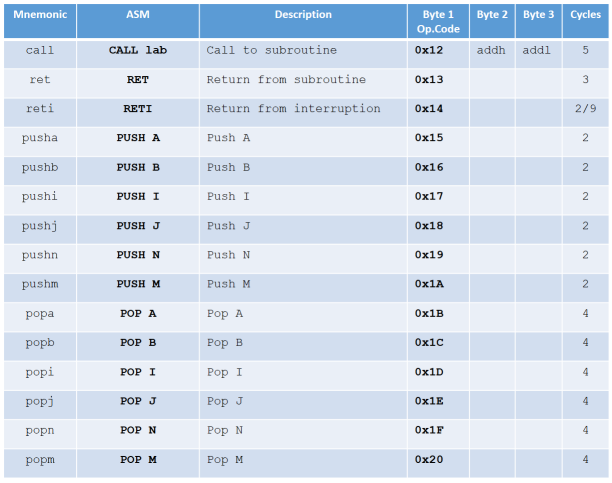
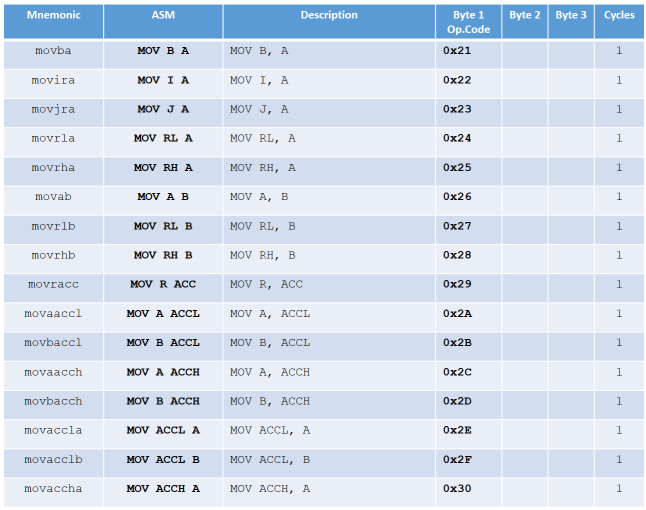
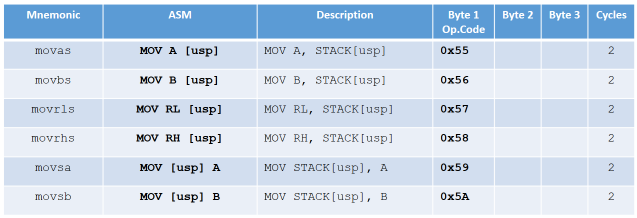
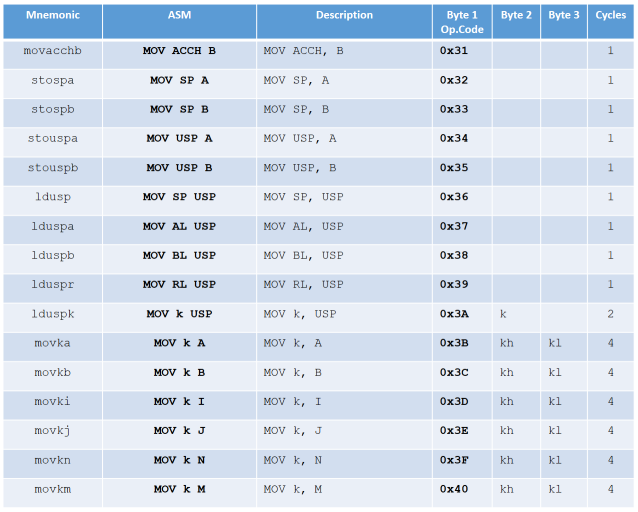
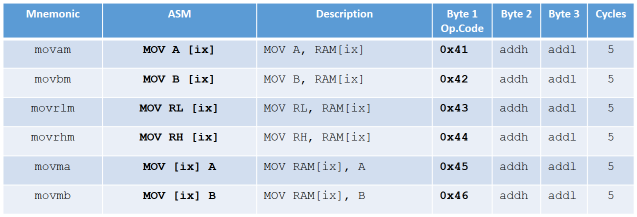
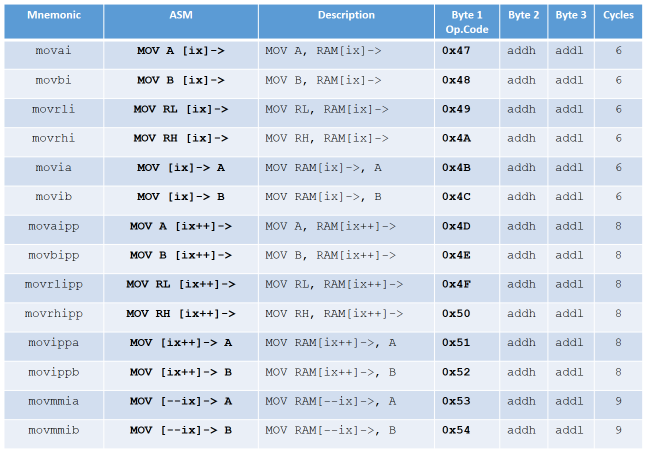
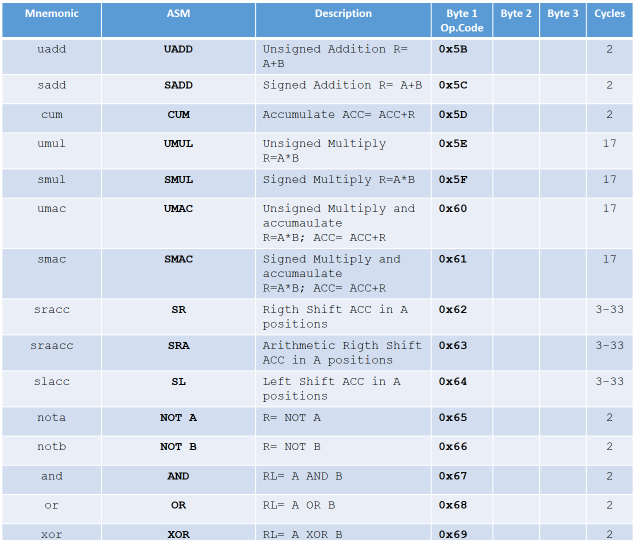
The proposed instruction set is can be conveniently codified with bytes. The following tables summarizes the proposed instruction codification:
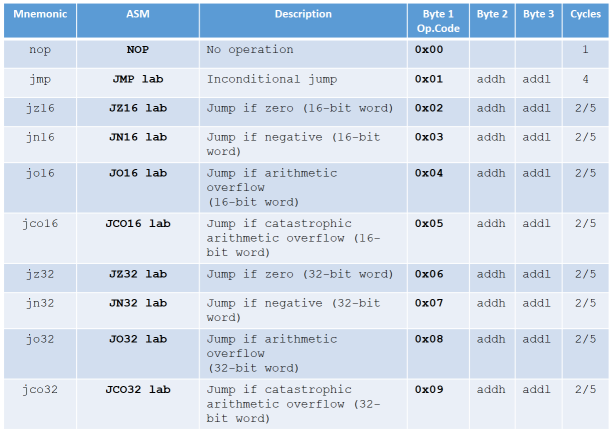
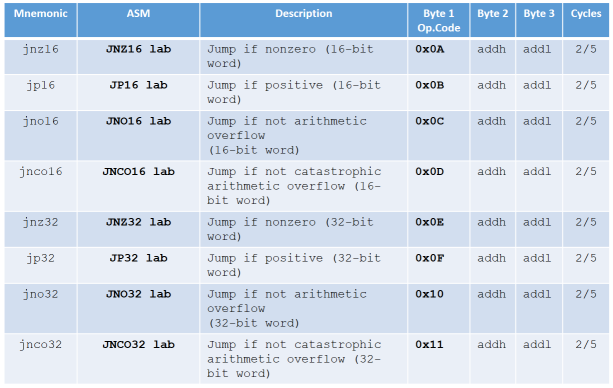
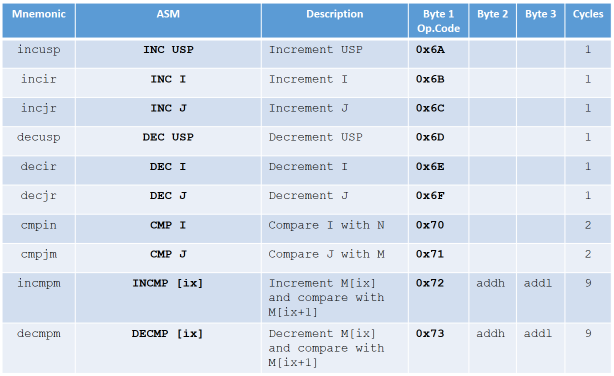
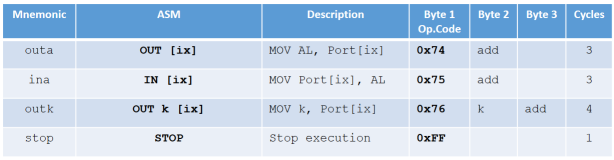
Figure-8 Figure-9 Figure-10 Figure-11 Figure-12 Figure-13 Figure-14 Figure-15 Figure-16 Figure-17 Figure-18

The following is a demo program:
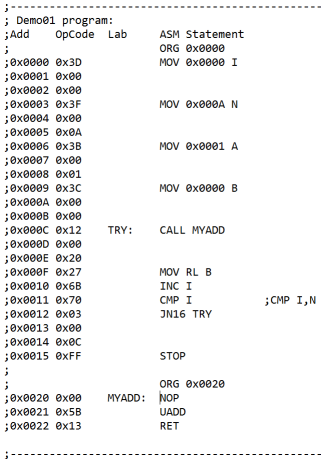
Figure-19

How to test

The CPU system must be programed before a code execution. The RAM and ROM loads are enabled with signal MODE=0. With signal MODE=1, the code execution starts with signal RUN=1.

To program the code space and access the data space, SPI transfers are used. The SPI word size is 32 bits with the following format:
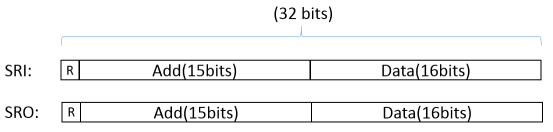
Figure-20

The bit 31 (MSB) is set to specify a read operation. The address field specifies the location being accessed and de data field contains the information to be written or read. In the following figure, the SPI addressing map is presented:
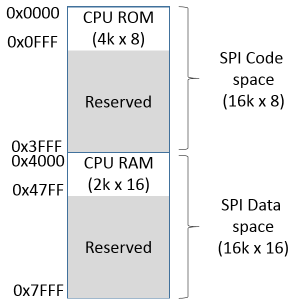
Figure-21

For SPI transfers, the following specification is assumed:

  • CS signal is active low, and it idles high.
  • SCK signal is active low, and it idles high.
  • Data is valid on the second SCK edge (rising or falling) after CS has been asserted.
  • The most significant bit is the first to be transmitted.

In the case of a read sequence, the read command must be followed by a stuff SPI word (let's say, all ones or all zeros word). The read information will be in the data field of the SPI word transmitted by the slave SPI.

Within the slave_spi4nano module, the SCK frequency is assumed as CLK/8. For example, if the CLK frequency is 50 MHz, the SCK frequency is 6.25 MHz. SPI interface also works with low frequency, for example, if CLK frequency is 1525.879 Hz, the SCK frequency is 190.8 Hz. As a quick and practical reference for SPI signaling, although rough but illustrative, you can refer to the test code test.py.

Additional hardware

As practical reference, a master SPI module, may be found in the following repository:

https://github.com/galaguna/Nano119-CPU-programmable-with-SPI

IO

#InputOutputBidirectional
0OUT_CTRL0OUT8B0OUT4B0
1OUT_CTRL1OUT8B1OUT4B1
2OUT_CTRL2OUT8B2OUT4B2
3SPI_SCKOUT8B3OUT4B3
4SPI_MOSIOUT8B4EINT0_SRC
5SPI_CSOUT8B5EINT1_SRC
6RUNOUT8B6EINT2_SRC
7MODEOUT8B7SPI_MISO

Chip location

Controller Mux Mux Mux Mux Mux Mux Mux Mux Mux Mux Analog Mux Mux Mux Mux Mux Mux Mux Mux Mux Mux Analog Mux Mux Mux Mux Mux Mux Mux Mux Mux Mux tt_um_chip_rom (Chip ROM) tt_um_factory_test (Tiny Tapeout Factory Test) tt_um_teuscher_eml_fabric (EML Fabric — analog exp/ln compute cells) tt_um_wokwi_465656663515438081 (Convert binary to hex on 7 segments) tt_um_nikita_face_detect (FPGA Face Detection) tt_um_obstacle_avoider (Obstacle Avoider State Machine) tt_um_poket_animal (Poket Animal) tt_um_drewbabel_uart (Configurable FIFO-buffered UART with APB CSR) tt_um_wokwi_469163916296039425 (TT Workshop Test) tt_um_jonahsaunders_slsvga (tt_um_jonahsaunders_slsvga) tt_um_fatigue_monitor (Fatigue Monitor (PPG Pulse-Interval Variability)) tt_um_vedam_dual_port_ram (Dual Port RAM) tt_um_wokwi_469739097665887233 (Tiny Tapeout Template Copy) tt_um_spdif_to_i2s_kilpelaj (S/PDIF to I2S receiver) tt_um_morse_converter (ASCII to Morse Code Converter) tt_um_wokwi_469806914724000769 (Spin, Text and VGA) tt_um_wokwi_469701770572338177 (TinyTapeout) tt_um_garnetkoebel_communotron (Communotron) tt_um_wokwi_469449970323169281 (full adder) tt_um_duzabf_2026_ow (A WIP Online Workshop 2026 project) tt_um_wokwi_469807513638180865 (Tiny Tapeout NAK) tt_um_ttsky26c_oguz (ttsky26c-202607-mehmetoguzderin by Oguz) tt_um_kashif_fp4_sparse_tpu (FP4 Sparse Mini-TPU) tt_um_moein_maleki_arm16 (arm16) tt_um_wokwi_469453454643027969 (ON Check System) tt_um_felixcheng_neural_core (Neural Compute Core (V0.15)) tt_um_wokwi_469788774011248641 (Spin Display - select-reset-reverse) tt_um_wokwi_469449443070765057 (Samuel's first chip) tt_um_wokwi_469449007236383745 (testinttrsv01) tt_um_vga_ca (VGA cellular Automaton) tt_um_dosci_500hz (Digital Oscillator 500 Hz) tt_um_wokwi_469747443569078273 (XOR test project - Tiny Tapeout workshop) tt_um_wokwi_469585758593419265 (spinner) tt_um_fp16_mac (FP32 Math Unit) tt_um_1DC_vga_dyoa (VGA Design Your Own ASIC) tt_um_haydenevans_top (Systolic Processing Element) tt_um_wokwi_469806252715961345 (TT_Proj_SA) tt_um_wokwi_469448996577604609 (Tiny Tapeout - Reto) tt_um_ehofmannbr_pmodvga_06 (VGA Color Tiles) tt_um_lfglabs_lsc1u (leanSilicon LSC-1 Micro arithmetic kernel) tt_um_wokwi_469804280240495617 (Zetterling SRAM) tt_um_wokwi_469806066852696065 (TileTestchase) tt_um_wokwi_469449118072978433 (binary_add_v1) tt_um_voltage_amplifier_neuron (Voltage Amplfier Neuron) tt_um_wokwi_469449686545956865 (Tiny Tapeout Template Copy_JinoShiono) tt_um_wokwi_469448887171240961 (Tiny Tapeout - Mini CORDIC) tt_um_wokwi_469809033878555649 (Tiny Tapeout Yummy Chip - bgianfo) tt_um_sirajmuhammad_bpsk_mod (BPSK Baseband Modulator) tt_um_K_coder_9 (TENs device frequency controller) tt_um_wokwi_469758119198926849 (LL_6BitShiftRegister_ToggleEnabledFeedback) tt_um_Asaadkhex_6x6u (6x6 UART Bussbar Switch) tt_um_wokwi_469809198944364545 (tt8-8bit-cpu Copy) tt_um_wokwi_469710279607305217 (Tiny Tapeout Submission KL - SiliDize) tt_um_wokwi_469629799092815873 (2:1 Mux with differential outputs) tt_um_poundbrad_reciprocal_counter (Two-Channel Reciprocal Counter) tt_um_joonatanalanampa_cordic (CORDIC-1) tt_um_x4ntha_nova (Data General Nova 1200 CPU) tt_um_quick_bus (quick_bus) tt_um_wokwi_470058539448408065 (Nigel's Tiny Tapeout Project) tt_um_wokwi_470058244557293569 (Tiny Tapeout Kabisan) tt_um_wokwi_470058241869790209 (Abdi's desgin) tt_um_wokwi_470060107756808193 (Sukhraj Deol's Chip) tt_um_wokwi_470058578588614657 (The Chip of Master George Stead) tt_um_wokwi_470069286344622081 (Tiny Tapeout ISHA) tt_um_ucl_display (Flashing... lights) tt_um_wokwi_470058746279043073 (Arihant's first Wokwi design) tt_um_wokwi_470060103260512257 (Tiny Tapeout Jabriel Copy) tt_um_wokwi_470069460157662209 (haadi's tiny tapeout) tt_um_wokwi_470058418706939905 (Kitty) tt_um_wokwi_470058490118136833 (Iris) tt_um_wokwi_470060098828179457 (Temz_ tiny tapeout) tt_um_wokwi_470058023187099649 (Osman WOKWI project 1) tt_um_wokwi_470057988621827073 (Viraj Tiny Template Full Adder TEST) tt_um_wokwi_470069802034377729 (Tiny Tapeout Template Copy) tt_um_wokwi_470070136685362177 (full adder) tt_um_wokwi_470070449402211329 (Anastasia Copy (2)) tt_um_wokwi_470059864883484673 (Keyaan’s first Wokwi design) tt_um_wokwi_470071200164912129 (full adder tiny tapeout Copy) tt_um_wokwi_470060671178857473 (SBUSixth First Chip Design Mentored by Tiny Tapeout) tt_um_wokwi_470099562753182721 (Isaac Tiny Tapeout) tt_um_wokwi_470120538476737537 (efwz8voices) tt_um_lelo_gr01_analogicus (LELO-GR01) tt_um_lelo_gr04_analogicus (LELO-GR04) tt_um_lelo_gr02_analogicus (LELO-GR02) tt_um_pump_out (60 Hz RMS Pump-Out Controller) tt_um_urish_simon (Simon Says memory game) tt_um_lelo_gr03_analogicus (LELO-GR03) tt_um_wokwi_470299374901578753 (Shrimp) tt_um_vga_clock (VGA clock) tt_um_frequency_counter (Frequency counter) tt_um_z2a_rgb_mixer (RGB Mixer demo) tt_um_mattvenn_r2r_dac_3v3 (Analog 8 bit 3.3v R2R DAC) tt_um_rebeccargb_universal_decoder (Universal Binary to Segment Decoder) tt_um_rebeccargb_hardware_utf8 (Hardware UTF Encoder/Decoder) tt_um_rebeccargb_intercal_alu (INTERCAL ALU) tt_um_rebeccargb_vga_pride (VGA Pride) tt_um_ogggggish_ota_ldo (SSF Capless LDO) tt_um_hariri4534_audioplayback (audioplayback) tt_um_wokwi_470637150792846337 (Joni - Tiny Tapeout Teardown2026 Workshop) tt_um_wokwi_470635013242210305 (Tom's first Wokwi design) tt_um_wokwi_470635780983408641 (Tiny Tapeout-AyeshaTeardown26) tt_um_wokwi_470639152626282497 (KeKoaM Tiny Tapeout) tt_um_wokwi_470637073520124929 (Tiny Tapeout workshop) tt_um_toby43479_iox (IO Expander with PWM) tt_um_wokwi_470635764113915905 (Divider Demo) tt_um_wokwi_470635580461052929 (Mann-teardown-project) tt_um_wokwi_470639672984256513 (KCs 001 TinyTapeout Design) tt_um_wokwi_470635507665754113 (Tiny Tapeout Template Copy) tt_um_wokwi_470637047364443137 (Pixel-Curio-Chip) tt_um_terihear_tinytearout (TinyTearout) tt_um_wokwi_470643025042834433 (TT 2026) tt_um_wokwi_470637360757626881 (Tiny Tapeout Template Copy) tt_um_wokwi_470635627278929921 (Tiny Tapeout Workshop) tt_um_wokwi_474471160110403585 (Cylon-Scanner) tt_um_wokwi_470646659230201857 (bloopbloop) tt_um_pthomas_sigma_delta (Continuous-Time Sigma-Delta ADC (1st order)) tt_um_sky_tpu_3x3 (Sky TPU 3x3) tt_um_tpcannon7_fir (tinyfir) tt_um_bruniliomuy_top (Fir_Filter) tt_um_semiqa_diff_opamp (Diff-In-Diff-Out-OpAmp) tt_um_TinyProcessor_naiyar_ (TinyProcessor) tt_um_CCDmos3D (ADC for CCDmos3D pixel) tt_um_snn_lif_neuron (snn_lif_neurons) tt_um_galaguna_NanoSys_fit (Nano-120_CPU@ler.uam.mx) tt_um_rowles_regime (Single-Bit Macro Regime Classifier) tt_um_rowles_fedmodel (The Fed Model (F1/F2)) tt_um_sky26c (tt_sky26c) tt_um_aka_regfile_ecc (regfile_ecc) tt_um_fwilson12_mac (int8 MAC) tt_um_davidbroughsmyth_ecg_sar12 (heart_monitor_adc_art) tt_um_foxworks_picorv32 (TCD Foxworks PicoRV32) tt_um_saltworks_ndf_c32 (Neural dataflow fabric — bit-serial MAC cells on a self-routing switch) tt_um_yjeum11 (DTMF (Touch-Tone) decoder) tt_um_vedic_mult (4-bit Vedic Multiplier) tt_um_atx_phased_interferometer (Acoustic Interferometer) tt_um_tilesos_dual_adc (Dual-Path Noise-Shaping ADC) tt_um_darga_cirom (Darga CiROM digital read + ternary MAC) tt_um_azara_cirom (Azara CiROM ternary read) tt_um_spi_reg_bank (8-bit Modified RISC-V) tt_um_aialaqili_updown_counter (4-bit Up/Down Counter) tt_um_noahzperez29_riscv_core (Noah RISC-V Core) tt_um_fp8_fpu (FP8 (E4M3) Floating-Point Unit) tt_um_costinemanuelv_gps_daily_trigger (GPS Daily Trigger) tt_um_ja_achtung_1x1 (JA Achtung Compact) tt_um_ja_achtung_1x2 (JA Achtung Full) tt_um_pwm_spice (spice-pwm-tapeout) tt_um_wecallemjazzyfact_bgr_ldo (BGR + LDO 3.3V/1.8V Integrated IP) tt_um_lelo_temp_wulffern (LELO-TEMP) tt_um_wokwi_472389622799861761 (3-Bit 101 Pattern Detector) tt_um_LnL_SoC (Lab and Lectures SoC) tt_um_dash_lucas_risc (risc_processor) tt_um_serdes_ephotonics (UCIe-style SERDES with analog TX driver & RX slicer) tt_um_joram200 (Kalman Filter Hardware Accelerator) tt_um_colbywonn_poly_synth (Poly Synth v1.0) tt_um_nobleg30_uart_vga_scroller (UART VGA Text Scroller) tt_um_multi_precision_mult (Multi-Precision Multiplier) tt_um_pratibha_munnangi_qkt_mac (QKT MAC Accelerator) tt_um_akankaan_bf16_fma (BF16 Fused Multiply-Add (FMA)) tt_um_rtfce (RTFCE - Reconfigurable Temporal Fault/Constraint Engine) tt_um_hdc_classifier (HDC Classifier) tt_um_preethi8a_adaptive_lfsr_prng (Self-Seeding Adaptive 16-bit Galois LFSR PRNG) tt_um_dilip951_cpu_systolic_array (Reconfigurable mixed-precision 2x2 systolic MAC array) tt_um_pqc_ntt_bfly (Crypto-Agile NTT Butterfly (ML-KEM / ML-DSA / FN-DSA)) tt_um_mlkem_coefficient_integrity (Fault-Aware Constant-Time FO Backend for ML-KEM) tt_um_vital_ap (VITAL-AP: Adaptive Pixel Register) tt_um_olaf8 (OLAF-8: Bounded-Memory Online Adaptive Fuzzy Inference) tt_um_Median_MAD (Streaming Median-MAD Estimator) tt_um_tnt_mosbius (tnt's variant of SKY130 mini-MOSbius) tt_um_undip_ann_q610 (UNDIP ANN Accelerator (SPI + bring-up self-test)) tt_um_cpu8 (CPU8) tt_um_vaishnavipatil5_configurable_cam (Configurable CAM with Masked Pattern Matching and Priority Resolution) tt_um_gina_env_monitor (Environmental Mapping Processor) tt_um_manasvibhat_bloom_filter (Bloom Filter Membership Tester) tt_um_amazing_sage_snn (LIF Neuron SNN) tt_um_nkanderson_lut_snn (LUT Spiking Network Classifier) tt_um_bigmanraffa_clm (Clementine: 4-lane int8 SIMT GPU) tt_um_adityarprasad_fft (Adaptive-Precision FFT) tt_um_oscillating_bones (Oscillating Bones) tt_um_silicon_edge_ns_sar_adc (NS SAR ADC) tt_um_sishi888_tinymind (TinyMind SoC) tt_um_afra_123_ecc_memory (Runtime-Reconfigurable ECC Memory) tt_um_kenchangh_mnist (MNIST Digit Recognition) tt_um_ece298a_8_bit_cpu_top (8-Bit CPU) tt_um_libormiller_SIMON_V2 (SIMON V2) tt_um_WaiMingLee888_nanov_1tile (NanoV RV32E one-tile RISC-V processor) tt_um_four_bit_nn_accel (4-bit Neural Network Accelerator) tt_um_rsa_simple (RSA Simple Encryptor) tt_um_synapticrw_lif_neuron (LIF Neuron (SynapticRW Teardown 2026)) tt_um_smunigan_ipv4_filter (IPv4 Header Filter) tt_um_jjy_spi_watchdog (SPI-Configurable Watchdog Timer) tt_um_osian_beam_controller (Programmable Metasurface Beam Controller) tt_um_namramazhar_popcnt_shiftreg (17-bit Wallace-tree POPCNT with shift-register input) tt_um_obookstay_puf (An arbiter PUF) tt_um_arminkardovic_montenegro_securekey (Montenegro SecureKey) tt_um_rcyaon_droop (All-Digital Supply Droop Detector) tt_um_ctw_spms (CTW-SPMS — Programmable Smart Power Management & Supervisor) tt_um_taiwoopesade_tempo_detector_sky26c (Hardware Audio Tempo Detector) tt_um_wokwi_470059878406973441 (Ehan's first TinyTapeout Project) tt_um_wokwi_470637170309995521 (My First Wokwi Thing!) tt_um_wokwi_470637401137246209 (Teardown Tiny Tapeout) tt_um_wokwi_469443433165025281 (Tiny Tapeout First Design Beth Plummer) tt_um_wokwi_472423526521678849 (4-bit to 5x7 Matrix Decoder for Tiny Tapeout) tt_um_wokwi_470057961258181633 (Tiny Tapeout Template Kavana) tt_um_wokwi_470057993933917185 (ivane- Tiny Tapeout (full adder)) tt_um_wokwi_470088776251343873 (training_project_kaylem) tt_um_neuropong (NeuroPong) tt_um_tamagotchi (TamaGotThis) tt_um_group02_seethebeat (SeeTheBeat) tt_um_kul_chromechain (Chrome Chain) tt_um_baked_weights (Baked-Weights Shakespeare GPT) tt_um_gilangfajrul_sar_adc (sar-adc) tt_um_Logy_FMAC (FMAC) tt_um_porkfreezer_rrio_opamp (RRIO Op-amp) tt_um_diff_engine (DSLX finite_difference) tt_um_dragonochi (WISH) tt_um_siliconsonics (ultrasonic sonar: range and bearing) tt_um_kul_conway (Interactive Conway's Game of Life) tt_um_algofoogle_ttsky26c_analog (Assorted analog in 1 tile) tt_um_mariavictoriaalm_qubit_sim ( tt-2qubit-sim) tt_um_andre_dpe (Dot product engine) tt_um_rmranjitkarNULL_pong_top (last_minute_Pong) tt_um_SAR_ADC (CTW LDO and Dynamic Comparator) tt_um_fabulous_sky_26c (Tiny FABulous FPGA) tt_um_tomvdsch_tiny32_soc (Tiny32 RV32IMA Zephyr-target SoC) tt_um_np523_pong (Pong) tt_um_usfq_adc_procmon (USFQ 8-bit Tracking ADC and Process Variation Monitor) tt_um_rangfuu_alu (Tiny ALU PD) tt_um_wokwi_473800139156677633 (Tiny Snake with PRISM 8) tt_um_mini_nn (Four-MAC Core Neural Network Inference Engine) tt_um_kianv_rv32_regfile (KianV uLinux RISC-V regfile edition) tt_um_2048_vga_game (2048 sliding tile puzzle game (VGA)) tt_um_urish_rings (VGA Rings) tt_um_silicon_art_vga_screensaver (VGA Screensaver with Silicon Art ROM) tt_um_rom_vga_screensaver (VGA Screensaver with embedded bitmap ROM) tt_um_krisjdev_manchester_baby (Manchester Baby) tt_um_urish_sic1 (SIC-1 8-bit SUBLEQ Single Instruction Computer) tt_um_ThomasCowieEngineering_LMC (Little Man Computer CPU) tt_um_pranavUl_ascon_aead128 (Ascon bit-serial permutation engine) tt_um_orca (ORCA — Online Reconfigurable Circuit with Adaptation) tt_um_krisjdev_artwork (Silicon Artwork) tt_um_htfab_caterpillar (Simon's Caterpillar) tt_um_htfab_vga_tester (Video mode tester) Available Available Available Available Available Available Available Available Available Available