865 FMAC
865 : FMAC
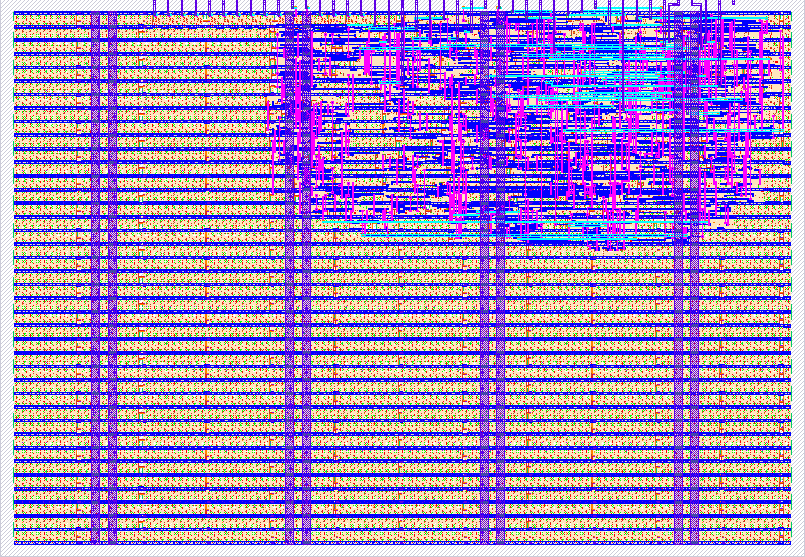
- Author: Antoine Lelong
- Description: 8-bit signed fused multiply-add (z = a*b + c), streaming one result every 2 cycles
- GitHub repository
- Open in 3D viewer
- Open in Tiny Tapeout Explorer
- Clock: 50000000 Hz
How it works
FMAC is a synchronous 8-bit signed fused multiply-add: it computes
z = a * b + c
where a, b, c and z are 8-bit two's complement integers. The
product and the sum are carried in 16 bits internally, so no intermediate
overflow is possible (a*b is in [-16256, 16384], a*b+c in
[-16384, 16511]); z is the low 8 bits of the sum (mod-256 wraparound,
e.g. 100 * 100 + 0 = 10000 -> z = 240 = -16).
Streaming protocol (one result every 2 cycles)
Both input buses carry data, so two operands are loaded per cycle. The design free-runs a 2-phase toggle (starting in phase 0 after reset):
| Cycle (phase) | ui[7:0] |
uio[7:0] |
uo[7:0] |
|---|---|---|---|
| even (phase 0) | a |
b |
previous z |
| odd (phase 1) | c |
(unused) | — |
On each even cycle the design captures a (from ui) and b (from
uio); on each odd cycle it captures c (from ui) and latches
z = a*b + c. A result is valid on uo one cycle after its c is
presented — one result every 2 cycles.
Usage
- Hold
rst_nlow for a few cycles, then release it. The design starts in phase 0. - On an even cycle, drive
ui = a,uio = b. - On the next (odd) cycle, drive
ui = c. - Read
zonuothe following even cycle. - Repeat with the next
(a, b, c)triple for a continuous stream.
The host drives clk and rst_n, so it can count cycles from reset to
stay phase-aligned. There is no separate start/valid signal (no spare
pins); after reset a = b = z = 0.
How to test
The cocotb tests in test/test.py cover:
- reset behavior (
z = 0after reset) - corner cases (min/max operands, wraparound)
- 2000 randomized
(a, b, c)triples against a Python reference - back-to-back streaming (one result every 2 cycles)
Run with make from the test/ directory (see the Tiny Tapeout test
workflow). A plain-Verilog self-checking testbench is also provided in
test/tb_selfcheck.v for quick iverilog runs without cocotb.
External hardware
None.
IO
| # | Input | Output | Bidirectional |
|---|---|---|---|
| 0 | A/C[0] | Z[0] | B[0] |
| 1 | A/C[1] | Z[1] | B[1] |
| 2 | A/C[2] | Z[2] | B[2] |
| 3 | A/C[3] | Z[3] | B[3] |
| 4 | A/C[4] | Z[4] | B[4] |
| 5 | A/C[5] | Z[5] | B[5] |
| 6 | A/C[6] | Z[6] | B[6] |
| 7 | A/C[7] | Z[7] | B[7] |