Tiny Tapeout > Tiny Tapeout Chips > Tiny Tapeout SKY 26a > 935 V-SPACE Demo: Command & Control Chronograph
935 V-SPACE Demo: Command & Control Chronograph
935 : V-SPACE Demo: Command & Control Chronograph
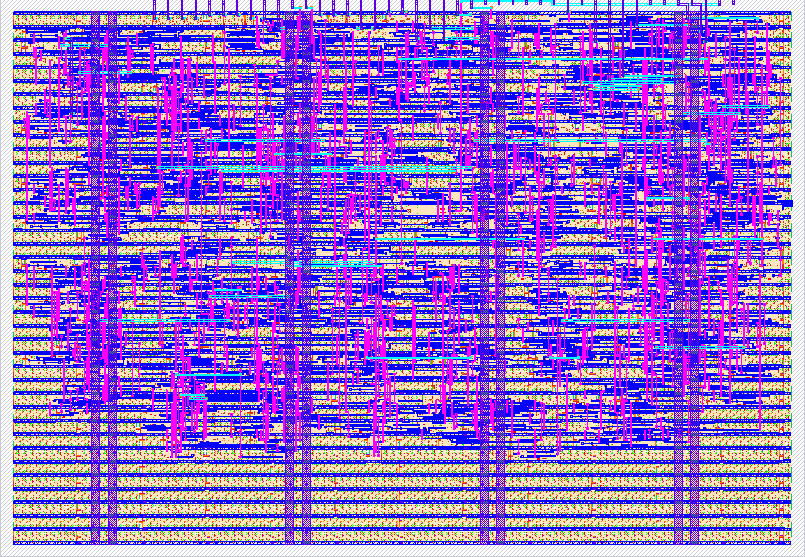
- Author: Advaittej
- Description: Interactive 1Hz stopwatch with hardware debouncing, lap memory, alarm target, and 9600-baud UART RX/TX telemetry.
- GitHub repository
- Open in 3D viewer
- Open in Tiny Tapeout Explorer
- Clock: 10000000 Hz
Bidirectional Command & Control Chronograph
How it works
This design elevates a standard 1Hz digital stopwatch into an interactive, bidirectional hardware peripheral. It operates on a standard 10 MHz clock and integrates mixed-signal human interface handling with asynchronous serial communication. The architecture is divided into five core silicon modules:
- Hardware Debouncers: Physical buttons are notoriously noisy. Inputs
ui_in[0]andui_in[1]are fed through 8-bit shift-register debouncers, ensuring a state change only triggers after 8 consecutive identical clock cycles, rendering switch-bounce physically impossible. - The Core Chronograph & Shift-Memory: A 24-bit clock divider generates a precise 1Hz pulse to drive a 4-bit BCD counter (0-9). Upon receiving a "Lap" pulse, the current BCD state is pushed into a 3-deep register memory array. The most recent lap is exposed to the bidirectional pins
uio_out[7:4]. - The Alarm Comparator: Pure combinational logic constantly compares the running timer against a 4-bit hardware target defined by switches
ui_in[7:4]. - Autonomous UART Transmitter (TX): When the Alarm Comparator detects a match, an edge-detector triggers a hardcoded UART state machine. It autonomously streams the string
"VIT Vellore\r\n"at 9600 baud out ofuio_out[0]. - UART Command Decoder (RX): The chip listens to
uio_in[1]. A 2-stage synchronizer protects against metastability, feeding a 16x oversampled receiver state machine. It decodes ASCII serial characters in real-time, allowing laptop control of the stopwatch (S= Start/Pause,L= Lap,R= Reset).
How to test
Because this chip supports both physical and digital interfaces, testing is broken into two phases. Ensure the Tiny Tapeout board is powered and clocked at 10 MHz.
Phase 1: Physical Interface Verification
- Reset: Press the system reset button (
rst_nLOW) to clear all memory arrays. The 7-segment display will show0. - Start/Pause: Press the button wired to
ui_in[0]. The display will toggle between running at 1Hz and freezing. - Lap Memory: While running, press
ui_in[1]. Observe the output LEDs onuio_out[7:4]update to match the current digit on the 7-segment display. - Target Alarm: Set the DIP switches
ui_in[7:4]to binary0101(5). When the 7-segment display hits5, the decimal point (uo_out[7]) will illuminate solid.
Phase 2: UART Telemetry Verification
- Connect the
GNDof a USB-to-TTL Serial adapter to the board's Ground. - Connect the RX pin of the adapter to
uio_out[0](Chip TX). - Connect the TX pin of the adapter to
uio_in[1](Chip RX). - Open a serial terminal (PuTTY/TeraTerm) on your PC. Configure it to 9600 Baud, 8 Data Bits, No Parity, 1 Stop Bit (8N1).
- Bidirectional Control: - Type
Son your keyboard. The stopwatch will start/pause.- Type
Lon your keyboard. The lap memory will trigger. - Type
Ron your keyboard. The system will undergo a soft reset back to 0.
- Type
- Data Exfiltration: Set your physical switches
ui_in[7:4]to3. TypeSto start the timer. The exact moment the timer hits 3, your serial terminal will receive the string:VIT Vellore.
External hardware
To fully verify the capabilities of this ASIC, you will need:
- Tiny Tapeout Demo Board (or equivalent carrier board).
- 7-Segment Display PMOD connected to the dedicated output pins (
uo_out[0:7]). - Two tactile push-buttons connected to
ui_in[0]andui_in[1]. - Standard DIP switches for
ui_in[7:4]. - A 3.3V USB-to-TTL Serial Cable (e.g., FTDI or CH340 based) for laptop bidirectional communication.
IO
| # | Input | Output | Bidirectional |
|---|---|---|---|
| 0 | Start / Pause Button | Segment A | UART TX Telemetry (Output) |
| 1 | Lap Button | Segment B | UART RX Commands (Input) |
| 2 | Segment C | ||
| 3 | Segment D | ||
| 4 | Alarm Target Bit 0 | Segment E | Lap Memory Bit 0 (Output) |
| 5 | Alarm Target Bit 1 | Segment F | Lap Memory Bit 1 (Output) |
| 6 | Alarm Target Bit 2 | Segment G | Lap Memory Bit 2 (Output) |
| 7 | Alarm Target Bit 3 | Alarm Match LED (Dec Point) | Lap Memory Bit 3 (Output) |