999 Tiny Secure Telemetry Engine
999 : Tiny Secure Telemetry Engine
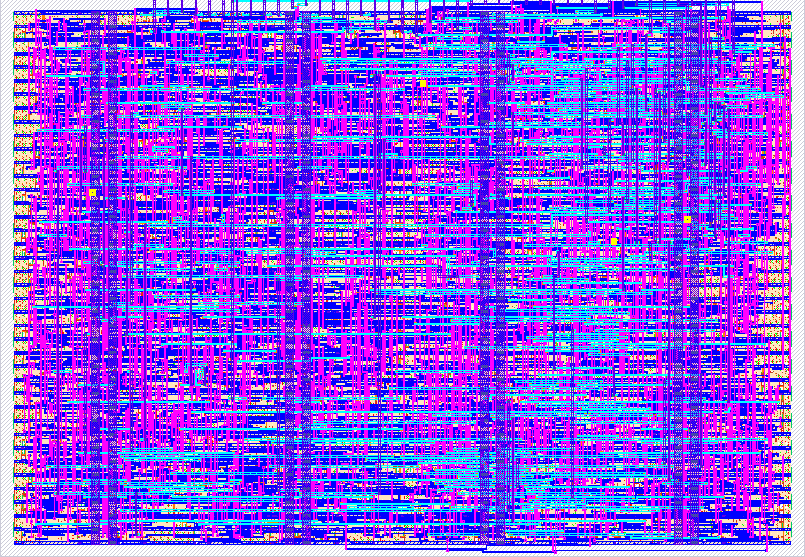
- Author: Chidambaresh N ,Dr.Sudhanya P, Charukkesh S, Dhivya G, Priyavarshini T, Sriharivasan P S
- Description: 8-bit security and integrity co-processor with nonlinear permutation, keystream, and CRC modes
- GitHub repository
- Open in 3D viewer
- Open in Tiny Tapeout Explorer
- Clock: 25000000 Hz
Tiny Secure Telemetry Engine
Tiny Secure Telemetry Engine is an 8-input, 8-output ASIC-oriented security and integrity co-processor for TinyTapeout. The design provides a compact stateful datapath for telemetry mixing, pseudo-random byte generation, lightweight integrity checking, and key/configuration stirring.
The chip is implemented as tt_um_chidam_secengine and uses only the dedicated 8-bit input bus and dedicated 8-bit output bus for the user application. The bidirectional uio pins are intentionally unused and are held inactive.
Application
Small embedded and IoT systems often need a tiny hardware block that can mix incoming telemetry, generate changing challenge/response bytes, and maintain an integrity state without using a full software cryptographic engine. This project demonstrates a compact hardware security primitive suitable for:
- sensor telemetry integrity tagging
- lightweight challenge/response experiments
- pseudo-random stream generation
- stateful packet/session mixing
- educational ASIC security datapath study
This is not intended as a drop-in replacement for standardized cryptography such as AES, SHA, or HMAC. It is a small manufacturable hardware primitive designed for TinyTapeout area and IO limits.
How It Works
Internally, the design contains:
- a 32-bit nonlinear state register
- a 16-bit rolling key register
- an 8-bit integrity/check register
- an 8-bit counter
- a registered 8-bit output
Each enabled clock cycle mixes the current input byte with the internal state using nibble substitution, bit rotations, XOR diffusion, and a lightweight feedback step. The selected mode controls how the state, key, integrity byte, and output are updated.
Pinout
| Pin | Direction | Description |
|---|---|---|
ui_in[5:0] |
Input | Payload/control bits |
ui_in[7:6] |
Input | Mode select |
uo_out[7:0] |
Output | Registered result byte |
uio_in[7:0] |
Input | Unused |
uio_out[7:0] |
Output | Held at 0x00 |
uio_oe[7:0] |
Output | Held at 0x00, bidirectional pins disabled |
clk |
Input | System clock |
rst_n |
Input | Active-low reset |
ena |
Input | Design enable |
Modes
The two most significant input bits select the operating mode:
ui_in[7:6] |
Mode | Behavior |
|---|---|---|
00 |
Absorb | Mixes the payload into the nonlinear telemetry state and integrity register |
01 |
Stream | Produces a pseudo-random stream-style output byte and advances the rolling key |
10 |
Integrity | Updates the lightweight CRC-style feedback state and emits an integrity-derived byte |
11 |
Stir | Re-seeds/stirs the state, key, counter, and integrity byte using the current input |
The internal input byte used by the datapath is:
din = {ui_in[5:0], ui_in[7:6]};
This lets both the payload and selected mode influence the state evolution.
Reset State
On active-low reset, the engine initializes to fixed nonzero constants:
state_reg = 32'h6a09_e667;
key_reg   = 16'h243f;
crc_reg   = 8'h5a;
ctr_reg   = 8'h00;
out_reg   = 8'h00;
After reset, uo_out is 0x00. When ena is high, the state advances on each rising clock edge. When ena is low, the sequential registers hold their values.
Example Use
- Reset the design by driving
rst_n = 0. - Release reset with
rst_n = 1. - Drive
ena = 1. - Select a mode using
ui_in[7:6]. - Provide a 6-bit payload on
ui_in[5:0]. - Read the registered result from
uo_out[7:0]after the next rising clock edge.
Design Notes
The final implementation was tuned to fit TinyTapeout Sky130 placement and routing. Earlier larger versions intentionally increased utilization but exceeded placement limits. The current design keeps meaningful stateful logic while leaving enough placement/routing margin for the GDS flow to complete.
Source
Top module:
tt_um_chidam_secengine
Main RTL file:
src/project.v
Testbench files:
test/tb.v
test/test.py
License
Apache-2.0
IO
| # | Input | Output | Bidirectional |
|---|---|---|---|
| 0 | payload_0 | result_0 | |
| 1 | payload_1 | result_1 | |
| 2 | payload_2 | result_2 | |
| 3 | payload_3 | result_3 | |
| 4 | payload_4 | result_4 | |
| 5 | payload_5 | result_5 | |
| 6 | mode_0 | result_6 | |
| 7 | mode_1 | result_7 |