35 SAR FSM
35 : SAR FSM
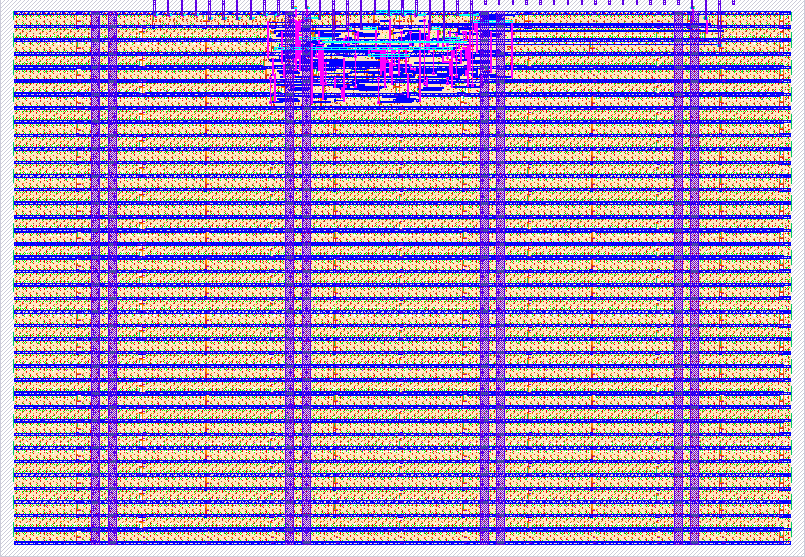
- Author: Sönke Appel
- Description: A parameterizable successive approximation (SAR) finite state machine (FSM) for an ADC
- GitHub repository
- Open in 3D viewer
- Open in Tiny Tapeout Explorer
- Clock: 100000000 Hz
How it works
This is a parameterizable implementation of a successive approximation (SAR) finite state machine (FSM) for an ADC, as required for operation in a SAR ADC as shown in the following figure:
<a title="White Flye, CC BY-SA 2.5 <https://creativecommons.org/licenses/by-sa/2.5>, via Wikimedia Commons" href="https://commons.wikimedia.org/wiki/File:SA_ADC_block_diagram.png"><img width="960" alt="SA ADC block diagram" src="https://upload.wikimedia.org/wikipedia/commons/thumb/6/61/SA_ADC_block_diagram.png/960px-SA_ADC_block_diagram.png"></a>
How to test
The design can be tested with the TinyTapeout DevKit.
- Apply a sequence of four bits to pin
ui_in[0], synchronized to the clock.- After five clock cycles, the serialized sequence should appear in parallel on pins
uo_out[3:0]. - On pins
uio_out[3:0], each bit is set from MSB down to LSB on each clock cycle. - Depending on
ui_in[0], the current bit remains set or is cleared on the next clock cycle.
- After five clock cycles, the serialized sequence should appear in parallel on pins
Example: For the ui_in[0] sequence "1010" after a reset, the following signals should be present at the consecutively numbered clock cycles:
uio_out.value[3:0] == 0b1000(internal)
uo_out.value[3:0] == 0b0000uio_out.value[3:0] == 0b1100(internal)
uo_out.value[3:0] == 0b0000uio_out.value[3:0] == 0b1010(internal)
uo_out.value[3:0] == 0b0000uio_out.value[3:0] == 0b1011(internal)
uo_out.value[3:0] == 0b0000uio_out.value[3:0] == 0b1000(internal -> restart)
uo_out.value[3:0] == 0b1010(output result)
External hardware
The design can be tested with the TinyTapeout DevKit.
Alternatively, the design can be tested using a 4-bit DAC setup and a comparator, as shown in the figure above.
IO
| # | Input | Output | Bidirectional |
|---|---|---|---|
| 0 | Compareator output | sar_out[0] Conversion Result | sar_int[0] DAC input |
| 1 | sar_out[1] Conversion Result | sar_int[1] DAC input | |
| 2 | sar_out[2] Conversion Result | sar_int[2] DAC input | |
| 3 | sar_out[3] Conversion Result | sar_int[3] DAC input | |
| 4 | debug ui[0] (loopback for testing) | ||
| 5 | |||
| 6 | |||
| 7 | End of conversion flag (EOC) |