1006 Formally-Verified Constant-Time AES S-Box
1006 : Formally-Verified Constant-Time AES S-Box
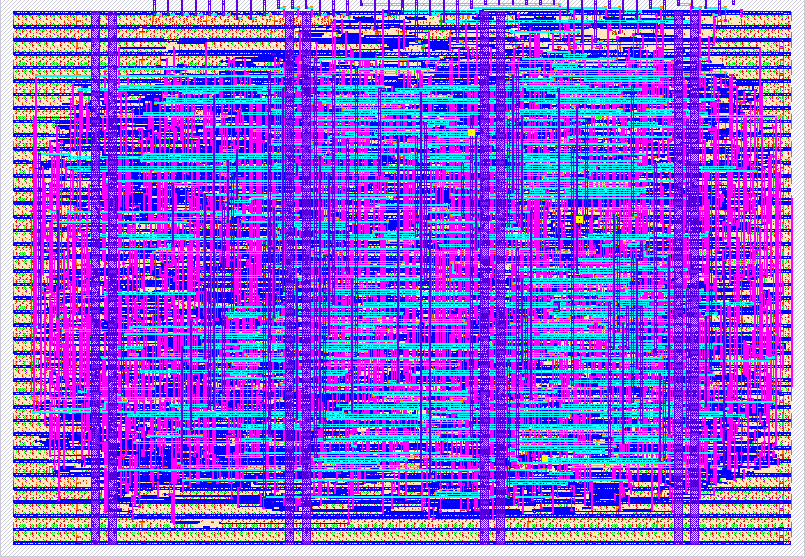
- Author: Onyeka Obi
- Description: Constant-time AES SubBytes/InvSubBytes with registered I/O. Part of the rtlforge project.
- GitHub repository
- Open in 3D viewer
- Open in Tiny Tapeout Explorer
- Clock: 50000000 Hz
How it works
This is a constant-time AES S-Box implementing both SubBytes (encrypt) and InvSubBytes (decrypt) operations per FIPS 197. The input byte is looked up in the standard AES substitution table via purely combinational logic (the synthesis tool optimizes the 256-entry case statement into a LUT network). Output is registered with one clock cycle latency.
The design is inherently constant-time in hardware: every input takes the
identical path through the same combinational logic, with no data-dependent
control flow, memory access patterns, or timing variation. The mode select
mux operates on the control signal (uio_in[1]), never on secret data.
This is part of the rtlforge project, which generates formally-verified cryptographic IP from Rust specifications.
Design reference: FIPS 197, "Advanced Encryption Standard (AES)", NIST, 2001.
How to test
Set ui_in[7:0] to the input byte, uio_in[0] = 1 (valid), uio_in[1] = 0
for encrypt (SubBytes) or 1 for decrypt (InvSubBytes). After one clock cycle,
read uo_out[7:0] for the result. uio_out[0] indicates output valid.
To exhaustively verify: iterate all 256 input values and compare against the FIPS 197 S-Box tables (Figure 7 for encrypt, Figure 14 for decrypt). The cocotb testbench does this automatically for both modes plus a round-trip check (InvSubBytes(SubBytes(x)) == x for all x).
External hardware
None required. The design uses only the dedicated I/O pins on the TinyTapeout carrier board.
IO
| # | Input | Output | Bidirectional |
|---|---|---|---|
| 0 | sbox_in[0] | sbox_out[0] | in_valid |
| 1 | sbox_in[1] | sbox_out[1] | mode (0=encrypt, 1=decrypt) |
| 2 | sbox_in[2] | sbox_out[2] | |
| 3 | sbox_in[3] | sbox_out[3] | |
| 4 | sbox_in[4] | sbox_out[4] | |
| 5 | sbox_in[5] | sbox_out[5] | |
| 6 | sbox_in[6] | sbox_out[6] | |
| 7 | sbox_in[7] | sbox_out[7] |