809 Configurable Galois LFSR
809 : Configurable Galois LFSR
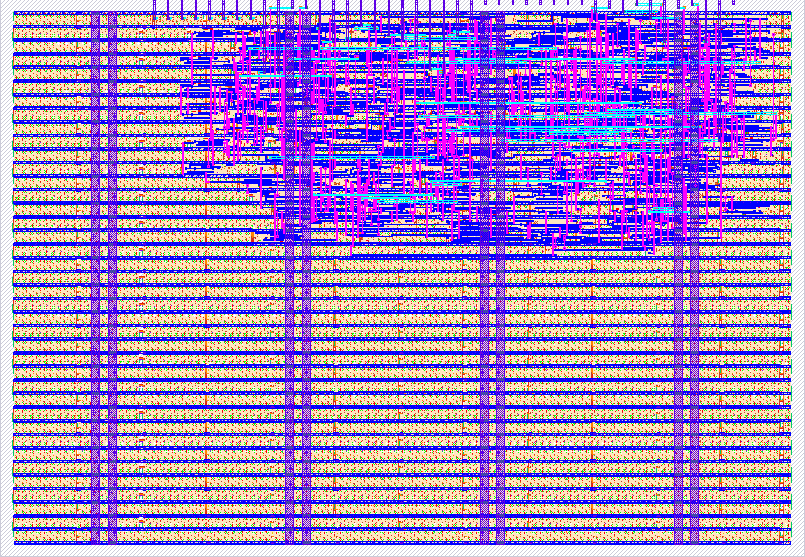
- Author: Adithyan B, S Govind, Gouri Ajith
- Description: 16-bit Galois LFSR with configurable width (4/8/12/16-bit), primitive polynomial selection, nibble-serial seed loading, and full 16-bit output
- GitHub repository
- Open in 3D viewer
- Open in Tiny Tapeout Explorer
- Clock: 50000000 Hz
Configurable Galois LFSR
How it works
This project implements a 16-bit Configurable Galois LFSR (Linear Feedback Shift Register) designed for Tiny Tapeout SKY130.
Architecture
A Galois LFSR (right-shift variant) is used. Each clock cycle in RUN mode:
feedback_bit = lfsr_reg[0]
lfsr_next    = {0, lfsr_reg[15:1]} XOR (feedback_bit ? tap_mask : 0)
lfsr_next    = lfsr_next AND width_mask   (zero out inactive upper bits)
Compared to a Fibonacci LFSR, the Galois architecture distributes XOR gates across the register rather than concentrating them in a single long chain. This results in a shorter combinational critical path — beneficial for ASIC timing closure on SKY130.
Configurable Width
Four widths are supported, selected by ui_in[3:2] (captured once at reset release):
ui_in[3:2] |
Width | Max Period | Default Polynomial |
|---|---|---|---|
00 |
4-bit | 15 | x⁴+x+1 |
01 |
8-bit | 255 | x⁸+x⁶+x⁵+x⁴+1 |
10 |
12-bit | 4095 | x¹²+x¹¹+x¹⁰+x⁴+1 |
11 |
16-bit | 65535 | x¹⁶+x¹⁵+x¹³+x⁴+1 |
All default polynomials are verified primitive polynomials — guaranteed maximal-length sequences.
Operating Modes
Controlled by ui_in[1:0]:
ui_in[1:0] |
Mode | Description |
|---|---|---|
00 |
RUN | LFSR advances by one step each clock cycle |
01 |
LOAD_SEED | Load a custom 16-bit seed (nibble-serial, 4 cycles) |
10 |
LOAD_TAP | Select a primitive polynomial from the lookup table (1 cycle) |
11 |
HOLD | LFSR output frozen; no state change |
Loading a Custom Seed (LOAD_SEED)
Loading a 16-bit seed takes 4 consecutive clock cycles in LOAD_SEED mode, sending one 4-bit nibble per cycle via ui_in[7:4]:
| Cycle | ui_in[7:4] |
Loads |
|---|---|---|
| 1 (entry) | seed[3:0] |
Bits [3:0] |
| 2 | seed[7:4] |
Bits [7:4] |
| 3 | seed[11:8] |
Bits [11:8] |
| 4 | seed[15:12] |
Bits [15:12] |
Switch to RUN to apply the seed. The seed is automatically masked to the active width. Loading 0x0000 is safe — hardware promotes it to 0x0001.
Example: Load seed 0xA5C3 for 8-bit LFSR (effective seed = 0x00C3)
Cycle 1: ui_in = 8'b0011_0001  (mode=01, width=01, data=4'h3)
Cycle 2: ui_in = 8'b1100_0001  (mode=01, width=01, data=4'hC)
Cycle 3: ui_in = 8'b0101_0001  (mode=01, width=01, data=4'h5)
Cycle 4: ui_in = 8'b1010_0001  (mode=01, width=01, data=4'hA)
Switch:  ui_in = 8'b0000_0100  (mode=00 = RUN, width=01)
Selecting a Polynomial (LOAD_TAP)
In LOAD_TAP mode, one clock cycle selects a pre-validated primitive polynomial:
ui_in[5:4] (poly_idx) |
4-bit | 8-bit | 12-bit | 16-bit |
|---|---|---|---|---|
00 |
x⁴+x+1 | x⁸+x⁶+x⁵+x⁴+1 | x¹²+x¹¹+x¹⁰+x⁴+1 | x¹⁶+x¹⁵+x¹³+x⁴+1 |
01 |
x⁴+x³+1 | x⁸+x⁴+x³+x²+1 | same as 00 | same as 00 |
10 |
same as 00 | same as 00 | same as 00 | same as 00 |
11 |
same as 01 | same as 01 | same as 00 | same as 00 |
All table entries are verified primitive polynomials — guaranteed maximal-length sequences regardless of selection.
Protection Features
| Feature | Description |
|---|---|
| Lockup protection | If LFSR state = 0x0000 in RUN mode, next state is forced to 0x0001 |
| Zero-seed guard | If loaded seed (masked to active width) is 0x0000, LFSR starts from 0x0001 |
| Primitive poly table | LOAD_TAP only allows pre-validated primitives — non-maximal sequences impossible |
| Width masking | Inactive upper bits are permanently forced to 0 |
How to test
Quick Start (default 8-bit PRBS)
- Assert
rst_n = 0, setui_in = 8'h04(mode=RUN, width=8-bit) - Release
rst_n = 1 {uio_out, uo_out}now outputs the LFSR sequence each clock cycleuo_out[0]is the serial PRBS bit (LSB)
Full Sequence Verification
- Reset in 8-bit mode
- Set
ui_in[1:0] = 00(RUN) - Clock 255 times and record
uo_out - Verify all 255 values from
0x01to0xFFappear exactly once
Loading a Custom Seed
- Reset in desired width mode
- Set
mode = LOAD_SEEDand clock 4 nibbles (LSB-first) - Set
mode = RUN— LFSR starts from custom seed on the next cycle
External hardware
No external hardware required. Can drive an LED with uo_out[0] (serial bit output) or a logic analyser for PRBS verification.
IO
| # | Input | Output | Bidirectional |
|---|---|---|---|
| 0 | mode[0] | lfsr_out[0] (LSB / serial bit) | lfsr_out[8] |
| 1 | mode[1] | lfsr_out[1] | lfsr_out[9] |
| 2 | width_sel[0] (latched at reset release) | lfsr_out[2] | lfsr_out[10] |
| 3 | width_sel[1] (latched at reset release) | lfsr_out[3] | lfsr_out[11] |
| 4 | data_in[0] / poly_idx[0] | lfsr_out[4] | lfsr_out[12] |
| 5 | data_in[1] / poly_idx[1] | lfsr_out[5] | lfsr_out[13] |
| 6 | data_in[2] | lfsr_out[6] | lfsr_out[14] |
| 7 | data_in[3] | lfsr_out[7] | lfsr_out[15] (MSB) |