745 Cable Tester
745 : Cable Tester
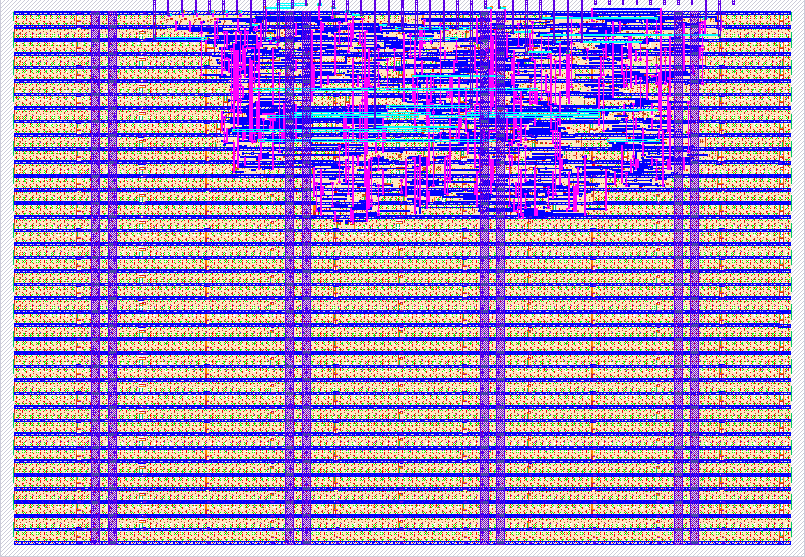
- Author: Daniel Bovensiepen
- Description: Ethernet cable continuity tester: drives each RJ45 wire and reports per-wire pass/fail on 8 LEDs
- GitHub repository
- Open in 3D viewer
- Open in Tiny Tapeout Explorer
- Clock: 25000000 Hz
How it works
This is an 8-wire DC continuity tester for Ethernet (and any other 8-conductor) cable.
The 8 bidirectional uio pins each connect to one wire of an RJ45 jack on the test
board. On the far end of the cable under test, all 8 wires are tied together at a
single common node (a soldered-together RJ45 plug — described below).
After reset the chip runs forever, on a continuous loop:
- Drive
uio[k]high while all otheruiopins are high-Z inputs. - Wait
2^SETTLE_BITSclock cycles so the cable's RC time constant can settle. - Sample all 8 input pins. For every bit
j != kthat read high, set bitjof an internal accumulator. - Advance
k; afterkreaches 7, copy the accumulator into the visible output register, clear the accumulator, and start the next pass.
In steady state, uo_out[j] = 1 iff some other intact wire saw wire j light up
during that other wire's drive cycle. Because the far end shorts all wires together,
this happens exactly when wire j is electrically continuous from the near-end RJ45
to the far-end common node.
For the fabricated build, SETTLE_BITS = 13 (8192 cycles per pin, ≈ 2.6 ms per
full pass at 25 MHz). Simulation builds with -DSIM_FAST shrink this to 3 bits.
Limitation
If only one wire in the entire cable is intact, it has no partner to confirm against and will be reported as bad. Cables with seven or more broken wires fail the same way for this and every other reason.
The tester also does not detect:
- Split pairs (correct DC continuity, wrong twisted-pair routing). Those are AC-only faults — a real time-domain reflectometer is needed.
- Cable length, impedance, return loss, NEXT, or shielding integrity.
- Wire-to-wire swaps at the connector (e.g. T568A vs T568B miswiring). The far-end common node hides any swap.
How to test
You need two pieces of hardware:
Far-end shorting plug: an RJ45 male connector with all 8 contacts soldered together into a single node. No resistors, no diodes, no PCB. The simplest version is a piece of stranded wire crimped into a spare RJ45 plug.
Near-end test board: routes the 8 cable wires to uio[0..7], with on-board
LEDs on uo[0..7] and per-line protection. See External hardware below.
Once both are built:
- Plug the shorting plug onto one end of the cable under test.
- Plug the other end into the tester board's RJ45 jack.
- Apply power.
After ~one display-update period (a few milliseconds at the fab clock), each of
the 8 uo LEDs reflects the state of the corresponding wire:
- All 8 LEDs on → the cable is good.
- Any LED off → that specific wire is open. The LED bit number
kcorresponds to RJ45 pink+1.
The chip retests continuously, so you can wiggle the cable and watch LEDs flicker to find intermittent faults.
External hardware
For each uio[k] line, between the chip pin and the RJ45 jack:
- 220 Ω series resistor (current limit + light ESD softening).
- 100 kΩ pull-down to GND (defines logic 0 when the wire is open).
- TVS diode array to GND across the 8 lines (e.g. SP0524). Ethernet jacks attract static; without TVS the chip will not survive routine cable swaps.
For each uo[k] line: an LED with a series resistor (~1 kΩ for typical LEDs)
to GND.
No magnetics, no PHY ICs — this is a DC test, not an Ethernet PHY.
Far-end dongle: a single RJ45 male plug with all 8 contacts shorted to one node. Zero electronic parts.
IO
| # | Input | Output | Bidirectional |
|---|---|---|---|
| 0 | WIRE0_OK (RJ45 pin 1) | WIRE0 (RJ45 pin 1) | |
| 1 | WIRE1_OK (RJ45 pin 2) | WIRE1 (RJ45 pin 2) | |
| 2 | WIRE2_OK (RJ45 pin 3) | WIRE2 (RJ45 pin 3) | |
| 3 | WIRE3_OK (RJ45 pin 4) | WIRE3 (RJ45 pin 4) | |
| 4 | WIRE4_OK (RJ45 pin 5) | WIRE4 (RJ45 pin 5) | |
| 5 | WIRE5_OK (RJ45 pin 6) | WIRE5 (RJ45 pin 6) | |
| 6 | WIRE6_OK (RJ45 pin 7) | WIRE6 (RJ45 pin 7) | |
| 7 | WIRE7_OK (RJ45 pin 8) | WIRE7 (RJ45 pin 8) |