168 Kraken IO Subprocessor
168 : Kraken IO Subprocessor
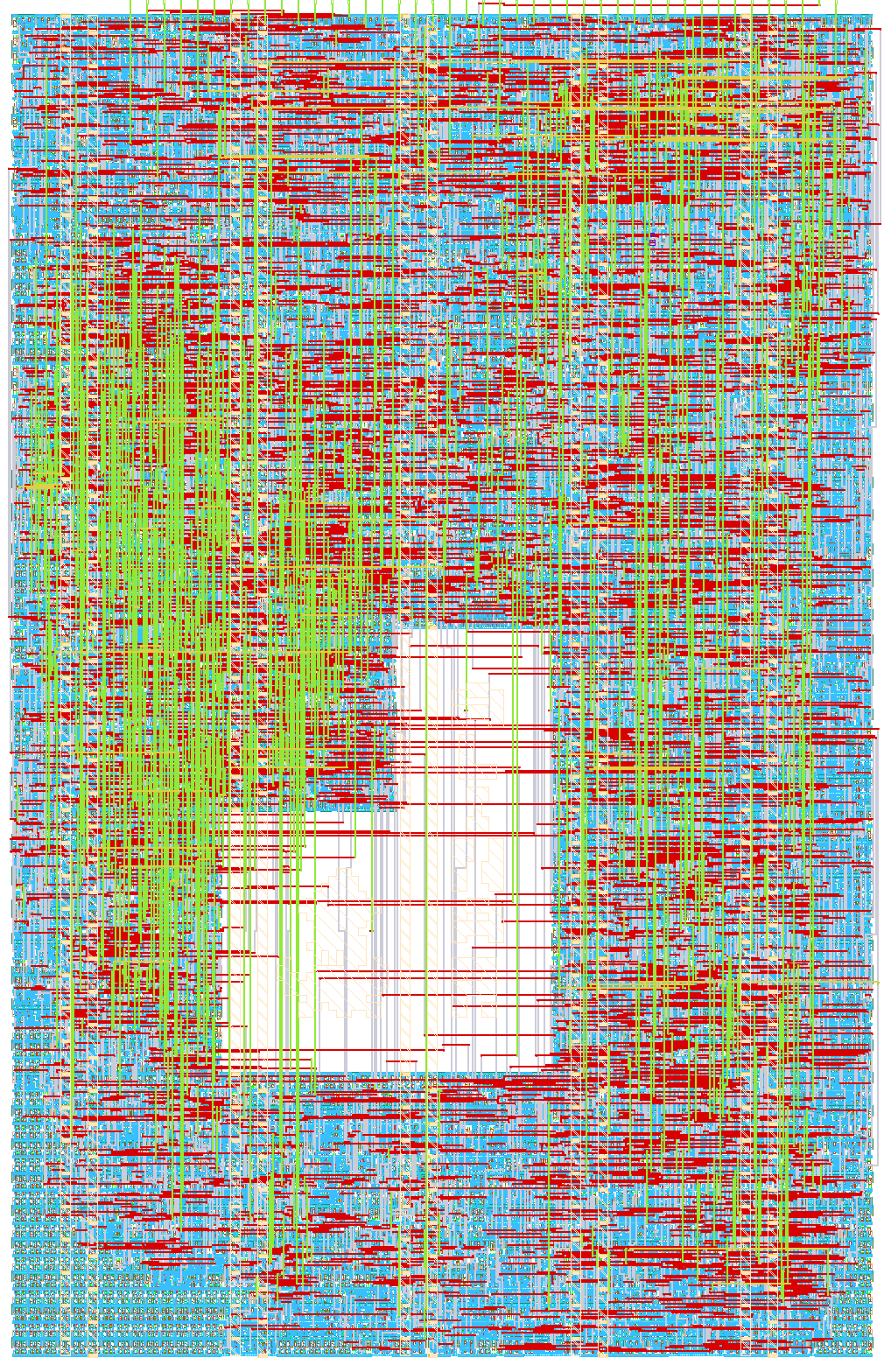
- Author: Matthias Musch
- Description: A PIO-like state machine that runs short pioasm scripts
- GitHub repository
- Open in 3D viewer
- Open in Tiny Tapeout Explorer
- Clock: 0 Hz
How it works
Kraken IO Subprocessor (mini) is a two-tile, RP2040-PIO-compatible programmable I/O block for Tiny Tapeout. It runs short programs compiled with pioasm and is meant for bit-banged protocols (UART, SPI, WS2812, and similar) without tying up a host CPU.
The design contains:
- One PIO state machine with an 8-word instruction memory (IMEM), 2-bit GPIO (
uo[1:0]), TX/RX shift registers, and depth-2 TX/RX FIFOs. - A pin loader for programming IMEM and SM configuration without a system bus. Set
uio[7]=1to enter config mode; setuio[7]=0for run mode. - A runtime clock divider so the SM can run slower than the chip clock.
Instruction encoding and opcodes match the RP2040 PIO (JMP, WAIT, IN, OUT, PUSH/PULL, MOV, IRQ, SET). The SM fetches from IMEM, executes one instruction per enabled clock (after optional delay cycles), drives the two GPIO outputs, and can shift data to/from the host through the FIFO interface.
Pin loader (config mode, uio[7]=1)
Pulse uio[0] (rising edge) to apply the operation, with payload bytes on ui[7:0]:
| Encoding | Operation | Details |
|---|---|---|
uio[6]=0 |
IMEM write | uio[4:2] = address (8 words), uio[1] = half, uio[0] = strobe. Low byte on first strobe (half=0), high byte on second (half=1). Latch addr/half while strobe=0. |
uio[6]=1 |
Other ops | uio[5:3] = op code, uio[0] = strobe |
uio[5:3] |
Operation | ui[7:0] meaning |
|---|---|---|
| 1 | EXEC wrap | ui[3:0] = wrap bottom, ui[7:4] = wrap top (low 3 bits used) |
| 2 | PIN config | Set/out/sideset counts, side-set enable, side-set pindir |
| 3 | CLKDIV low | Low byte of 16-bit divider |
| 4 | CLKDIV high | High byte of 16-bit divider |
| 5 | SHIFT | Input/output shift direction, autopush, autopull |
| 6 | THRESH | Push/pull bit thresholds |
| 7 | INPIN | Input base pin and jump pin |
Run mode (uio[7]=0)
| Pin | Role |
|---|---|
ui[1:0] |
GPIO inputs to the SM |
ui[7:0] |
TX FIFO data (e.g. UART TX bytes) |
uio[0] |
tx_push — rising edge pushes ui[7:0] when FIFO not full |
uio[1] |
sm_enable (with ena) — SM runs when high |
uio[2] |
sm_restart — rising edge clears SM and FIFOs |
uio[3] |
rx_pop — rising edge pops RX FIFO into a host-visible latch |
uio[4] |
RX hold acknowledge — clears latched RX byte on uo_out |
uo[1:0] |
PIO GPIO outputs |
uo[2] |
tx_full |
uo[3] |
rx_empty |
uo[7:4] |
IRQ flags (when no latched RX byte) |
uo[7:0] |
Latched RX byte (after rx_pop, until uio[4] ack) |
How to test
RTL simulation
From the test/ directory (requires pioasm on PATH, or macOS pico-sdk-tools):
make assemble   # hello_world.pio → generated/hello_world.hex
make -B         # cocotb: pin-load IMEM, enable SM, check uo[0] square wave
The default test loads a two-instruction SET-pin square wave through config mode (uio[7]=1), then enables the SM in run mode and checks uo[0] toggles 1,1,0,0,....
On silicon (Tiny Tapeout IHP demo board)
- Select this design on the chip multiplexer (reset
sel_rst_n, pulsesel_incto your project address). - Hold reset (
rst_nlow), then release. - Program the SM in config mode (
uio[7]=1): write IMEM words, set wrap/clock divider/shift thresholds, then leave config mode (uio[7]=0). - Run: drive
uio[1]=1(sm_enable). Pulseuio[2]once if you need a clean restart. - UART TX example: load a standard 8N1 UART TX pioasm program with
wrapcovering your program range, setclkdivfor your baud rate, then for each byte place it onui[7:0]and pulseuio[0]. Watchuo[2](tx_full) before pushing; serial data appears onuo[0](or whichever OUT pin your program uses). - UART RX example: connect the incoming serial line to the GPIO input used by your program (
ui[0]orui[1]). When data arrives, pulseuio[3]to latch a received byte onuo[7:0], read it from the host, then pulseuio[4]to release the latch. Checkuo[3](rx_empty) before popping.
Monitor uo[7:4] for IRQ flags if your program uses irq instructions.
Gate-level simulation (after hardening): copy the generated netlist to test/gate_level_netlist.v and run make -B GATES=yes.
External hardware
- Tiny Tapeout IHP demo / breakout board and a 3.3 V host microcontroller (RP2040, Arduino, ESP32, etc.) to select the design, bit-bang the config loader, and drive run-mode control pins.
- For UART: a USB–serial adapter or logic analyzer on the PIO TX output (
uo[0]oruo[1], depending on your program). For RX testing, tie the adapter’s TX to the PIO input pin, or loop TX back to RX on the breadboard. - Optional: LEDs or a scope on
uo[1:0]to visualize bit-banged waveforms (WS2812, SPI, etc.).
No PMOD or dedicated daughterboard is required; all control and data paths use the standard Tiny Tapeout ui / uo / uio pins.
IO
| # | Input | Output | Bidirectional |
|---|---|---|---|
| 0 | gpio_in (also LSBs of TX byte when pushing) / TX byte for UART programs | PIO GPIO out | tx_push (rising edge) |
| 1 | gpio_in (also LSBs of TX byte when pushing) / TX byte for UART programs | PIO GPIO out | sm_enable (level, with ena) |
| 2 | TX byte for UART programs | tx_full | sm_restart (rising edge) |
| 3 | TX byte for UART programs | rx_empty | rx_pop (rising edge) |
| 4 | TX byte for UART programs | irq_flags[3:0] (or full uo[7:0]=rx byte when rx_hold_valid) | rx_hold ack (clear latched RX byte on uo) |
| 5 | TX byte for UART programs | irq_flags[3:0] (or full uo[7:0]=rx byte when rx_hold_valid) | config-mode select |
| 6 | TX byte for UART programs | irq_flags[3:0] (or full uo[7:0]=rx byte when rx_hold_valid) | config-mode select |
| 7 | TX byte for UART programs | irq_flags[3:0] (or full uo[7:0]=rx byte when rx_hold_valid) | config-mode select |