416 1D CA/GO/SO CFAR radar detector
416 : 1D CA/GO/SO CFAR radar detector
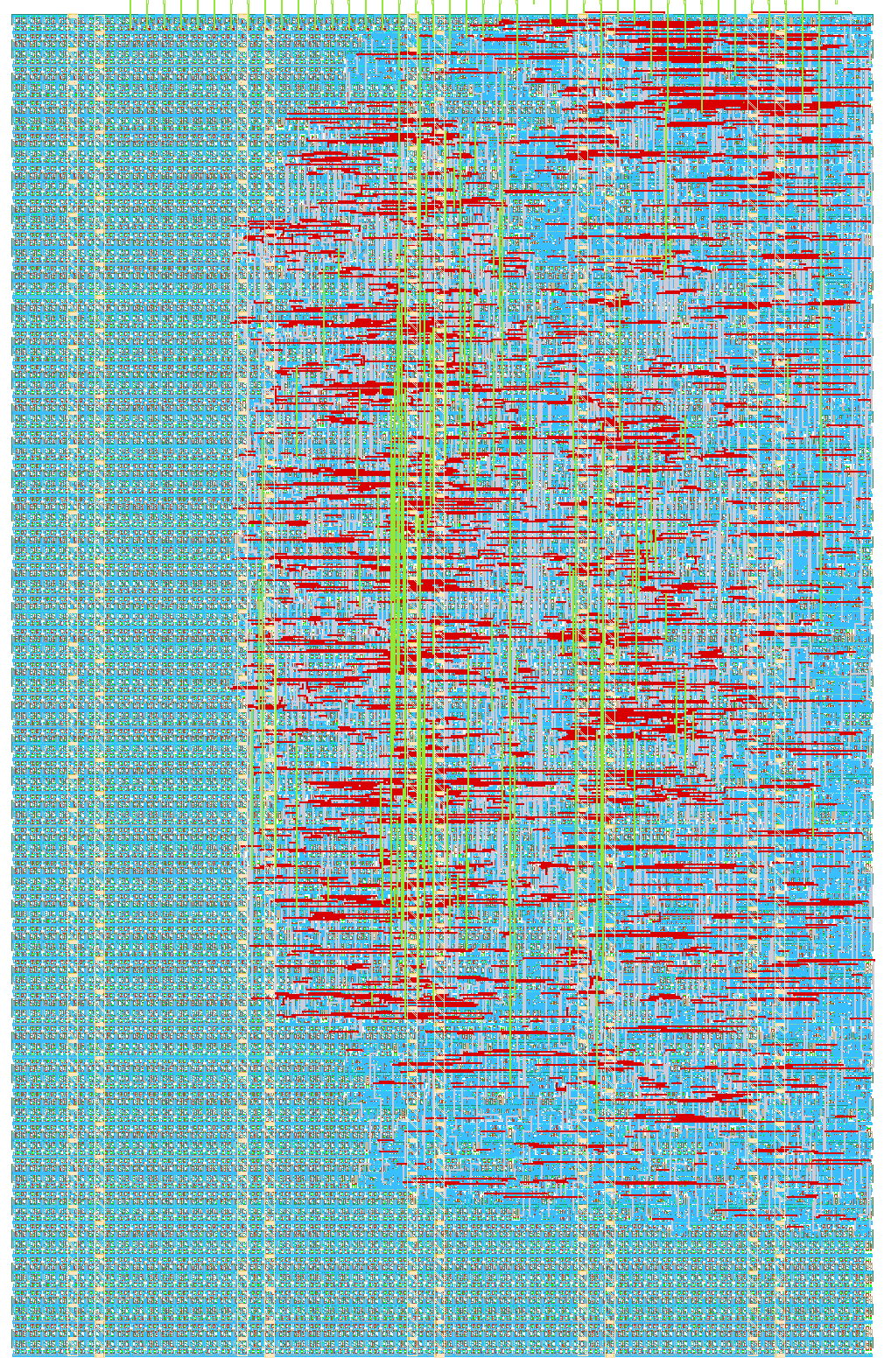
- Author: Lars Nitschke
- Description: A constant false alarm rate detector for pulse radar, processing one 8-bit magnitude sample per clock and emitting one detection decision per range cell, with cell-averaging, greatest-of and smallest-of variants selectable at runtime.
- GitHub repository
- Open in 3D viewer
- Open in Tiny Tapeout Explorer
- Clock: 50000000 Hz
How it works
A constant false alarm rate (CFAR) detector for pulse radar. One unsigned 8-bit magnitude sample enters per clock, one per range cell. A 21-stage shift register forms a sliding window: 8 training cells each side, 2 guard cells each side, and the cell under test in the middle. Two incremental half-sums track the training groups, updated by adding the entering cell and subtracting the leaving one, so cost does not grow with window size. A mode multiplexer selects cell-averaging (both halves), greatest-of, smallest-of, or a single-sided half for use at profile boundaries; the single-sided modes double the chosen half so every mode presents a nominal 16-cell sum. The threshold is a hardwired shift-add multiple of that sum, selected by three pins, and the comparison is done at 19 bits with no multiplier and no divider. Latency is a fixed 12 clock cycles.
How to test
Hold rst_n low, then release it. Assert sop high for one cycle concurrent with the first sample of a range profile, with mode and alpha_sel valid on the same cycle — sop must be asserted at least once after reset before any output is meaningful. Feed one 8-bit magnitude sample per clock on ui_in; every clock is treated as a sample and there is no data-valid input. The valid output rises 22 cycles after sop and detections are meaningful from then on. The host must supply 10 cells of margin either side of the region of interest, so for 512 cells of interest clock in 532 samples. Note valid protects the leading edge only and cannot detect the end of a profile.
External hardware
None. Magnitude samples are provided digitally from off-chip; there is no on-chip RF or ADC.
IO
| # | Input | Output | Bidirectional |
|---|---|---|---|
| 0 | sample[0] | det | mode[0] |
| 1 | sample[1] | valid | mode[1] |
| 2 | sample[2] | half_sel | mode[2] |
| 3 | sample[3] | v_dbg[0] | alpha_sel[0] |
| 4 | sample[4] | v_dbg[1] | alpha_sel[1] |
| 5 | sample[5] | v_dbg[2] | alpha_sel[2] |
| 6 | sample[6] | v_dbg[3] | sop |
| 7 | sample[7] | v_dbg[4] |