390 IEEE Digital EEG Threshold Event Detector
390 : IEEE Digital EEG Threshold Event Detector
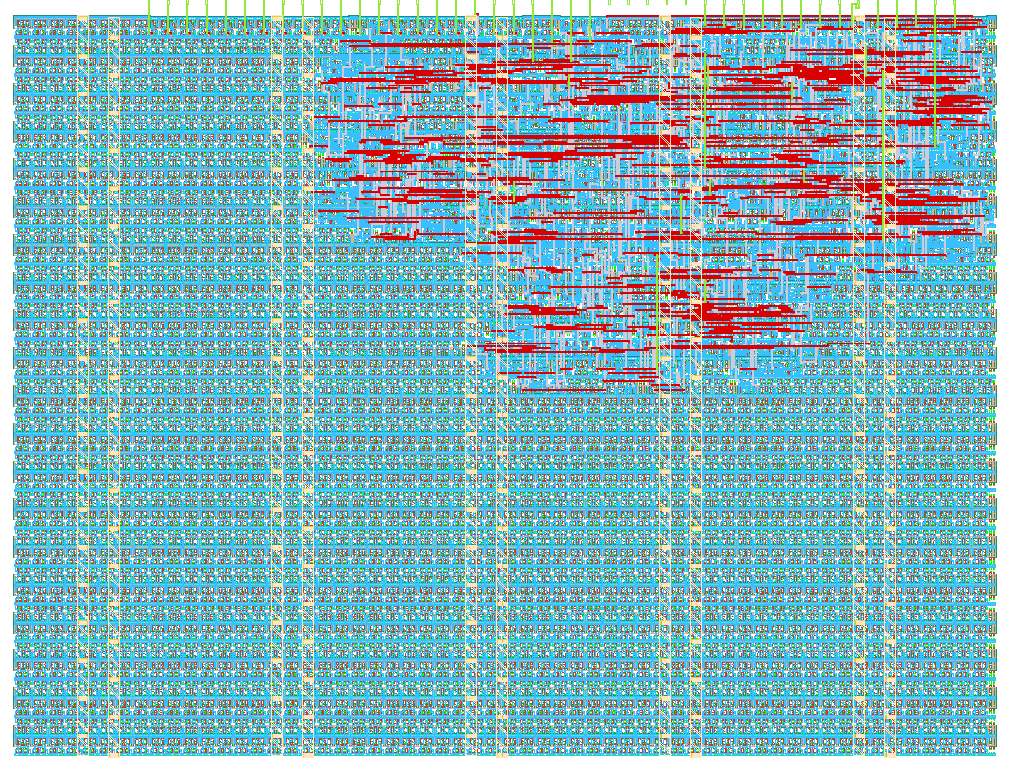
- Author: Jacob Kebaso
- Description: A digital threshold-crossing event detector with hysteresis and a refractory period, intended as the event-detection stage downstream of an external ADC digitizing an EEG signal. No analog pins are used; all thresholding and hysteresis logic is implemented digitally.
- GitHub repository
- Open in 3D viewer
- Open in Tiny Tapeout Explorer
- Clock: 10000 Hz
What is this project?
This project is a digital threshold-crossing event detector with hysteresis and a refractory period — effectively a "digital Schmitt trigger" designed to sit downstream of an external ADC that has already digitized a physiological signal such as an EEG channel.
The motivation comes from wearable seizure-detection hardware. A common building block in EEG-based seizure onset detectors is a threshold-crossing detector: raise a flag when a signal feature (raw amplitude, line length, band energy, etc.) exceeds a threshold for long enough to be a real event rather than noise, and only clear that flag once the signal has genuinely settled back down — not the instant it dips below the trigger point. That "settle back down" behaviour is hysteresis, and doing it with two separate thresholds (a high arming threshold and a lower re-arming threshold) is exactly how an analog Schmitt trigger comparator behaves, except implemented here entirely in synchronous digital logic.
No analog pins are used anywhere in this design. All thresholding, hysteresis, and timing logic is implemented as ordinary synthesizable Verilog operating on an 8-bit digital sample bus. This keeps the design low-risk for a first tapeout (fully simulatable and testable with cocotb before submission) while still directly modelling a real analog behaviour in the digital domain.
The project is intended as a standalone building block that could later feed into a larger seizure-detection or neural-event-detection pipeline — the output is a simple digital flag that a downstream microcontroller or state machine can act on (log the event, trigger an alert, wake up a higher-power processing stage, etc.).
How it works
Interface summary
| Pin | Direction | Meaning |
|---|---|---|
ui_in[7:0] |
in | Digitized sample value (normal mode) or configuration value (config mode) |
uio_in[0] |
in | cfg_mode — 1 selects a configuration write cycle, 0 selects normal sample processing |
uio_in[2:1] |
in | cfg_addr — selects which configuration register is written during a config cycle |
uio_in[7:3] |
in | unused |
uio_out[7:0] |
out | unused, driven low |
uio_oe[7:0] |
out | all zero — every uio pin is an input |
uo_out[0] |
out | event_detected — high while the detector is in the DETECTED state |
uo_out[1] |
out | armed — high while the detector is in the MONITOR (idle/watching) state |
uo_out[2] |
out | above_high — raw comparator debug bit: is the current sample ≥ th_high? |
uo_out[3] |
out | in_refractory — high while the detector is in the REFRACTORY state |
uo_out[7:4] |
out | unused, driven low |
Configuration registers
The detector has four 8-bit configuration registers, written one at a time over ui_in while cfg_mode = 1:
cfg_addr |
Register | Meaning |
|---|---|---|
2'b00 |
th_high |
Arming threshold. A sample at or above this value counts toward triggering a detection. |
2'b01 |
th_low |
Re-arming (hysteresis) threshold. Must be set lower than th_high. The detection flag is only cleared once the sample drops below this value — not merely below th_high. |
2'b10 |
debounce_limit |
Number of consecutive samples that must be at or above th_high before a detection is actually declared. This suppresses single-sample noise spikes. |
2'b11 |
refractory_len |
Number of clock cycles the detector holds in a refractory (locked-out) state after a detection clears, before it can arm and trigger again. |
On reset, sensible defaults are loaded automatically (th_high = 200, th_low = 150, debounce_limit = 4, refractory_len = 32) so the design is meaningfully functional even before any configuration writes occur — useful for quick bench testing.
Detection state machine
The core of the design is a three-state finite state machine, evaluated once per clock cycle whenever cfg_mode = 0:
- MONITOR (idle / armed): the detector watches incoming samples. Each cycle a sample is at or above
th_high, an internal counter increments; any sample belowth_highresets that counter to zero. Once the counter reachesdebounce_limit, the state machine transitions toDETECTED. - DETECTED: the
event_detectedoutput is asserted. The detector stays in this state — continuing to report a detected event — for as long as the sample remains at or aboveth_low. This is the hysteresis band: even if the signal dips briefly belowth_high(but stays aboveth_low), the detection is not cleared prematurely. - REFRACTORY: once the sample genuinely falls below
th_low, the detector clearsevent_detectedand enters a lockout period lastingrefractory_lenclock cycles, during which no new detection can be declared even if the signal spikes again immediately. This mirrors the refractory period of a biological neuron and prevents rapid re-triggering on a single noisy event. After the countdown reaches zero, the detector returns toMONITORand can arm again.
Why this design avoids analog pins
A "true" analog comparator front end was considered first, but Tiny Tapeout's standard digital IO pads already buffer every ui_in/uio_in signal through a fixed-threshold (and possibly hysteretic) digital buffer before user logic ever sees it — so a hand-designed transistor-level comparator inside a normal digital tile cannot see a true continuous analog input without a ua[] analog pin. Rather than fight that constraint, this project embraces it: it assumes an external ADC (or a companion microcontroller, which is realistic for an actual EEG wearable pipeline anyway) performs the analog-to-digital conversion, and this chip implements the threshold/hysteresis/refractory logic that would otherwise require an analog comparator — entirely in the digital domain, fully synthesizable, and fully verifiable in simulation before submission.
How to test
Simulation (cocotb)
The included cocotb testbench (test.py) exercises the full state machine and should be run before submission using the standard Tiny Tapeout test flow (from the project's test/ directory):
make -B
The testbench does the following, in order:
- Applies reset and confirms the detector powers up in the MONITOR (armed) state.
- Writes all four configuration registers (
th_high=100,th_low=60,debounce_limit=3,refractory_len=5) using thecfg_mode/cfg_addrprotocol. - Drives a run of low-amplitude "baseline" samples and confirms
event_detectedstays low andarmedstays high. - Drives a run of samples above
th_highfor more thandebounce_limitcycles and confirmsevent_detectedasserts. - Drives a sample that falls between
th_lowandth_highand confirms the detection is not cleared (verifying hysteresis). - Drives a sample below
th_lowand confirms the detector transitions to REFRACTORY, clearingevent_detected. - Waits out the refractory period and confirms the detector re-arms (
armedgoes high again). - Repeats a high-amplitude run and confirms the detector can re-trigger after re-arming.
Bench testing on real silicon
Once the chip is back and mounted on the Tiny Tapeout demo board:
- Hold
rst_nlow briefly, then release it — the detector will power up in MONITOR with the default thresholds already active, so you can test immediately without sending any configuration writes. - Drive
ui_in[7:0]from a function generator through an external ADC (or from a microcontroller producing 8-bit digital samples) representing your signal of interest. - Watch
uo_out[1](armed) anduo_out[0](event_detected) on a logic analyzer or LEDs. Slowly ramp the input above the defaultth_high(200) for a few cycles and confirmevent_detectedgoes high; bring it back down belowth_low(150) and confirm the detector clears and then re-arms after the refractory window. - To try custom thresholds, drive
uio_in[0] = 1withuio_in[2:1]set to the desired register address andui_inset to the desired 8-bit value, for one clock cycle per register, then returnuio_in[0]to 0 before resuming normal sample streaming.
External hardware
No external hardware is strictly required to exercise the digital logic itself (samples can be driven directly as 8-bit digital values from a microcontroller or test bench). For an end-to-end demonstration against a real analog signal, an external ADC (e.g. an SPI ADC such as the MCP3008, or a microcontroller's built-in ADC) is needed to digitize the analog signal into the 8-bit sample stream expected on ui_in.
IO
| # | Input | Output | Bidirectional |
|---|---|---|---|
| 0 | sample[0] | event_detected | cfg_mode |
| 1 | sample[1] | armed | cfg_addr[0] |
| 2 | sample[2] | above_high (debug) | cfg_addr[1] |
| 3 | sample[3] | in_refractory (debug) | |
| 4 | sample[4] | ||
| 5 | sample[5] | ||
| 6 | sample[6] | ||
| 7 | sample[7] |