485 ULSR demo

485 : ULSR demo
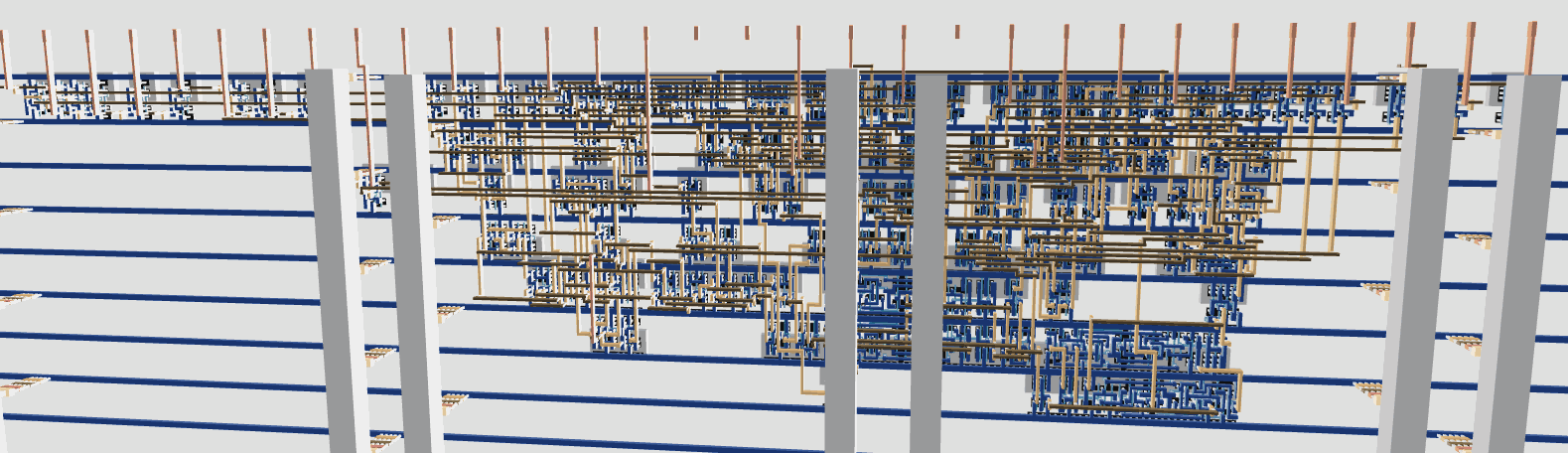
Design render

How it works

As the name "Universal Latch-based Shift Register" implies, it's a shift register based on individual latches. The first advantage of this asynchronous method is the need of only two input signals.

  • Instead of running on a single high-fanout clock pulse, there are two independent clock signals SD and SC with relaxed timing and fewer buffers.
  • Instead of using one DFF per bit, it is split into its Master and Slave latches

All the operations, like shifting one bit, require non-overlapping, alternating pulses on SD and SC. This takes care of any transient condition and glitches. Capture and Update require slightly more complicated sequences but still use only SD and SC. The only exception is RESET, which is performed with an overlapping sequence.

How fast does it run ?

I have no idea, it's all asynchronous magic. Short chains should reach 10 or 20MHz easily but since it's meant to be driven from some Arduino-style MCU through USB or a serial port, raw speed is not critical. The focus is on minimising any impact on the target circuit (surface, routing, power,...).

Architecture

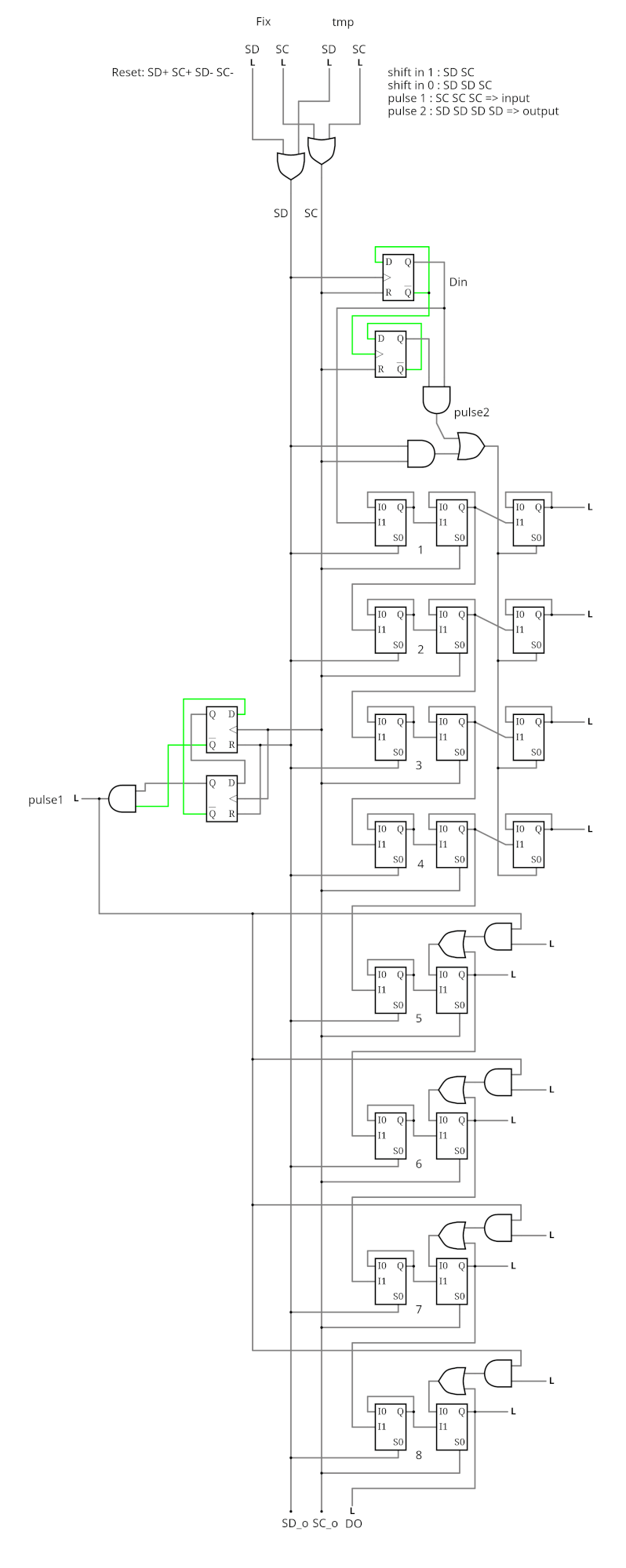
Below is an abridged diagram showing only 4 in and 4 out pins. Source : DTAP2-ULSR on Hackaday.io where transparent latches are replaced by back-fed MUX2 for simulation sake. There are 3 main stages :

  • data input generator (recreates the missing data in pin's value)
  • output block (somewhat merged with the previous block)
  • input block (with its own counter)

The actual implementation has 12 bits of depth, with the 4 middle ones being both inputs and outputs.
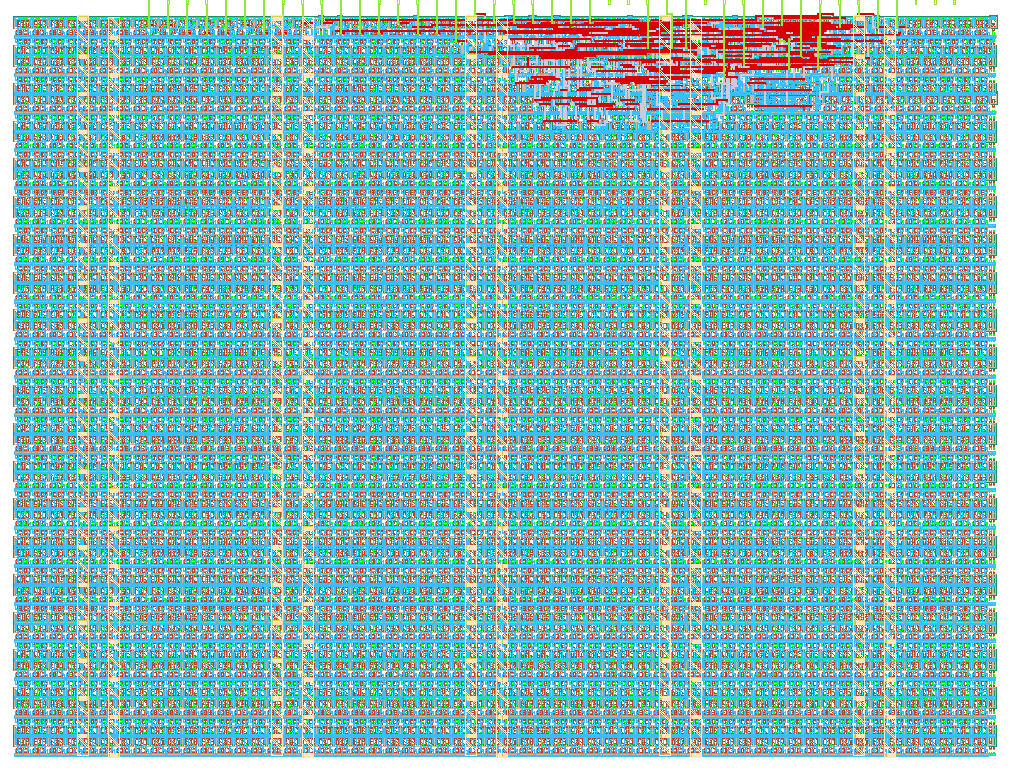
Structure

The input, output and inout stages are made from 2 or 3 latches, made from standard A21OI and A221OI cells. They are smaller than a DFF.

Cell usage

For 8 inputs and 8 outputs (including 4 combined in and out)

  •  a22oi a221oi a21oi : 66 (including one for the full adder, the rest for the bulk of the scan chain)
  •  buf : 35 (I never asked for them)
  •  inv : 4 (including one for the full adder)
  •  dfrbp : 4 (for the decoders/counters)
  •  xor2 : 2 (Full adder)
  •  and2 : 1 capture decoder.

Result:

Conclusion :  112 total cells (excluding fill and tap cells) And it's still bloated by the toolchain with

  • many unwanted buffers (added at the interface),
  • some "constant" cells (tiehi, tielow) for the io dir port and unused outputs,
  • some gates for the extra full adder...

But can you do something this compact with the JTAG standard? And since each bit/stage does not require absolute synchronism or a tight timing, the clock network is relaxed and each register uses less space than a standard DFF.

Asynchronous design

Asynchronous circuits are frowned upon and notoriously prone to weird errors. After all, synchronous designs are much easier to analyse and get right. However the latter relies on the asumption of a magically simultaneous clock pulse that arrives everywhere at the same time. The ULSR does not assume this, in particular to make implementation more convenient: no clock tree synthesis, saving power and area. The ULSR runs slower the JTAG and requires more timing margin, but that's only a fair compromise.

One consequence is that a clock signal can drive only one of the synchronous gates like DFF, which must be chained, like below. This lets the Place&Route tools optimise for density without consideration for timing. Since only one DFF gets a clock signal, the setup & hold only depends on the host toggling the SD and SC pins slow enough, though there is ample margin at 1Mbps.

Protocol

You can find these operations in the test/test.py script.

  • RESET is : set SD high, set SC high, set SD low, set SC low.
  • inject a '0' bit in the chain : pulse SD, pulse SD, pulse SC.
  • inject a '0' bit in the chain : pulse SD, pulse SC.
  • Capture : RESET then pulse SC 4 times
  • Update : pulse SD 4 times

A more elaborate protocol can be designed on top of this, for example: addressing specific registers by counting the number of bits injected. Let your imagination go wild!

How to test

Use some Arduino for example, and play with the SD/SC signals. About 1us between each bit toggle is a good ballpark. An Arduino sketch will be provided someday, transcribing the code in test/test.py

5 leftover pins are connected to a Full Adder that you can test it with the scan chain through external wires. Have fun injecting errors to see if the scan chain can detect them!

IO

#InputOutputBidirectional
0I0O0SD
1I1O1SC
2I2O2DO
3I3O3FA1
4I4O4FA2
5I5O5FA3
6I6O6FAS
7I7O7FAC

Chip location

Controller Mux Mux Mux Mux Mux Mux Mux Mux Mux Mux Analog Mux Mux Mux Mux Mux Mux Mux Mux tt_um_chip_rom (Chip ROM) tt_um_factory_test (Tiny Tapeout Factory Test) tt_um_ieee_LDO (LDO) tt_um_chip_ieee_analog (IEEE Bandgap Reference) tt_um_snn_voice_calculator_mauro_ciccone (snn-voice-calculator) tt_um_hx2003_delay (4 Channel - 32 Tap Programmable Delay with Delay Locked Loop Calibration) tt_um_adxl362_test (tt_um_adxl362_test) tt_um_larsnit_cfar (1D CA/GO/SO CFAR radar detector) tt_um_abeccari_swsynth (Sine Wave Synthesizer) tt_um_dpi_adexp (AdExp DPI Neuron ) tt_um_140oo041_fpu130 (FPU-130) tt_um_blonghi_uart (uart) tt_um_directsgg_mini_proceo_8bit (Mini 8-bit Processor) tt_um_umaece1982_lfsr (Low-Power LFSR-Based Test Pattern Generator) tt_um_deploy_timer (launch deployment timer) tt_um_urish_simon (Simon Says memory game) tt_um_nimelli_kinematic_wave_engine (Kinematic Wave Engine) tt_um_multi_seg_monitor (Multi Segment Monitor) tt_um_UART_TX (project) tt_um_crc8_lfsr (CRC-8 Serial LFSR) tt_um_tinynpu4 (TinyNPU4) tt_um_alu_bns (6-bit multi function ALU ( eldawly_V2) ) tt_um_echoworld424_tpv (Timing-Prediction Test Vehicle) tt_um_gyro_lockin (Laser Gyro Lock-in Readout Core) tt_um_josue_olivos_sar_adc (4-Bit Charge-Redistribution SAR ADC Controller) tt_um_flower (VGA Flower) tt_um_vperumal_l1_fabric (Scalable Banked L1 Memory Fabric for Edge AI) tt_um_preinception_top (Preinception: Simple Compute Accelerator) tt_um_italu (iTALU: Interactive Testable Arithmetic Logic Unit) tt_um_neuron (4-Input Signed Neuron / Perceptron) tt_um_4tap_mac (4-Tap Signed MAC Unit) tt_um_mac_engine (DSP MAC Engine) tt_um_crypto_led_demo (QAMER CryptoUART: Encrypted UART with LED Status) tt_um_layernorm (LayerNorm) tt_um_ez130_8t_mystery (EZ130 8T Mystery Circuit) tt_um_sent2spi (SENT Receiver with SPI Interface) tt_um_llr_hepiarisc (Hepiarisc with SPI flash) tt_um_rebeccargb_vga_pride (VGA Pride) tt_um_hasi_ising (Oscillator Ising Machine) tt_um_c061618g2 (Circuitli C061618G2) tt_um_tiny_dram_pim (Tiny Dual-Channel DRAM-PIM Controller + PU) tt_um_Tbilisi_CORDIC_Engine (Tbilisi CORDIC Engine) tt_um_rahulmascarenhas_folded_nn (Frozen ternary backbone + loadable head) tt_um_miniMAC (miniMAC_IHP26b) tt_um_rumcajs (IEEE DOORSH) tt_um_sg13g2_mystery (SG13G2 Mystery Circuit) tt_um_ULSR88 (ULSR demo) tt_um_ez130_7t_mystery (EZ130 7T Mystery Circuit) tt_um_tinyopt4 (ieee_tt_tinyopt4) tt_um_vga_example (IEEE VGA Animated Beach) tt_um_hyphen133_drone_detection (IEEE Acoustic Drone Detector) tt_um_nuatlabs_fifo_pwm (Async FIFO with CDC + PWM Peripheral) tt_um_nuatlabs_uart (8N1 UART Transceiver) tt_um_eeg_threshold_detector (IEEE Digital EEG Threshold Event Detector) tt_um_smart_traffic (Smart Traffic Light Controller) tt_um_94442024_mini_cpu (Mini 8-bit Accumulator CPU) tt_um_wokwi_475369131246576641 (IEEE_UPB_TT_1) tt_um_aion (AION) tt_um_rebeccargb_hardware_utf8 (Hardware UTF Encoder/Decoder) tt_um_rebeccargb_universal_decoder (Universal Binary to Segment Decoder) tt_um_rebeccargb_intercal_alu (INTERCAL ALU) tt_um_flappy_bird (IEEE Flappy Bird VGA Game) tt_um_oryan01_alu (ALU CASS PUCV) tt_um_S4xU4 (S4xU4) tt_um_vga_ca (Space CA) tt_um_llr_simplenpu (simple SPI flash streaming NPU) tt_um_pucv_pspwm (3LFCC PS-PWM Modulator) tt_um_yuri_fpga (Tiny FPGA) tt_um_mikailgedik_inverted_inverters (Inverted inverters) tt_um_esauqch_hamming74 (Hamming(7,4) encoder/decoder (IEEE)) tt_um_hackin7_analog_experiments (TinyAnalogExperiments) tt_um_snake (snake game) tt_um_mini_kraken (Kraken IO Subprocessor) tt_um_fabien_pio (AstraPIO) tt_um_chiplab (ChipLab) tt_um_wokwi_475490677474407425 (Tiny_Divider) tt_um_c061618g2tr (Circuitli C061618G2TR) tt_um_catalinlazar_nanopio (nanoPIO) tt_um_catalinlazar_uart_spi_i2c_bridge (UART-SPI-I2C Bridge) tt_um_enzonappi_sent_i2c (SENT to I2C bridge) tt_um_kush1434_proof (Proof) tt_um_schwallsunk_signal_discriminator (Highspeed voltage discriminator) tt_um_tiarinix_ttihp_verilog_template (8-bit educational SAP-style CPU) tt_um_vga_glyph_mode (BOOTCAMP) tt_um_GiulioGirelli_packet_processor (Configurable Low-Latency Match-Action Packet Processor) tt_um_vga_tictactoe (Tic Tac Toe) tt_um_vga_dvd_player (DVD player) tt_um_clea_katseye_rain (KATSEYE) tt_um_romd_uart_hello (UART Hello World) tt_um_vga_snake (CDM PYTHON GAME) tt_um_vga_slot_machine (tt_um_vga_slot_machine) tt_um_jet_seq8b (SEQ8 Programmable Sequencer) tt_um_kibo_leak_inspect (KIBO Leak-Inspection Target Controller (VGA)) tt_um_endless_runner (Endless Runner) tt_um_omega_infinity_kaoru (OMEGA INFINITY KAORU 3D Metal Grid Processor) tt_um_nikleberg_mixer (Mixer) tt_um_lahnb_sgdma (TinyDMA: A Descriptor-Based Dual-PSRAM Memory Mover) tt_um_gstj_lockin (Digital IQ Lock-in (IEEE)) tt_um_benpayne_ps2_decoder (PS/2 Keyboard Decoder for 68k) tt_um_cass_s_ui_neuron_lif (Neurona LIF con Aprendizaje STDP Dinamico (IEEE)) tt_um_vga_glyph_mode_CDM_Matrix (CDM Matrix) tt_um_qd39l_xor_stream (Fixed-ROM XOR Stream Engine) tt_um_conv3x3 (3x3 Clock Rate Streaming Input Convolution Engine) tt_um_mc14500b_soc_extended (MC14500B Extended 1-bit Microcontroller SoC) tt_um_vga_hypno_spiral (tt_um_vga_hypno_spiral) tt_um_mattizen_morse_tree (Morse Tree LED Decoder) tt_um_CDM (Colegio de Muntinlupa DVD-like Display) tt_um_romd_uart_loader (UART SPI RAM Loader) tt_um_TscherterJunior_stapel_geraet (stapel gerät) tt_um_das2225_dna_accel (DNA_Accel) tt_um_tinysoc (TinySoC) tt_um_barrel_shifter (Barrel Shifter) tt_um_approx_mac_coprocessor (Approximate DSP: Time-Multiplexed MAC Coprocessor) tt_um_joesagents_market_split_oracle (Market-split oracle) tt_um_mgpauly1458_ringmeter (Ring oscillator frequency meter) tt_um_pettit_prism_lite (PRISM with Risc-V (TinyQV) SoC) tt_um_workshop_cpu (IEEE Workshop Simple CPU) tt_um_algofoogle_analog_junk (Simple comparator + 2 DACs analog layout in a 1x1 tile) tt_um_lkhanh_cordic (TinyQV SoC (Dual Memory Backend)) tt_um_4x4npu (4x4NPU: Dual-Lane INT4 Neural Accelerator) tt_um_abiaselli_izh_bridge_3x2 (Izhikevich event bridge (4 contexts)) tt_um_fabulous_ihp_26b (Tiny FABulous FPGA) tt_um_zanderivo_voronoi (Four-Metric VGA Nearest-Prototype Visualizer)