425 4-Tap Signed MAC Unit
425 : 4-Tap Signed MAC Unit
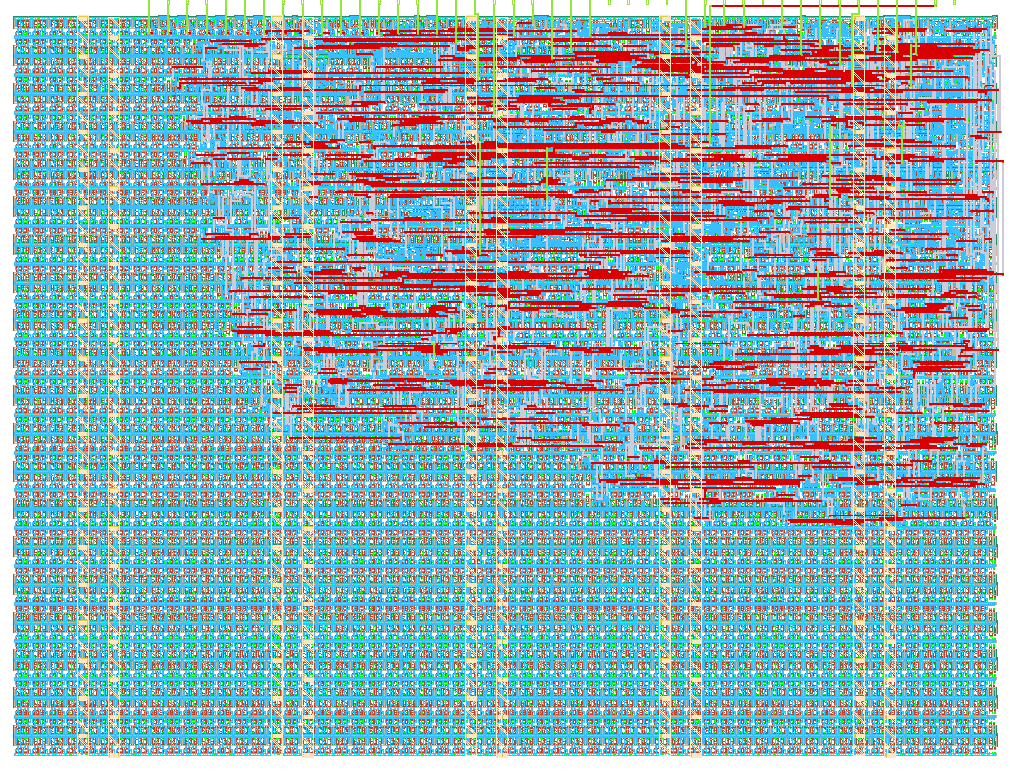
- Author: Mohammed Abdul Mujeeb
- Description: Four-tap signed multiply-accumulate unit for DSP and dot-product operations.
- GitHub repository
- Open in 3D viewer
- Open in Tiny Tapeout Explorer
- Clock: 50000000 Hz
How it works
The 4-Tap Signed MAC Unit performs four signed 4-bit multiplication operations and combines their results into a multiply-accumulate result.
The operation is:
Y = (W0 × X0) + (W1 × X1) + (W2 × X2) + (W3 × X3)
Four signed 4-bit weights and four signed 4-bit samples are stored internally. Each corresponding weight and sample are multiplied to produce an 8-bit signed product. The four products are then added together.
The design also supports a running accumulation mode. When ACCUMULATE is
asserted, the newly calculated MAC sum is added to the previously stored
accumulator value. Otherwise, the current MAC operation replaces the
accumulator value.
Input and control signals
| Pin | Function |
|---|---|
ui_in[1:0] |
Selects one of the four MAC taps |
ui_in[2] |
LOAD_WEIGHT — loads a weight into the selected tap |
ui_in[3] |
LOAD_SAMPLE — loads a sample into the selected tap |
ui_in[4] |
START_MAC — starts the MAC calculation |
ui_in[5] |
ACCUMULATE — adds the new result to the existing accumulator |
ui_in[6] |
CLEAR_ACC — clears the accumulator and result |
ui_in[7] |
Unused |
uio_in[3:0] |
Signed 4-bit data input |
uio_in[7:4] |
Unused |
The calculated result is available on uo_out[7:0]. The internal accumulator
is 12 bits wide, while the lower 8 bits are provided at the output.
The design uses an active-low reset through rst_n and operates
synchronously with the Tiny Tapeout clk input.
How to test
First apply reset to initialize the four weights, four samples, accumulator, and output.
Loading a weight
- Select the desired tap using
ui_in[1:0]. - Place the signed 4-bit weight on
uio_in[3:0]. - Assert
ui_in[2](LOAD_WEIGHT) for one clock cycle.
Loading a sample
- Select the desired tap using
ui_in[1:0]. - Place the signed 4-bit sample on
uio_in[3:0]. - Assert
ui_in[3](LOAD_SAMPLE) for one clock cycle.
Repeat these operations for all four taps.
After loading the weights and samples, assert ui_in[4] (START_MAC) to
perform the calculation.
For example:
Weights = [1, 2, 3, 4]
Samples = [1, -1, 2, -2]
The expected MAC result is:
(1 × 1) + (2 × -1) + (3 × 2) + (4 × -2)
= 1 - 2 + 6 - 8
= -3
The signed result -3 is represented in two's complement. Its lower 8 bits
can be observed on uo_out[7:0].
To perform another MAC operation while retaining the previous result, assert
ui_in[5] (ACCUMULATE). To clear the stored result before a new
calculation, assert ui_in[6] (CLEAR_ACC).
External hardware
No external hardware is required for simulation.
For a physical demonstration, the ui_in control signals and
uio_in[3:0] data bus can be driven by an FPGA, microcontroller, or other
digital controller.
The uo_out[7:0] bus can be connected to a logic analyzer or other digital
interface to observe the MAC result.
IO
| # | Input | Output | Bidirectional |
|---|---|---|---|
| 0 | TAP_SEL[0] | MAC_RESULT[0] | DATA_IN[0] |
| 1 | TAP_SEL[1] | MAC_RESULT[1] | DATA_IN[1] |
| 2 | LOAD_WEIGHT | MAC_RESULT[2] | DATA_IN[2] |
| 3 | LOAD_SAMPLE | MAC_RESULT[3] | DATA_IN[3] |
| 4 | START_MAC | MAC_RESULT[4] | UNUSED |
| 5 | ACCUMULATE | MAC_RESULT[5] | UNUSED |
| 6 | CLEAR_ACC | MAC_RESULT[6] | UNUSED |
| 7 | UNUSED | MAC_RESULT[7] | UNUSED |