460 LFSR-Based Stochastic Neuron
460 : LFSR-Based Stochastic Neuron
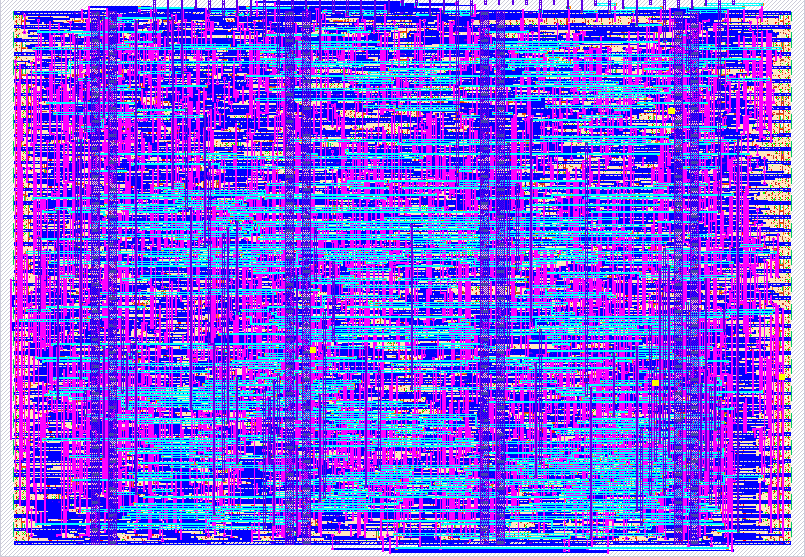
- Author: Prof. Santhosh Sivasubramani, IIT Delhi
- Description: Standalone stochastic neuron with configurable 16-bit LFSR, programmable sigmoid LUT, refractory period, and SPI interface for neuromorphic computing
- GitHub repository
- Open in 3D viewer
- Open in Tiny Tapeout Explorer
- Clock: 50000000 Hz
How it works
This design is a standalone stochastic leaky integrate-and-fire (sLIF) neuron with a 16-bit configurable-polynomial LFSR, an 8-entry programmable sigmoid activation LUT, a 16-bit leaky membrane accumulator, and a post-spike refractory period of 0–7 clock cycles. On every clock, the LFSR advances, the top 8 bits are compared against the sigmoid LUT output (indexed by a small slice of the membrane potential), and if the random number is below the activation value and the neuron is not in the refractory state, the input current (4-bit parallel weight_in plus an optional external ext_spike) is added to the accumulator. The accumulator also leaks by the 8-bit reg_decay each cycle. When the accumulator exceeds the 8-bit reg_threshold, spike_out asserts for one cycle, the accumulator resets, and the refractory counter loads with reg_ctrl[7:5] — suppressing further integration for that many cycles.
Two operating modes are supported: mode_sel=0 (parallel / free-run) runs the neuron under the hard input controls ext_spike (ui_in[0]), neuron_enable (ui_in[2]), and weight_in[3:0] (ui_in[7:4]); mode_sel=1 (SPI-controlled) moves the enable to the SPI reg_ctrl[0] bit and lets the user drive behavior entirely from the register file. A 16-bit SPI slave (Mode 0, MSB-first; CS=uio_in[0], MOSI=uio_in[1], MISO=uio_out[2], SCK=uio_in[3]) exposes the registers: reg_ctrl (0x00: [0]=enable, [1]=reset_accum, [2]=free_run, [7:5]=refractory_period), reg_poly_l/h (0x01/0x02 — 16-bit LFSR tap polynomial), reg_seed_l/h (0x03/0x04 — 16-bit seed loaded on write), reg_threshold (0x05), reg_decay (0x06), read-only reg_status (0x07: spike flag, overflow, refractory active), and an 8-entry programmable sigmoid LUT at 0x08–0x0F.
Outputs: spike_out on uo_out[0], LFSR MSB (lfsr[15], a cheap randomness monitor) on uo_out[1], accum_overflow (membrane == 16'hFFFF) on uo_out[2], threshold_flag (latched spike) on uo_out[3], and the top 4 bits of the membrane potential on uo_out[7:4] for on-chip / oscilloscope observation. Four debug taps are exposed on uio_out[7:4]: neuron_en, stoch_fire, lfsr[5], and lfsr[10].
How to test
- Apply reset (
rst_nlow, then release) and configure over SPI: write the LFSR polynomial (typically0x002Dfor a maximal-length 16-bit LFSR) to 0x01/0x02, a non-zero seed to 0x03/0x04, a threshold to 0x05 (e.g.0x80), a decay rate to 0x06 (e.g.0x01), andreg_ctrlwith the desired refractory period in[7:5](e.g.0x41= enable + 2-cycle refractory). - (Optional) Program the sigmoid LUT at 0x08–0x0F. The default curve provides a reasonable S-shape.
- For parallel mode (
mode_sel=0,ui_in[1]=0): driveneuron_enable=1onui_in[2]and present a 4-bit weight onui_in[7:4]; optionally pulseext_spikeonui_in[0]. - For SPI mode (
mode_sel=1): enable viareg_ctrl[0]=1; the neuron integrates internal state even without external signals. - Monitor
spike_out(uo_out[0]), readreg_status(0x07) for current flags, and observe the membrane MSBs onuo_out[7:4]as a slow analog-like signal. - To induce faster firing, either raise the input weight, lower the threshold (0x05), or lower the LUT values (which raises the probability the random number is below them).
A cocotb suite (18 tests in test/test.py) covers reset, SPI register roundtrip, LFSR polynomial and seed programming, LUT writes, threshold crossing, membrane leak/decay, refractory-period enforcement, overflow flagging, and uio_oe direction control. All tests pass in RTL and post-synthesis gate-level simulation.
External hardware
An SPI master (microcontroller or FPGA) on uio[0:3] is needed to configure the polynomial, seed, threshold, decay rate, refractory period, and LUT. An external spike source may drive ui_in[0] (ext_spike), and any 4-bit signal (e.g. a DAC digital word representing a pre-synaptic input or a small parallel bus) can drive ui_in[7:4] as the weight input. spike_out on uo_out[0] is the single-bit event output that feeds a downstream synapse, router, or counter; the membrane-MSB bus on uo_out[7:4] can be inspected directly or fed into an ADC/scope for state-of-health monitoring.
IO
| # | Input | Output | Bidirectional |
|---|---|---|---|
| 0 | ext_spike_in | spike_out | spi_cs_n |
| 1 | mode_sel | lfsr_msb | spi_mosi |
| 2 | neuron_enable | accum_overflow | spi_miso |
| 3 | threshold_flag | spi_sck | |
| 4 | weight_in[0] | membrane[12] | debug_neuron_en |
| 5 | weight_in[1] | membrane[13] | debug_stoch_fire |
| 6 | weight_in[2] | membrane[14] | debug_lfsr5 |
| 7 | weight_in[3] | membrane[15] | debug_lfsr10 |