747 ASAP CPU v2
747 : ASAP CPU v2
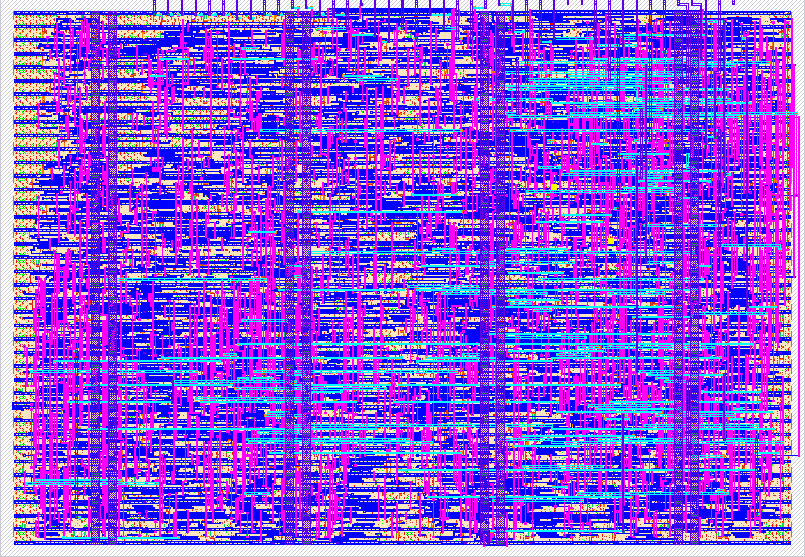
- Author: Aaron Libokuohai Bovensiepen
- Description: A SAP-1 inspired CPU
- GitHub repository
- Open in 3D viewer
- Open in Tiny Tapeout Explorer
- Clock: 1000000 Hz
How it works
ASAP CPU v2 is a SAP-1-style 8-bit computer, in the spirit of Ben Eater's breadboard CPU. It contains:
- a 4-bit program counter (
pc.v), - a 4-bit memory address register (
mar.v), - a 16 x 8 RAM (
ram.v), - an 8-bit instruction register (
ir.v), - an A and a B register (
register.v), - an 8-bit adder/subtractor ALU (
alu.v), - an 8-bit output register (
out_reg.v), - a 3-digit decimal 7-segment display driver (
display.v), - and a hard-wired control unit (
controller.v) driven by a 6-step T-state ring counter.
All blocks exchange data over a single 8-bit bus (a priority mux in
project.v — no internal tri-states). Every instruction runs in 6 clock
cycles: T0–T1 fetch the instruction (MAR ← PC, then IR ← RAM[MAR] and
PC ← PC+1), T2… execute, and any leftover steps are NOPs.
Instruction set
Each RAM byte is an instruction: opcode in bits [7:4], a 4-bit RAM address in
bits [3:0].
| Opcode | Mnemonic | Operation |
|---|---|---|
0x0 |
LDA n |
A ← RAM[n] |
0x1 |
ADD n |
A ← A + RAM[n] |
0x2 |
SUB n |
A ← A − RAM[n] |
0xE |
OUT |
OUT register ← A |
0xF |
HLT |
stop the CPU |
Any other opcode behaves as a NOP. HLT latches the CPU into a halted state
until reset; the display keeps refreshing.
Output / display
The OUT register is shown as a decimal number (0–255) across three discrete
single-digit 7-segment displays — three separate parts, not one 3-digit
module. display.v converts the value to BCD (double-dabble) and time-
multiplexes the digits over a shared segment bus:
uo[6:0]— segment linesa…g, wired in parallel to all three displays, active high (uo[0]=a= "SEG 1", …,uo[6]=g= "SEG 7").uo[7]— digit select 1 → the ones display, active high.uio[0]— digit select 2 → the tens display, active high.uio[1]— digit select 3 → the hundreds display, active high.
Exactly one digit-select line is high at a time and it advances every clock, so
at the rated 1 MHz all three displays look rock-steady. (uio_oe is 0x03:
only uio[1:0] are driven as outputs.)
Programming the RAM
uio[6] is the mode pin: 0 = RUN, 1 = PROGRAM.
- In PROGRAM mode the CPU is frozen after the mode input has passed through
its synchronizer. The RAM is written from the pins:
uio[5:2]is the address,ui[7:0]is the data byte, and the synchronized rising edge ofuio[7]writesRAM[uio[5:2]] ← ui[7:0]. Hold address and data stable for at least two clock cycles before raisinguio[7]and until at least one clock after lowering it. - In RUN mode synchronized
uio[7]is a reset (clears the PC and registers; RAM keeps its contents). The externalrst_npin asynchronously resets the CPU/display state in either mode.
How to test
- Hold
uio[6] = 1(PROGRAM mode), pulserst_nlow then high. - For each program byte: put the address on
uio[5:2]and the data onui[7:0], wait at least two clock cycles, raiseuio[7], wait at least two clock cycles, then loweruio[7]. - Set
uio[6] = 0(RUN mode), wait at least two clock cycles, and pulseuio[7]high then low — this resets the PC to 0 and the CPU starts running. - Clock the design and watch the result on the 7-segment displays.
Example: program LDA 14 ; ADD 15 ; OUT ; HLT at addresses 0–3, with
RAM[14] = 5 and RAM[15] = 3. After ~24 clocks the display reads 008.
The cocotb testbench in test/ exercises exactly this kind of sequence
(add, subtract, chained add, and that HLT freezes the output).
External hardware
Three single-digit common-cathode 7-segment displays (three separate parts, not
one 3-digit module). Wire the seven segment lines uo[6:0] to the matching
segment pins (a…g) of all three displays in parallel. Route each display's
common-cathode pin to ground through a low-side NPN transistor whose base is
driven by that display's select line: uo[7] for the ones digit, uio[0] for
tens, uio[1] for hundreds. Segments and selects are active high — if your
displays are common-anode, invert the segment and select lines instead. With no
external hardware you can still watch the multiplexed segment pattern on the
GPIO, or wire plain LEDs. To drive the program-mode inputs you also need eight
data switches (ui[7:0]), four address switches (uio[5:2]), and the mode /
write-reset switches (uio[6], uio[7]).
IO
| # | Input | Output | Bidirectional |
|---|---|---|---|
| 0 | RAM BIT 1 | SEG 1 | SEG SELECT 2 (OUT) |
| 1 | RAM BIT 2 | SEG 2 | SEG SELECT 3 (OUT) |
| 2 | RAM BIT 3 | SEG 3 | ADDRESS BIT 1 (IN) |
| 3 | RAM BIT 4 | SEG 4 | ADDRESS BIT 2 (IN) |
| 4 | RAM BIT 5 | SEG 5 | ADDRESS BIT 3 (IN) |
| 5 | RAM BIT 6 | SEG 6 | ADDRESS BIT 4 (IN) |
| 6 | RAM BIT 7 | SEG 7 | MODE (0 = RUN, 1 = PROGRAM) (IN) |
| 7 | RAM BIT 8 | SEG SELECT 1 | WRITE[PROGRAM MODE] | RESET[RUN MODE] (IN) |