896 CFAR Detector without Buzzer
896 : CFAR Detector without Buzzer
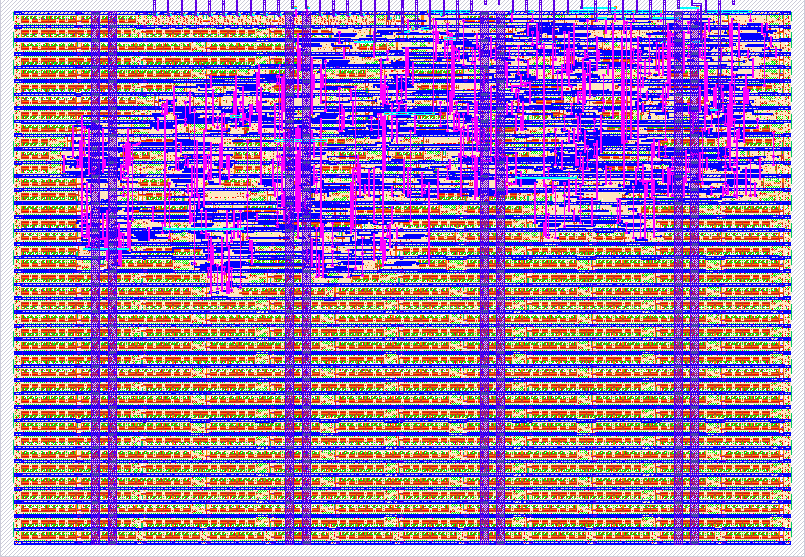
- Author: Ilamparuthi G
- Description: A simplified CFAR-based signal detection system using 14-bit ADC input and 7-segment display output.
- GitHub repository
- Open in 3D viewer
- Open in Tiny Tapeout Explorer
- Clock: 10000000 Hz
How it works
This project implements a hardware-efficient Constant False Alarm Rate (CFAR) signal detection engine, optimized for area-constrained silicon footprints. It processes a 14-bit digital input to dynamically adapt to varying noise floors and detect valid target signals.
Input Mapping: To bypass the standard 8-pin input limit, the design concatenates standard inputs with bidirectional pins configured as inputs:
ui_in[7:0]: Lower 8 bits of the incoming signal.uio_in[5:0]: Upper 6 bits of the incoming signal (uio_oe= 0).- These combine to form a unified 14-bit data bus (
{uio_in[5:0], ui_in[7:0]}).
CFAR Architecture: Instead of a memory-heavy sliding window, this design utilizes an Infinite Impulse Response (IIR) running average to estimate the background noise threshold.
- The baseline threshold continually updates:
threshold = (threshold + signal) >> 1. - A target is detected if the incoming signal exceeds this adaptive threshold multiplied by a fixed internal gain factor.
- The resulting binary state is routed directly to a built-in 7-segment display driver, providing immediate visual feedback alongside a dedicated high/low output flag (
uo_out[7]).
How to test
-
Initialization:
- Provide a standard clock signal to
clk. - Assert reset (
rst_n = 0) to clear the internal threshold registers. - Release reset (
rst_n = 1) to begin normal operation.
- Provide a standard clock signal to
-
Baseline / Noise Floor Test (No Detection):
- Apply a steady, low-level signal (e.g.,
ui_in = 50,uio_in = 0). - Expected Result: The threshold adapts to the noise floor. The 7-segment display shows
0and the detection flag (uo_out[7]) remains0.
- Apply a steady, low-level signal (e.g.,
-
Target Detection Test (Spike):
- Inject a sudden signal spike (e.g.,
ui_in = 250,uio_in = 0). - Expected Result: The signal abruptly exceeds the calculated
threshold * GAINcondition. The 7-segment display immediately updates to1and the detection flag (uo_out[7]) goes HIGH (1).
- Inject a sudden signal spike (e.g.,
External hardware
- 14-bit Signal Source: An external Analog-to-Digital Converter (ADC) or a microcontroller (e.g., Raspberry Pi Pico on the Tiny Tapeout demo board) to generate the input vectors.
- 7-Segment Display: The standard Tiny Tapeout PCB display to visualize the detection state.
(Note: To maximize pin availability for the 14-bit data bus, no additional external peripherals, such as buzzers, are used).
IO
| # | Input | Output | Bidirectional |
|---|---|---|---|
| 0 | ADC bit 0 | 7-seg a | ADC bit 8 |
| 1 | ADC bit 1 | 7-seg b | ADC bit 9 |
| 2 | ADC bit 2 | 7-seg c | ADC bit 10 |
| 3 | ADC bit 3 | 7-seg d | ADC bit 11 |
| 4 | ADC bit 4 | 7-seg e | ADC bit 12 |
| 5 | ADC bit 5 | 7-seg f | ADC bit 13 |
| 6 | ADC bit 6 | 7-seg g | unused |
| 7 | ADC bit 7 | Detection output | unused |