46 TinyQV Wishbone SoC
46 : TinyQV Wishbone SoC
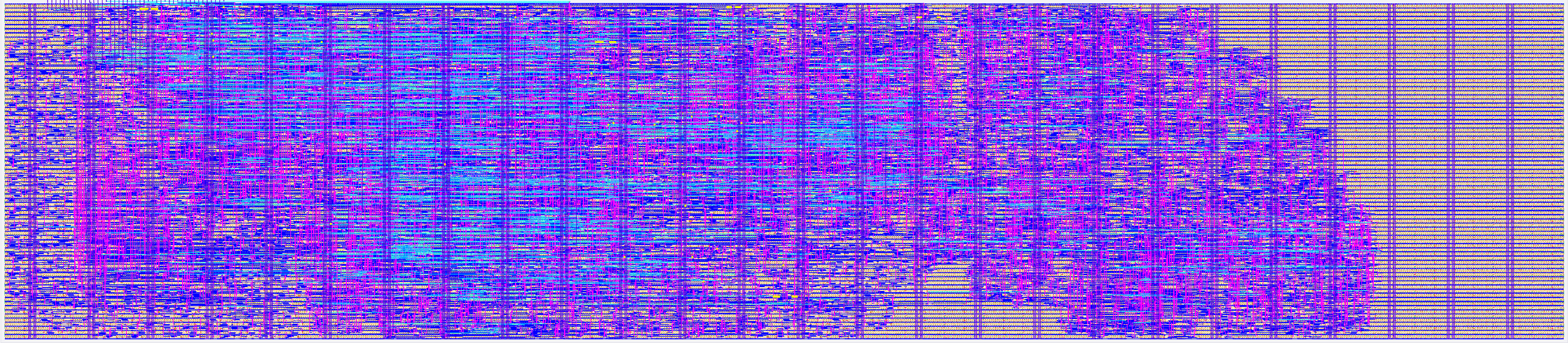
- Author: TSARKA
- Description: TinyQV RISC-V SoC with Wishbone UART16550/GPIO and exposed debug signals
- GitHub repository
- Open in 3D viewer
- Open in Tiny Tapeout Explorer
- Clock: 40000000 Hz
How it works
This project is a TinyQV RISC-V SoC wrapped for Tiny Tapeout with a Wishbone interconnect.
Main blocks:
- TinyQV CPU core and memory controller (
TinyQV/*) - Wishbone bridge (
TinyQV/wb_bridge.v) from CPU data bus to peripherals - GPIO8 peripheral on Wishbone (
Peripherals/GPIO/*) - UART16550 peripheral on Wishbone (
Peripherals/UART16550/*)
The top-level module is tt_um_TSARKA_TinyQV in src/project.v.
Top-level pin behavior:
ui[7]is the UART RX input.uio[7:0]carry the QSPI flash/RAM interface.uo[0]always mirrors UART TX.ui[0]selects the visibleuo[7:1]bank:0:uo[7:1]showgpio_out[7:1]1:uo[7:2]show fixed debug/status signals anduo[1]shows one selected debug probe
ui[4:1]select which debug probe is driven ontouo[1]while still feeding the GPIO input peripheral.ui[1:0]also act as the external interrupt request inputs consumed by the core.
Debug-mode output map:
uo[7]=interrupt_pendinguo[6]=data_readyuo[5]=fetch_restartuo[4]=branchuo[3]=instr_readyuo[2]=instr_completeuo[1]=debug_bus[ui[4:1]]uo[0]=uart_tx
The 16-entry selectable debug probe bus is:
0:instr_complete1:instr_ready2:instr_valid3:fetch_restart4:data_ready5:interrupt_pending6:branch7:gpio_irq8:early_branch9:ret10:reg_wen11:counter_012:data_continue13:stall_txn14:stop_txn15:uart_irq
Clocking:
- Project clock is configured for 40 MHz (
clock_hz: 40000000ininfo.yaml). - TinyTapeout hardening timing is aligned to this (
CLOCK_PERIOD: 25ns insrc/config.json). - The project footprint is configured as a
6x2Tiny Tapeout macro because the full TinyQV + Wishbone + UART16550 + GPIO SoC does not fit in a single tile.
How to test
Run RTL verification locally with cocotb + Icarus:
python3 -m venv test/.venv
. test/.venv/bin/activate
pip install -r test/requirements.txt
make firmware
make test-golden
make test-rtl
make test-comprehensive
make synth-gate-netlist
make test-gatelevel-smoke
make test-gatelevel
Current tests cover:
- Golden-model unit checks for the Wishbone bridge, GPIO model, and UART model
- Fast DUT-facing RTL smoke for reset ownership, QSPI chip-select exclusivity, output muxing, debug selector truth-table, and UART mirroring
- Manual QSPI instruction regressions for randomized ALU behavior, register load/store, peripheral interleave, timer interrupt entry, and external IRQ entry
- Firmware-backed QSPI boot tests for GPIO, UART hello/prime output, loopback, timer, and IRQ handling
- Gate-level regressions that reuse the same behavioral QSPI model against either a synthesized sky130 netlist or the final Tiny Tapeout/OpenLane netlist
- A deep gate-level signoff suite with explicit flash/protocol checks at latency
1/2/3, fixed-seed randomized ALU and memory stress, and full-program firmware sweeps on the stable lower latencies
Useful verification targets:
make test-firmware
make stage-gate-netlist
make test-gatelevel
make test-rtl-seeds
make test-comprehensive-seeds
make test-firmware-seeds
make test-gatelevel-smoke
make test-gatelevel-smoke-seeds
Notes:
make test-gatelevel-smokeis the quick local confidence pass.make test-gatelevelis the deeper signoff-oriented pass and is intentionally much slower.- The Tiny Tapeout
gdsgl_testjob is intended to exercise the deep signoff-style gate-level flow, not only the smoke checks.
CI signoff is wired through repo-level targets in Makefile and the workflow files under .github/workflows/.
External hardware
Optional external hardware for bring-up/demo:
- USB-UART bridge connected to:
ui[7]as UART RX input to SoCuo[0]as UART TX output from SoC
- QSPI flash / RAM connected to
uio[7:0]pins as documented ininfo.yamlpinout. - Optional GPIO consumers on
ui[7:0]/uo[7:0]. - A switch or jumper on
ui[0]to flip between GPIO view and debug view onuo[7:1]. - Optional four-bit selector on
ui[4:1]to step through the 16 debug probes exposed onuo[1]in debug mode.
IO
| # | Input | Output | Bidirectional |
|---|---|---|---|
| 0 | GPIO IN[0] / ext IRQ0 / uo mode select (0=GPIO, 1=debug) | UART TX (always) | QSPI Flash CS |
| 1 | GPIO IN[1] / ext IRQ1 / debug probe select bit 0 | GPIO OUT[1] / selected debug probe in debug mode | QSPI SD0 |
| 2 | GPIO IN[2] / debug probe select bit 1 | GPIO OUT[2] / DEBUG instr_complete | QSPI SD1 |
| 3 | GPIO IN[3] / debug probe select bit 2 | GPIO OUT[3] / DEBUG instr_ready | QSPI SCK |
| 4 | GPIO IN[4] / debug probe select bit 3 | GPIO OUT[4] / DEBUG branch | QSPI SD2 |
| 5 | GPIO IN[5] | GPIO OUT[5] / DEBUG fetch_restart | QSPI SD3 |
| 6 | GPIO IN[6] | GPIO OUT[6] / DEBUG data_ready | QSPI RAM A CS |
| 7 | GPIO IN[7] / UART RX | GPIO OUT[7] / DEBUG interrupt_pending | QSPI RAM B CS |