100 Neuromorphic PUF (distinct-tap LFSR arbiter + memristor XOR, GF180)
100 : Neuromorphic PUF (distinct-tap LFSR arbiter + memristor XOR, GF180)
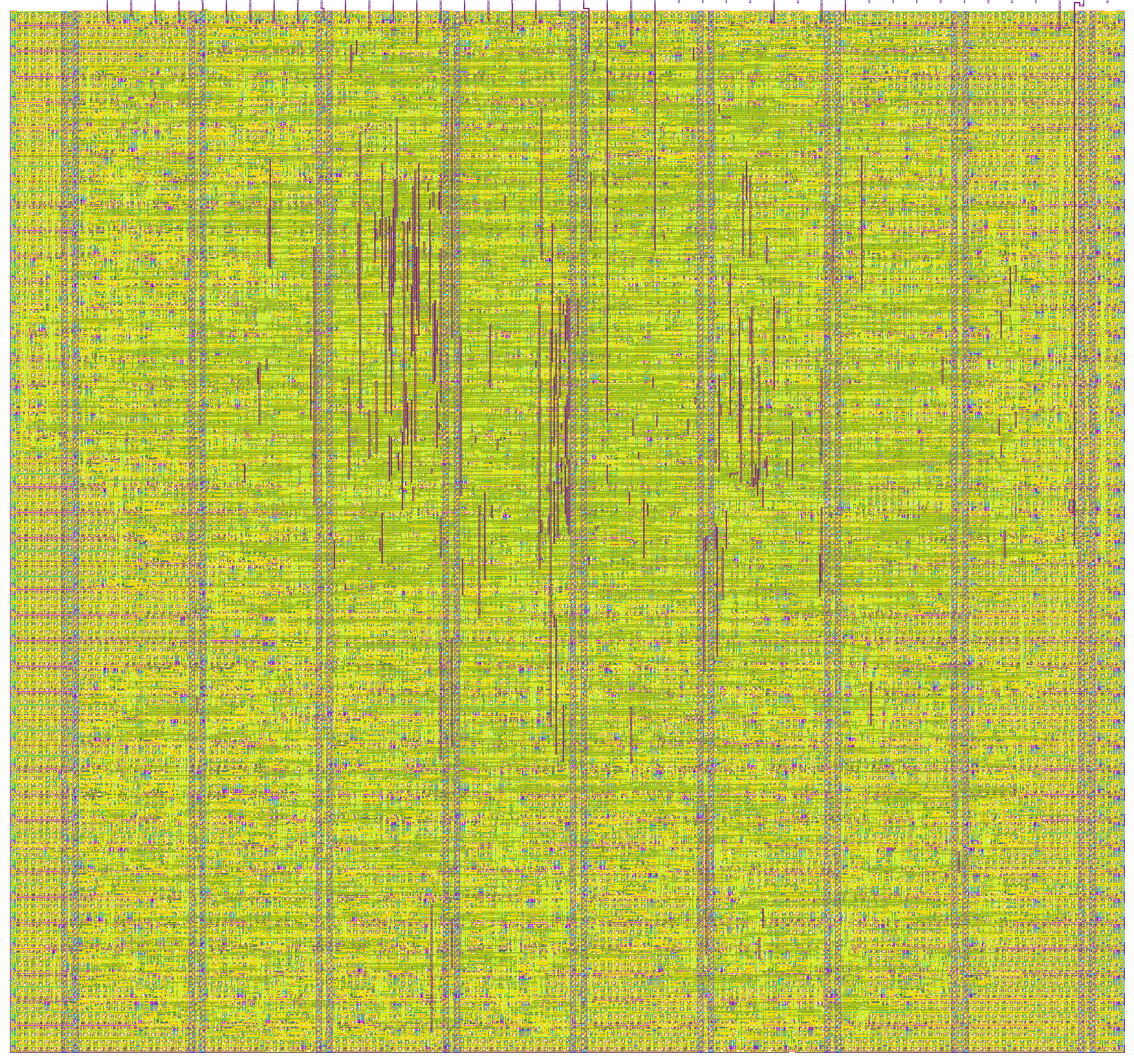
- Author: Prof. Santhosh Sivasubramani, IIT Delhi
- Description: GF180mcuD digital Physical Unclonable Function: 8 distinct-tap maximal-length 10-bit LFSRs act as synthesizable virtual ring-oscillators, a 6-bit challenge selects a pair, and an arbiter FSM compares their popcounts over a programmable 2^N-cycle window (N in 4..12) to produce a response bit. 64 challenges accumulate into a 64-bit response that can be XORed with a host-loaded memristor vector for dual-entropy mode. SPI-programmable, IRQ output, 25 MHz signoff clock, 1x2 tile (upsized from 1x1: global-placement utilization 103.6% on 1x1).
- GitHub repository
- Open in 3D viewer
- Open in Tiny Tapeout Explorer
- Clock: 25000000 Hz
How it works
A compact digital Physical Unclonable Function (PUF) for TinyTapeout GF 26a that derives a 64-bit device-unique signature by running an arbiter between eight distinct-tap maximal-length LFSRs and optionally XORing the result with a host-loaded 64-bit "memristor vector" for dual-entropy mode.
Because free-running combinational ring oscillators are rejected by the standard-cell ASIC flow (Yosys logic-loop check), this design replaces them with eight clocked 10-bit LFSRs, each with a distinct maximal-length tap polynomial. Their output bits have data-dependent popcounts over a given window, giving the challenge-response asymmetry of an RO-PUF without the non-synthesizable feedback loop.
Architecture
  +----------+   +------+
  | LFSR_0   |-->|      |
  |  taps    |   |  8:1 |  bit_a --+     +---------+
  |  {9,6}   |   | mux  |          |     |         |
  +----------+   |      |          +---->| counter |---> cnt_a
       :        |      |                |   A     |
  +----------+  |      |                +---------+
  | LFSR_7   |->|      |                                   +-----+
  | {9,8,5,2}|   +------+                                   |cmp  |-> resp_bit
  +----------+       ^                                      | >   |
                     |                                      +-----+
                +----+----+  idx_a = challenge[5:3]             ^
                | challenge|  idx_b = challenge[2:0]             |
                +---+------+                                    |
                    |  bit_b --+     +---------+                |
                    +--------->| counter |----> cnt_b -----------+
                               |   B     |
                               +---------+

  Every 2^N cycles (N in 4..12) one response bit is latched into resp[63:0]
  at position `challenge`. Optional XOR with mem_vec[63:0] for dual-entropy.
LFSR taps (all maximal-length, Xilinx XAPP052)
| LFSR | Taps | Seed |
|---|---|---|
| 0 | {9, 6} | 0x001 |
| 1 | {9, 5} | 0x002 |
| 2 | {9, 4} | 0x004 |
| 3 | {9, 2} | 0x008 |
| 4 | {9, 7, 6, 5} | 0x010 |
| 5 | {9, 8, 7, 4} | 0x020 |
| 6 | {9, 8, 6, 3} | 0x040 |
| 7 | {9, 8, 5, 2} | 0x080 |
SPI register map (16-bit frame, mode-0, MSB first)
| Addr | Name | Description |
|---|---|---|
| 0x00 | R_CTRL | {irq_en, —, —, clear_resp, mem_xor_en, —, start, global_en} |
| 0x01 | R_CHAL | 6-bit current challenge (idx_a = [5:3], idx_b = [2:0]) |
| 0x02 | R_CYCLES | {—, —, —, run_sweep, cyc_exp[3:0]} — effective exp clamped 4..12 |
| 0x03 | R_CHAL_MAX | 6-bit max challenges in sweep (1..64) |
| 0x04..0x0B | R_RESP0..7 | 64-bit response (LSB byte at 0x04) |
| 0x0C..0x13 | R_MVEC0..7 | 64-bit memristor vector (host write) |
| 0x1E | R_STATUS | {busy, done_sticky, irq_sticky, …} |
| 0x1F | R_CHAL_IDX | current challenge index within the sweep |
| 0x20 | R_W1C | write 1<<6 to clear done, 1<<5 to clear irq |
Degenerate challenges
Challenges where idx_a == idx_b (8 of the 64: 0x00, 0x09, 0x12, 0x1B, 0x24, 0x2D, 0x36, 0x3F) would always produce cnt_a == cnt_b and thus a
deterministic response bit of 0 — useless for PUF entropy. The arbiter
substitutes the corresponding mem_vec bit instead, so the host can either
skip these positions (treat them as the loaded fingerprint) or dual-entropy
them by setting mem_xor_en=1.
Pinout
ui_in[7:0]— reserved (tied off)uo_out[7:0]— live mirror ofresp[0](low byte of response)uio[0..3]— SPI (cs_n, mosi, miso, sck)uio[4]— busyuio[5]— done (sticky)uio[6]— irq (sticky)uio[7]— reserved
How to test
# generate response
spi_write(R_CYCLES, 0x14)         # run_sweep=1, cyc_exp=4 (16 cycles/chal)
spi_write(R_CHAL_MAX, 64)
spi_write(R_CTRL, 0x03)           # global_en=1, start=1
wait (status.done == 1)
read R_RESP0..R_RESP7             # 64-bit PUF response
spi_write(R_W1C, 0x40)            # clear done
Apply a mem_vec and retry with R_CTRL = 0x0B (global_en + start + mem_xor_en)
to fold in the host-supplied entropy.
External hardware
None required. The PUF derives its entropy from the LFSR arithmetic; the
mem_vec input lets an external memristor / OTP array or MCU contribute
additional entropy through normal SPI writes.
IO
| # | Input | Output | Bidirectional |
|---|---|---|---|
| 0 | reserved (tied-off, available for future memristor-byte live override) | resp[0][0] (live mirror of R_RESP0 bit 0) | spi_cs_n |
| 1 | reserved | resp[0][1] | spi_mosi |
| 2 | reserved | resp[0][2] | spi_miso |
| 3 | reserved | resp[0][3] | spi_sck |
| 4 | reserved | resp[0][4] | busy (out) |
| 5 | reserved | resp[0][5] | done (out, sticky) |
| 6 | reserved | resp[0][6] | irq (out, sticky) |
| 7 | reserved | resp[0][7] | reserved (driven low) |