355 CORDIC sin/cos generator
355 : CORDIC sin/cos generator
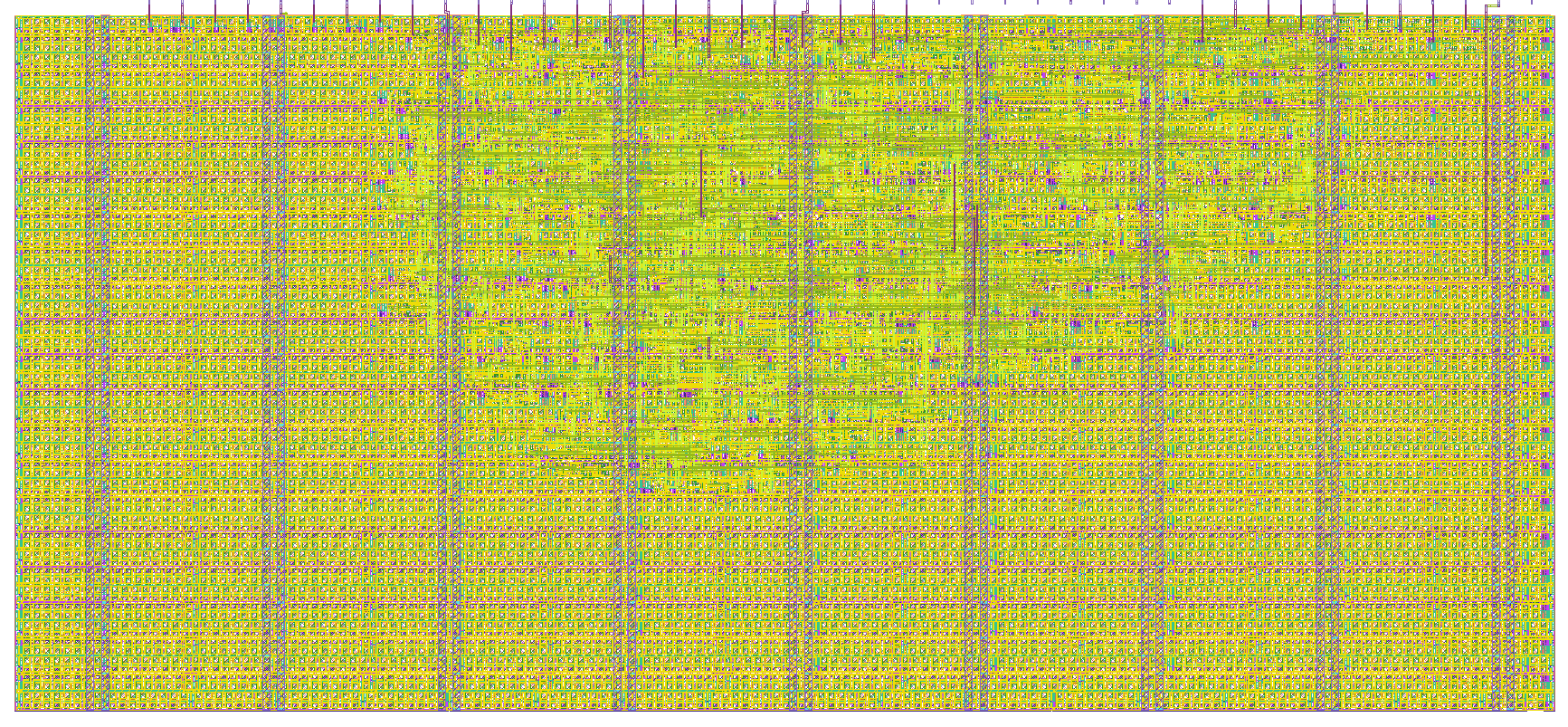
- Author: Jacques Te
- Description: Computes the sine and cosine of an 8-bit input angle using an iterative 8-stage CORDIC algorithm in Q2.6 fixed-point.
- GitHub repository
- Open in 3D viewer
- Open in Tiny Tapeout Explorer
- Clock: 50000000 Hz
How it works
This project computes the sine and cosine of an input angle using an iterative CORDIC (COordinate Rotation DIgital Computer) algorithm.
The angle is supplied as a 7-bit value on ui[6:0], where 0–127 maps linearly to
0°–360° (so each step is 360 / 128 ≈ 2.81°). Asserting start on ui[7] begins a
computation.
Internally the design works in Q2.6 fixed-point (8-bit two's-complement, where
1.0 = 64 = 0x40):
- Quadrant fold — the angle is reduced to the first quadrant (0°–90°), and per-quadrant sign flags are recorded so the result can be reflected back into the correct quadrant.
- Rotation — a vector is pre-scaled by the CORDIC gain (
1/K ≈ 0.607) and rotated through 8 fixed micro-rotations ofarctan(2^-i), each taken from a small lookup table. A small FSM (IDLE → LOAD → 8× COMPUTE → DONE) sequences the iterations; each iteration drives a residual-angle accumulator toward zero while the vector's X and Y components converge tocosandsin. - Sign correction — the recorded quadrant flags are applied, producing the final signed
sinandcos.
A result is ready roughly 11 clock cycles after start is asserted. start is a level:
hold it high to recompute continuously, release it to freeze and hold the last result.
The outputs are 8-bit two's-complement Q2.6 values:
| Raw (hex) | Decimal | Real value |
|---|---|---|
0x40 |
+64 | +1.0 |
0x00 |
0 | 0.0 |
0xC0 |
−64 | −1.0 |
(Convert any output to its real value with raw / 64.)
sin appears on uo[7:0], cos on uio[7:0] (the bidirectional pins, configured as outputs).
How to test
- Put a 7-bit angle on
ui[6:0](0–127 = 0°–360°). - Drive
start(ui[7]) high to trigger a computation, then low to latch the result. - After ~11 clock cycles, read
sinonuo[7:0]andcosonuio[7:0]. Interpret both as signed Q2.6 (value = raw / 64).
Example angles (input code → angle → expected outputs):
ui[6:0] |
Angle | sin (uo) |
cos (uio) |
|---|---|---|---|
| 0 | 0° | 0x00 (0) |
0x40 (+1.0) |
| 16 | 45° | 0x2E (≈0.72) |
0x2C (≈0.69) |
| 32 | 90° | 0x41 (≈+1.0) |
0x01 (≈0) |
| 64 | 180° | 0x00 (≈0) |
0xC0 (−1.0) |
| 96 | 270° | 0xBF (≈−1.0) |
0x01 (≈0) |
Outputs are within ±a few LSB of the ideal due to the 8-iteration, 8-bit fixed-point
approximation. The included cocotb test (test/test.py) sweeps all 128 angles and checks
them bit-exactly against a golden CORDIC model.
External hardware
No external hardware is required to drive the design — the angle and start come from the
demo board's input switches.
To view the outputs:
sinis onuo[7:0], which drives the demo board's 8 on-board LEDs directly.cosis onuio[7:0](the bidirectional/PMOD pins). To see it, attach an 8-bit LED PMOD (or any 8-LED breakout) to theuioheader. This is optional —cosis still readable via the RP2040/test harness without it.
IO
| # | Input | Output | Bidirectional |
|---|---|---|---|
| 0 | angle[0] | sin[0] | cos[0] |
| 1 | angle[1] | sin[1] | cos[1] |
| 2 | angle[2] | sin[2] | cos[2] |
| 3 | angle[3] | sin[3] | cos[3] |
| 4 | angle[4] | sin[4] | cos[4] |
| 5 | angle[5] | sin[5] | cos[5] |
| 6 | angle[6] | sin[6] | cos[6] |
| 7 | start | sin[7] | cos[7] |