485 Hardware Anomaly Detection

485 : Hardware Anomaly Detection
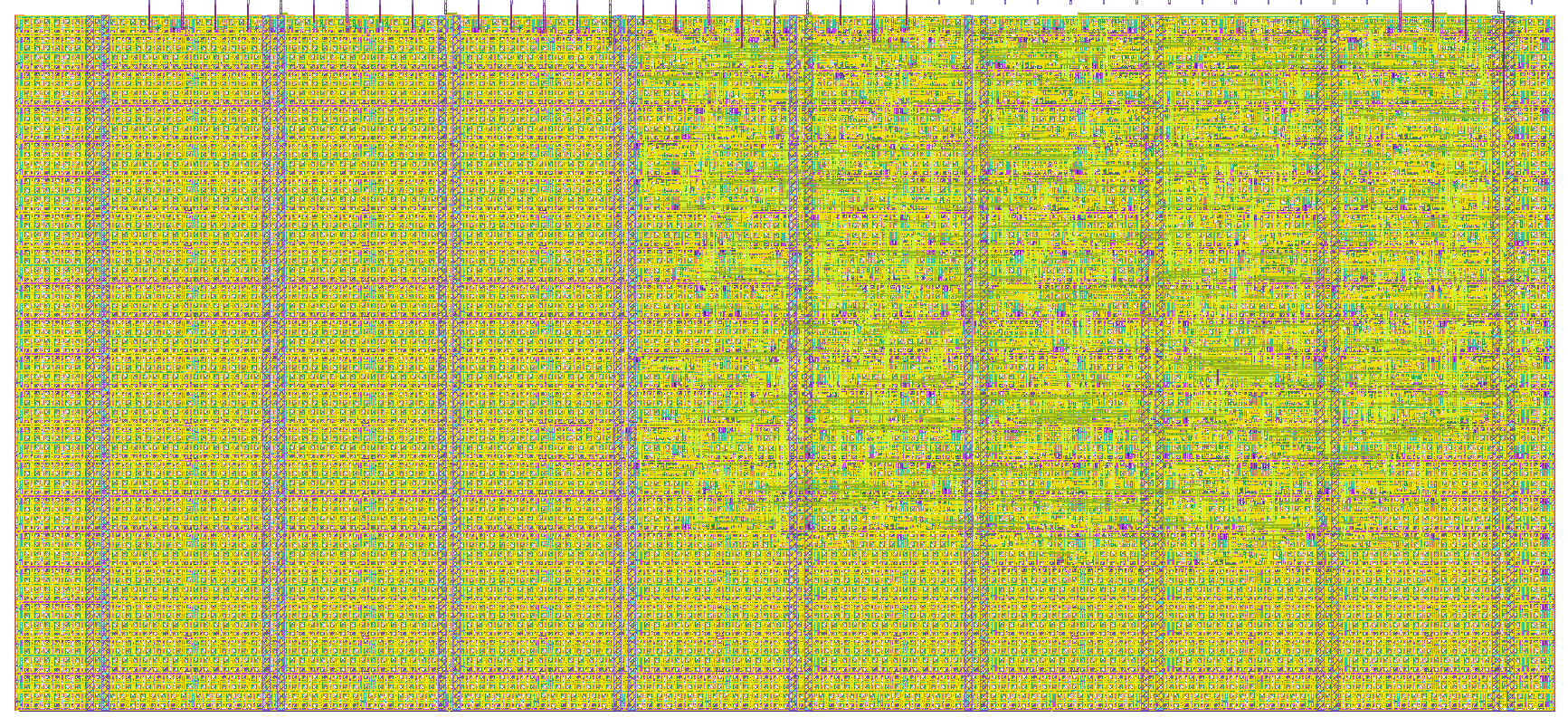
Design render

How it works

This project implements a lightweight, Machine Learning-based Hardware Anomaly Detection engine designed to analyze incoming V2X (Vehicle-to-Everything) packet data for malicious or anomalous behavior in real time. The architecture is deeply pipelined and operates in six stages:

  1. SIPO Ingestion: Incoming data is fed serially (LSB first) into a 64-bit shift register via the ui_in[0] pin, controlled by the ui_in[1] bit_valid strobe.
  2. Feature Extraction: Once 64 bits are captured, the core extracts two key 8-bit signed features: Velocity (bits 31:24) and Heading (bits 23:16).
  3. DMA Flow Control: Extracted features are passed into a pipeline register to decouple the serial ingestion from the math core.
  4. ML Inference Core: A highly optimized MAC (Multiply-Accumulate) unit applies hardcoded model weights to the inputs. It computes: (12 * Velocity) + (88 * Heading).
  5. Anomaly Scoring: The MAC result passes through a ReLU activation function (negative values are clamped to 0) and is evaluated against predefined thresholds:
    • < 1024: SAFE (0x00)
    • >= 1024: CAUTION (0x55)
    • >= 2048: WARNING (0xAA)
    • >= 4096: CRITICAL / ATTACK (0xFF)
  6. Output Endpoints: The 8-bit threat score is output on uo_out. A 1-cycle done_flag pulses on uio_out[0], and if the threat is critical, a hardware interrupt irq_flag pulses on uio_out[1].

How to test

To test the anomaly detection engine, you will need to simulate a serial data feed representing a 64-bit V2X packet:

  1. Reset the Core: Assert rst_n (active low) to clear all internal shift registers and pipelines.
  2. Feed Data: Drive ui_in[0] with your serial data stream (LSB first) while holding ui_in[1] (bit_valid) HIGH for exactly 64 clock cycles.
  3. Wait for Inference: After the 64th bit, drop ui_in[1] LOW. Wait a few clock cycles for the data to propagate through the MAC and scoring pipelines.
  4. Monitor Outputs: * Watch uio_out[0] for a 1-clock-cycle HIGH pulse. This indicates the evaluation is complete.
    • At that exact cycle, read the 8-bit threat score on the uo_out pins.
    • Check if uio_out[1] pulsed HIGH, which indicates an interrupt triggered by a CRITICAL score (0xFF).

Example Test Vectors:

  • Velocity = 10, Heading = 5: Engine score should read 0x00 (Safe).
  • Velocity = 120, Heading = 40: Engine score should read 0xFF (Critical) and uio_out[1] will pulse.

External hardware

  • Microcontroller (e.g., RP2040 / Raspberry Pi Pico): Required to bit-bang the serial data into the input pins (ui_in[0] and ui_in[1]) and monitor the output interrupt flag. The standard Tiny Tapeout demo board provides this capability.
  • (Optional) 8x LEDs: Connected to uo_out[7:0] to provide a visual, real-time representation of the threat level.
  • (Optional) Logic Analyzer: To visualize the serial ingestion and accurately capture the 1-cycle done_flag and irq_flag pulses.

IO

#InputOutputBidirectional
0serial_bit_inthreat_score[0]done_flag (out)
1bit_valid_strobethreat_score[1]irq_flag (out)
2mode_sel (reserved)threat_score[2]uart_tx (out)
3threat_score[3]
4threat_score[4]
5threat_score[5]
6threat_score[6]
7threat_score[7]

Chip location

Controller Mux Mux Mux Mux Mux Mux Mux Mux Mux Mux Mux Mux Mux Mux Mux tt_um_chip_rom (Chip ROM) tt_um_factory_test (Tiny Tapeout Factory Test) tt_um_Vincent2405_adder_tree (BSD Convolution Adder Tree) tt_um_BastiBudde_i2c_slave_sensor (I2C Slave Template with Emulated Sensor) tt_um_60hz_load (60 Hz Grid-Forming ASIC with Dump-Load Control) tt_um_spi_config_reg (Simple SPI configuration for analog designs) tt_um_ex_drosen766 (Project) tt_um_spi_cpu_top (SPI-CPU) tt_um_d5smith_mfa (Music for ASICs) tt_um_i2c_master (I2C Master Controller) tt_um_aswarby_mac (Aswarby INT8 MAC) tt_um_arrakeen_spsram_direct (TT-Arrakeen-SPSRAM-direct) tt_um_alu (8-bit Interactive ALU) tt_um_JCT_PoC (ttgf jct PoC) tt_um_jct_lea (LEA-128) tt_um_cwru_cpu (CWRU CPU) tt_um_teapot (100Mbps Ethernet Accelerator Wrapper) tt_um_jte_cordic (CORDIC sin/cos generator) tt_um_aidenkoch4 (Three Channel RGB PWM Controller) tt_um_pschuetz_tremolo (Tremolo guitar pedal ASIC) tt_um_jsabree11_fibonacci_checker (fibbonaci_tt) tt_um_connerdaehler_boop (Procedural ASIC) tt_um_Kieckenwama_Traffic_LIGHT_FSM (Traffic Light FSM) tt_um_KimLuu02_WashingMachine_FSM (WashingMachine_FSM) tt_um_PaulineKreis_PWM_Analyser (PWM-Analyser) tt_um_PWM (PWM Generator) tt_um_wokwi_466666882406199297 (Simple Sprinkler) tt_um_rebeccargb_universal_decoder (Universal Binary to Segment Decoder) tt_um_rebeccargb_hardware_utf8 (Hardware UTF Encoder/Decoder) tt_um_spi_master (SPI Master Slave Communication) tt_um_likitha_trng (Secure TRNG Entropy Generator) tt_um_wnn (8-bit WNN Pattern Recognizer) tt_um_raksha (Raksha) tt_um_uart_soc (UART_SOC) tt_um_ecdsa_verify (ECDSA Verification) tt_um_ecc_processor (ECC Processor) tt_um_fast_auth (Fast Authentication Accelerator) tt_um_karthik_trng (TRNG using Ring Oscillator) tt_um_push (Secure V2X Mini Demonstrator) tt_um_santosh_aes_sbox (AES S-Box Accelerator) tt_um_hardware_anomaly_detection (Hardware Anomaly Detection) tt_um_multi_protocol (Multi-Protocol Communication Controller) tt_um_pqc_ntt_butterfly (PQC NTT Butterfly Core) tt_um_cambridge_nlfsr (Programmable Chaotic NLFSR) tt_um_4b_accumulator_cpu (4 bit Accumulator CPU) tt_um_spi_slave (SPI Slave with 8-Register File) tt_um_geeta_doddamani_lfsr (4-bit Maximum-Length LFSR) tt_um_ecc_accelerator (ECC Scalar Accelerator) tt_um_egurapha_chacha20 (ChaCha20) tt_um_configurable_pwm (Configurable PWM Generator) tt_um_Arctic0 (Arctic0 16-bit CPU) tt_um_comp8 (8-bit Comparator) tt_um_pwm_cit (Configurable 8-bit PWM Generator) tt_um_rameshwar_door_lock (Digital Door Lock) tt_um_sandy_venky (8-bit LFSR Circuit) tt_um_ljhahne_pong (Pong) tt_um_v2x_warning (V2X Collision Warning) tt_um_ecc_scalar_mult (ECC Scalar Multiplication) tt_um_fhw_appel_spiPWMio (spiPWMio) tt_um_arrakeen_spsram_direct_sramrules (TT-Arrakeen-SPSRAM-direct-sramrules) tt_um_arrakeen_spsram_direct_5v (TT-Arrakeen-SPSRAM-direct-5V) tt_um_LukeSilva_cartrip (Car Trip) tt_um_coffeepot (100Mpbs 3 port Ethernet switch) tt_um_emiliopeju_lightscan (Lightscan) tt_um_Alanduan21_triad01_top (triad01) tt_um_lif_snn (4-Neuron LIF Spiking Neural Network) tt_um_smerity_mandelbrot (Smerity-Mandelbrot) tt_um_elvtide01_7SegmentDice (7SegmentDice) tt_um_elemental_harmony (Elemental Harmony Game) tt_um_pattern_gen (Programmable Waveform and PWM Generator) tt_um_antimatter15_pdm_vad (PDM Voice Activity Detector) tt_um_layla_spike_detector (Neural Spike Detector) tt_um_detronyx_arith_lab (Detronyx Arithmetic Lab Tile) tt_um_hasheddan_nni (Nearest Neighbor Interpolation) tt_um_brisq (BRISQ) tt_um_santhosh_spike_codec_gf (Neuromorphic Spike Codec (GF180)) tt_um_santhosh_aer_router_gf (Asynchronous-AER Spike Router (4-phase REQ/ACK, 16-entry routing table, GF180)) tt_um_santhosh_snn_wta_gf (Spiking Neural Network WTA Inference Engine (GF180)) tt_um_santhosh_cim_bist_gf (CIM Controller with BIST and Fault Map (GF180)) tt_um_santhosh_neuro_puf_gf (Neuromorphic PUF (distinct-tap LFSR arbiter + memristor XOR, GF180)) tt_um_detronyx_uart_trace_exerciser (Detronyx UART Trace Exerciser) tt_um_ro_puf (Tiny RIng Oscillator PUF) tt_um_franretfie_top (Quadrature sine generator) tt_um_cherny_xor_8bi (XORing given bits) tt_um_mealycpp_ascon_sdmc_uart (ASCON Integrated Crypto Processor) tt_um_reflex_s4 (AER Reflex Chip - MCP2515 CAN gateway) tt_um_polytrig_core (PolyTrig Digital Waveform Synthesis Core) tt_um_waferspace_vga_screensaver (Wafer.space Logo VGA Screensaver) tt_um_2048_vga_game (2048 sliding tile puzzle game (VGA)) tt_um_urish_simon (Simon Says memory game) Available