551 BRISQ
551 : BRISQ
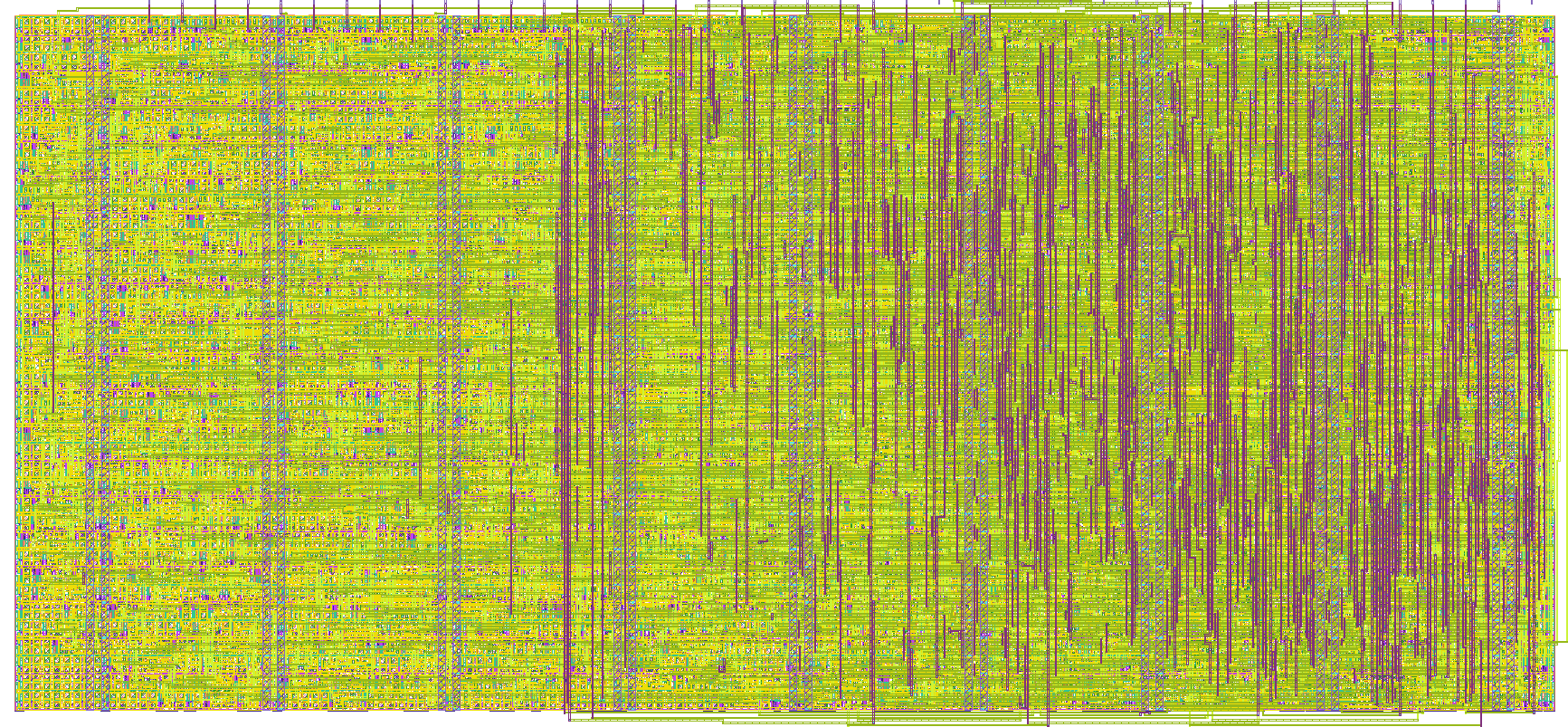
- Author: Poiku
- Description: BRISQ: Binary Reduced Inverse SQrt
- GitHub repository
- Open in 3D viewer
- Open in Tiny Tapeout Explorer
- Clock: 25000000 Hz
How it works
BRISQ computes an approximate IEEE-754 single-precision inverse square root:
y1 = y0 * (1.5 - 0.5 * x * y0 * y0)
The Tiny Tapeout top module is tt_um_brisq. The design receives one 32-bit
FP32 operand over an 8-bit byte-serial input bus, runs one Newton-Raphson
refinement, and returns one 32-bit FP32 result over an 8-bit byte-serial output
bus.
The initial estimate is generated in src/top.sv with a Quake-style integer
seed:
seed_y0 = WTF - (input_magnitude >> 1)
WTF is a localparam in the RTL and is currently 31'h5F3759DF. The cocotb
testbench reads this value from the design, so the expected-value model remains
parametric with the RTL seed constant.
The implementation is optimized for small area:
src/top.svcontains the Tiny Tapeout wrapper, byte SerDes, FSM, seed logic, and special-case handling.src/fp32_mul.svimplements a truncated positive-magnitude FP32-style multiplier using the highPRECISION_BITSfraction bits.src/fp32_sub.svimplements the parametric1.5 - bsubtractor used by the Newton correction term.
The default precision is 11 high fraction bits. This is an approximate datapath, not a fully rounded IEEE-754 FPU.
I/O protocol
All FP32 values are transferred most-significant byte first.
| Pin | Direction | Description |
|---|---|---|
ui_in[7:0] |
input | Input FP32 byte |
uio_in[0] |
input | Input byte valid |
uo_out[7:0] |
output | Output FP32 byte |
uio_out[7] |
output | Output byte valid |
uio_out[6] |
output | Final output byte |
uio[5:1] |
input/unused | Unused |
To send an operand, drive each byte on ui_in[7:0] and assert uio_in[0] for
the clock edge that accepts that byte. The receive FSM waits when uio_in[0] is
low, so the input stream can pause between bytes.
After the fourth input byte is accepted, the accelerator computes for four
clock cycles. It then drives four output bytes on uo_out[7:0]. uio_out[7]
is high while output bytes are valid, and uio_out[6] is high with the fourth
and final output byte.
Special cases
| Input class | Output |
|---|---|
| zero or subnormal | +inf |
| negative value | quiet NaN |
+inf |
+0.0 |
| NaN | quiet NaN |
How to test
From the test directory, install dependencies once:
python3 -m pip install -r requirements.txt
Run the self-checking cocotb RTL vector test:
make -B
Run the sweep test, which generates sweep_results/isqrt_sweep.csv and
sweep_results/isqrt_sweep.png:
make sweep
Use more sweep samples with:
make sweep SWEEP_POINTS=4096
For gate-level simulation, copy the hardened netlist to
test/gate_level_netlist.v and run:
make -B GATES=yes
The cocotb testbench writes tb.fst, which can be opened with GTKWave or
Surfer.
External hardware
None.
IO
| # | Input | Output | Bidirectional |
|---|---|---|---|
| 0 | fp32_in_byte[0] | fp32_out_byte[0] | fp32_in_valid |
| 1 | fp32_in_byte[1] | fp32_out_byte[1] | |
| 2 | fp32_in_byte[2] | fp32_out_byte[2] | |
| 3 | fp32_in_byte[3] | fp32_out_byte[3] | |
| 4 | fp32_in_byte[4] | fp32_out_byte[4] | |
| 5 | fp32_in_byte[5] | fp32_out_byte[5] | |
| 6 | fp32_in_byte[6] | fp32_out_byte[6] | fp32_out_last |
| 7 | fp32_in_byte[7] | fp32_out_byte[7] | fp32_out_valid |