386 Elemental Harmony Game
386 : Elemental Harmony Game
- Author: Aakarshitha Suresh
- Description: Elemental Harmony is a silicon-based 4 * 4 strategy game, like Tic-Tac-Toe, where players compete against a logic engine to score points by matching elemental patterns across a digital grid.
- GitHub repository
- Open in 3D viewer
- Open in Tiny Tapeout Explorer
- Clock: 10000000 Hz
How it works
🌟 Elemental Harmony A TinyTapeout Puzzle of Balance and Chaos
🎯 Objective Bring balance to a 4×4 elemental board by placing patterns (Air, Water, Fire, Earth) such that harmony outnumbers chaos. Win by creating rows or columns that embody elemental cooperation. Lose if conflict overtakes the board — or if you exhaust your allowed retries.
🌍 The Elements & Their Patterns
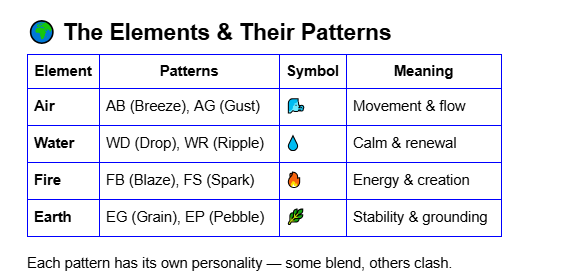
Each pattern has its own personality => some blend, others clash.
Elemental Harmony is a silicon-native strategy game implemented as a TinyTapeout-compatible hardware module. It utilizes an internal 16-bit occupancy register to manage a 4 * 4 grid, where a Finite State Machine (FSM) coordinates turns between a human player and an internal logic engine. The engine uses a Linear Feedback Shift Register (LFSR) to search for empty tiles and calculates scores based on adjacent "elemental" pattern matches using a combinational adder tree. A unique feature of the architecture is its tri-state error reporting system: if a player attempts to place a pattern on an occupied tile, the FSM transitions through a sequence of diagnostic states (ERROR1 through ERROR3) that stream the current board occupancy and fill-count back to the interface, allowing for external recovery and move retry without a full system reset.
PAIRWISE PATTERN SCORE TABLE As created in the specifications of the design Elemental Harmony. Here is the complete 8×8 Pairwise Pattern Score Table exactly as defined in the spec. Definition: Row = newly placed pattern Column = existing neighboring pattern (N/E/S/W) Values: +2 (strong), +1 (mild), 0 (same), −2 (conflict)

How to test
To verify the design, pull rst_n low to initialize the grid, then provide a 4-bit tile address and 3-bit pattern on ui_in before pulsing the Start bit (ui_in[7]). Monitor the uo_out port for the resulting Harmony score, which is valid when the strobe bit (uio_out[0]) is high. To test the robustness of the error-handling logic, intentionally attempt to place a pattern on a previously occupied tile; observe the FSM transition into the error states and verify that uo_out sequentially outputs the fill status and the 16-bit occupancy map (split into two 8-bit chunks). The test is successful if the system returns to the IDLE state after an error, ready to accept a corrected move at a valid, non-colliding position.
IO
| # | Input | Output | Bidirectional |
|---|---|---|---|
| 0 | h_pos[0] | uo_out[0] | design_done_strobe |
| 1 | h_pos[1] | uo_out[1] | fsm_state_out[0] |
| 2 | h_pos[2] | uo_out[2] | fsm_state_out[1] |
| 3 | h_pos[3] | uo_out[3] | fsm_state_out[2] |
| 4 | h_pat[0] | uo_out[4] | fsm_state_out[3] |
| 5 | h_pat[1] | uo_out[5] | unused_input[0] |
| 6 | h_pat[2] | uo_out[6] | unused_input[1] |
| 7 | start_pulse | uo_out[7] | unused_input[2] |