98 CIM Controller with BIST and Fault Map (GF180)
98 : CIM Controller with BIST and Fault Map (GF180)
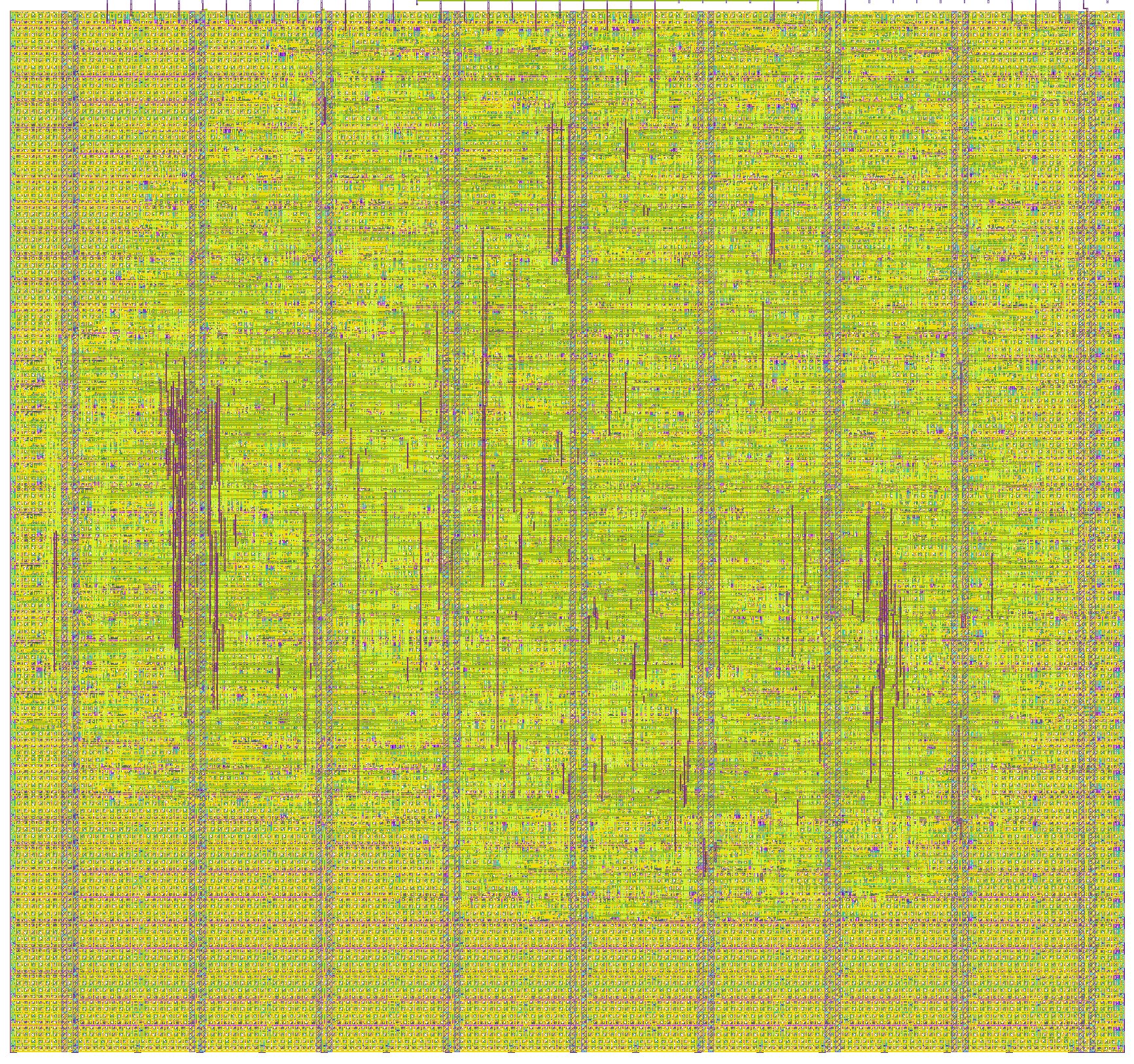
- Author: Prof. Santhosh Sivasubramani, IIT Delhi
- Description: GF180mcuD digital compute-in-memory peripheral: 8x8 1-bit cell array with built-in self-test (march/checkerboard/diagonal patterns), 64-bit sticky fault map, 16-bit dot-product accumulator over user-programmable row activations, SPI-programmable, irq output, 25 MHz signoff clock, 1x2 tile
- GitHub repository
- Open in 3D viewer
- Open in Tiny Tapeout Explorer
- Clock: 25000000 Hz
tt_um_santhosh_cim_bist_gf — how it works
Tile 6 of TTGF26a Scenario B (GF180mcuD, 1x1, 25 MHz).
An SPI-programmable compute-in-memory (CIM) controller with built-in self-test (BIST) and a persistent fault map.
Architecture
The block holds an 8x8 1-bit cell array (cmem), the digital stand-in for
a memristive or SRAM CIM crossbar. Two orthogonal finite-state machines
run against that array:
BIST FSM
On start_bist (CTRL[0] or rising edge on ui_in[0]):
- WRITE — walks rows 0..7, writing the pattern-specific expected byte into each row (march phase 0, checkerboard, or diagonal).
- READ — walks rows 0..7, XOR-ing the actual cell value against the
expected byte. The mismatch mask is OR-merged into
fault_row[r].ui_in[1]=1forces a mismatch oncell[0][0]for silicon-side testing. - For the march pattern, the BIST re-runs WRITE then READ with the inverted phase (all-ones) so stuck-at-0 faults are also detected.
- DONE — sets sticky
bist_done, clearsbist_running.
A 4-bit zero-extended popcount of each mismatch byte is accumulated into a
saturating 8-bit FAULT_COUNT, and any non-zero mismatch latches
fault_ever.
CIM FSM
On start_cim (CTRL[1]):
- Walks rows 0..7. For each row where
INPUT_VEC[r]=1, adds the 4-bit zero-extended popcount ofcmem[r]into a 16-bit accumulator. - DONE — sets sticky
cim_done, clearscim_running.
This models a 1-bit-weight column sum: activated rows contribute their total "on" cells into the accumulator.
The two FSMs are mutually exclusive: CIM waits while BIST is running and vice versa.
SPI protocol
Shared spi_slave (16-bit frame {R/Wn, 7-bit addr, 8-bit data}, mode 0,
MSB first). The full register map is in the main README.
Sticky flags (bist_done, cim_done, fault_ever) are cleared by writing
1 to the corresponding bit of STATUS (W1C). clear_fault_map in CTRL is a
self-clearing pulse that zeros the fault map, fault counter, and
fault_ever without disturbing the cell contents — useful for running
BIST periodically as a watchdog without losing the stored weights.
How to test
- Via SPI, write the 8 rows of
cmem(0x03 after setting ROW_SEL at 0x02) to load weights. - Write
INPUT_VEC(0x04) with the activation vector. - Write CTRL (0x00) = 0x02 to start CIM. Poll
cim_done(uo[2] or STATUS bit 6); readACCUM_LO/HI(0x05/0x06). - For BIST: set PATTERN (0x01), write CTRL = 0x01, poll
bist_done, readFAULT_COUNT(0x09) and fault rows (0x08 after setting 0x07).
External interfaces
| Pin | Purpose |
|---|---|
ui_in[0] |
External BIST start (rising edge) |
ui_in[1] |
Inject fault (forces cell[0][0] mismatch) |
uo_out[0] |
Busy |
uo_out[1] |
bist_done sticky |
uo_out[2] |
cim_done sticky |
uo_out[3] |
fault_ever sticky |
uo_out[4] |
cim_done && accum == 0 |
uio[6] |
irq (when irq_en and either sticky done is set) |
Novelty
First TTGF tile to expose persistent cell-level defect data over a host
interface — pairs with tt_um_santhosh_xbar_ctrl_gf (Tile 3) and
tt_um_santhosh_rsd_char_gf (Tile 8) for a full memristive-array
diagnostic flow.
IO
| # | Input | Output | Bidirectional |
|---|---|---|---|
| 0 | start_ext (external BIST trigger; rising edge) | busy (bist_running | cim_running) | spi_cs_n |
| 1 | inject_fault (BIST test aid: forces cell[0][0] mismatch) | bist_done (sticky) | spi_mosi |
| 2 | reserved | cim_done (sticky) | spi_miso |
| 3 | reserved | fault_ever (sticky) | spi_sck |
| 4 | reserved | accum_zero (cim_done && accum==0) | bist_running |
| 5 | reserved | accum[8] | cim_running |
| 6 | reserved | accum[9] | irq |
| 7 | reserved | accum[10] | reserved |