36 Neural Spike Detector
36 : Neural Spike Detector
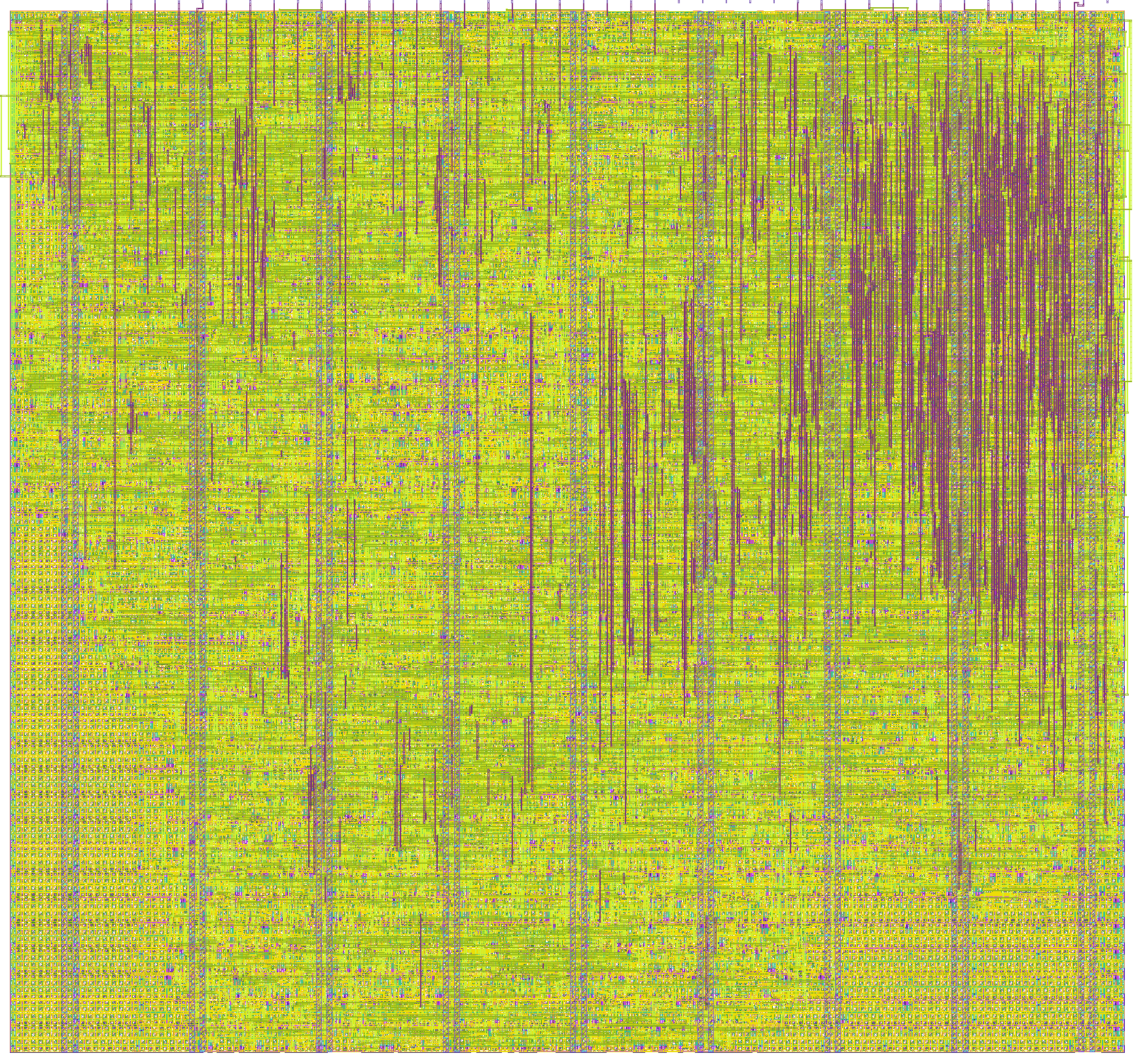
- Author: Layla Adeli
- Description: Adaptive neural spike detector with IIR bandpass filter (300-3000 Hz), Nonlinear Energy Operator (NEO), and EWMA adaptive threshold. Digital backend for neural recording AFEs.
- GitHub repository
- Open in 3D viewer
- Open in Tiny Tapeout Explorer
- Clock: 10000000 Hz
How it works
The design implements a real-time neural spike detector. The 8-bit signed input sample is passed through a 2nd-order IIR bandpass filter (300-3000 Hz) which then isolate the neural spike band. The filtered signal feeds a Nonlinear Energy Operator (NEO), which finds psi[n] = x[n-1]^2 - x[n]*x[n-2], amplifying spike energy relative to background noise. An adaptive threshold is computed as k * sigma^2, and sigma is tracked via an exponential weighted moving average (EWMA) of the signal's absolute value, and k is a configurable multiplier (default is set to 5) set via a simple SPI interface. When the NEO output crosses the adaptive threshold, a spike is flagged and a 7-bit rolling timestamp is output, followed by a configurable refractory period (default 50 samples) to prevent re-triggering on the same spike waveform. This is the very first revision, and my first experience with not just Tiny Tapeout, but also with Verilog for a project such as this. If there are bugs, I am planning on submitting a more in depth version in a future tapeout once I have gained more exposure. :)
How to test
Want to apply an 8-bit signed sample to ui_in on each clock_en pulse (internally divided down from the system clock to ~10 kHz). Then, feed in real or synthetic neural recording data containing spike waveforms superimposed on background noise, and monitor uo_out[7] for the spike-detected pulse and uo_out[6:0] for the timestamp. Configure the threshold multiplier and refractory period via the 3-wire SPI interface on uio[2:0] (CS_n, SCLK, MOSI). A cocotb testbench (test/test_spike_detector.py) verifies spike detection, false-positive rejection on pure noise, refractory period behavior, and SPI configuration.
External hardware
External hardware can include ADC or microcontroller that sends data for the input. Also would want either external microcontroller or use the TT board given to capture the pulses at the output. Overall, some sort of analog to digital block, and signal generator would be ideal. In initial testing I used a Python script to generate synthetic neural data, so that could be another solution without an external ADC.
IO
| # | Input | Output | Bidirectional |
|---|---|---|---|
| 0 | ADC sample bit 0 (LSB) | Timestamp bit 0 (LSB) | SPI SCLK (input) |
| 1 | ADC sample bit 1 | Timestamp bit 1 | SPI MOSI (input) |
| 2 | ADC sample bit 2 | Timestamp bit 2 | SPI CS_n (input, active low) |
| 3 | ADC sample bit 3 | Timestamp bit 3 | Debug: filtered signal MSB (output) |
| 4 | ADC sample bit 4 | Timestamp bit 4 | |
| 5 | ADC sample bit 5 | Timestamp bit 5 | |
| 6 | ADC sample bit 6 | Timestamp bit 6 (MSB) | |
| 7 | ADC sample bit 7 (MSB, sign) | Spike detected (1-cycle pulse) |