640 M31 Mersenne-31 Arithmetic Accelerator
640 : M31 Mersenne-31 Arithmetic Accelerator
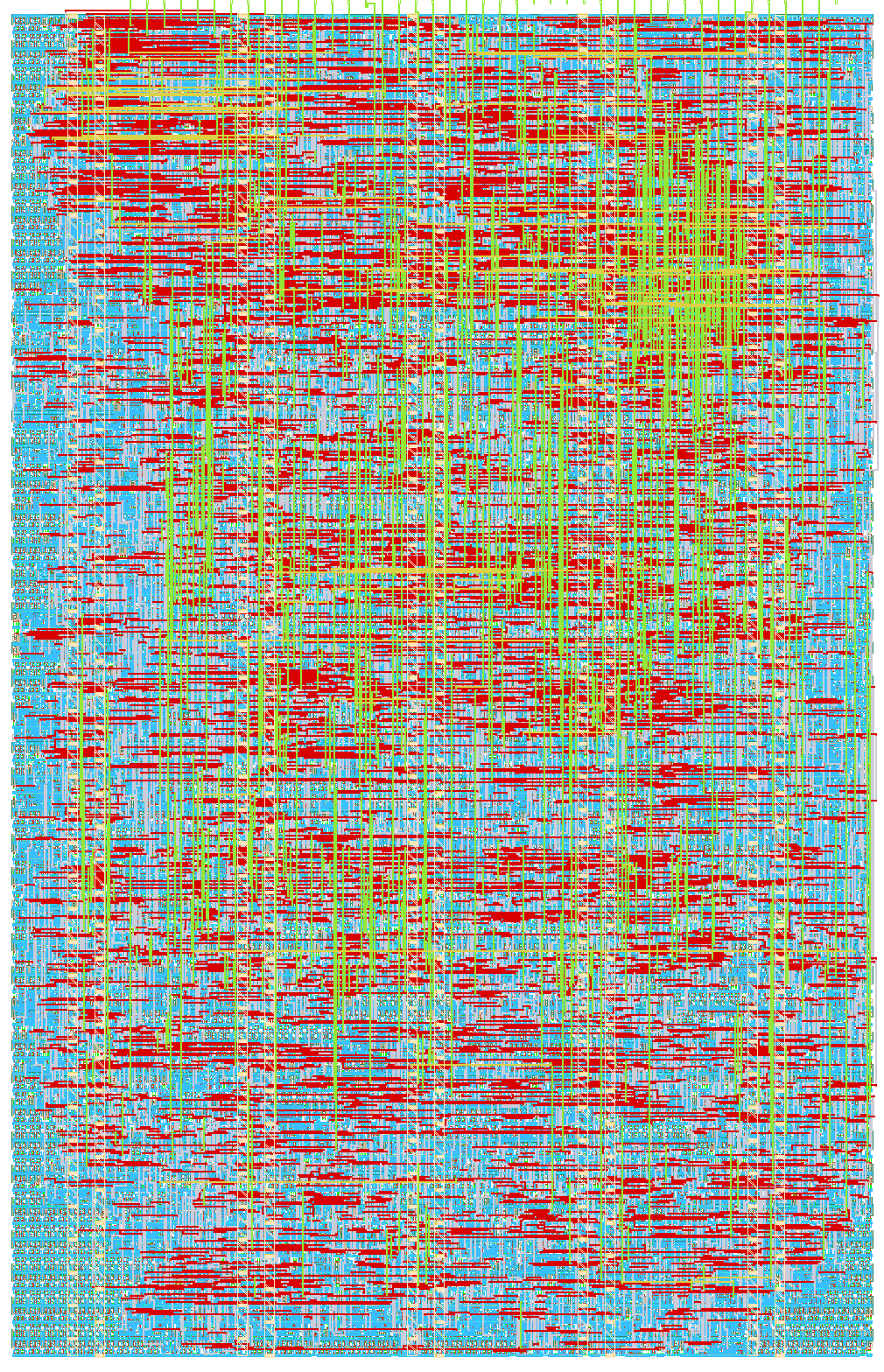
- Author: Brendan Murrell
- Description: Hardware accelerator for modular arithmetic over the Mersenne-31 prime field
- GitHub repository
- Open in 3D viewer
- Open in Tiny Tapeout Explorer
- Clock: 66000000 Hz
How it works
M31-ACCEL is a hardware accelerator for modular arithmetic over the Mersenne-31 prime field (p = 2^31 - 1), designed for ZK-STARK and Plonky3 applications.
Architecture
The accelerator contains three 32-bit registers (A, B, C) and supports the following operations:
| Opcode | Operation | Description | Cycles |
|---|---|---|---|
| 0x0 | NOP | No operation | 1 |
| 0x1 | ADD | A = (A + B) mod p | 1 |
| 0x2 | SUB | A = (A - B) mod p | 1 |
| 0x3 | MUL | A = (A × B) mod p | 32 |
| 0x4 | CLR | Clear all registers | 1 |
| 0x5 | MAC | A = (A + B × C) mod p | 32 |
Modular Reduction
The design uses bit-folding for efficient Mersenne prime reduction. Since 2^31 ≡ 1 (mod p), any 62-bit product can be reduced by folding the upper 31 bits back into the lower 31 bits:
result = low[30:0] + high[30:0]
if result >= p: result -= p
Pin Interface
Input pins (ui_in[7:0]):
- During load: DATA byte to shift into selected register
- During execute: OPCODE[3:0] selects operation
Bidirectional pins (uio_in[7:0]):
- [0] CMD_EN: 1 = execute opcode, 0 = load/read register
- [1] REG_SEL[0]: Register select bit 0
- [2] RW: 1 = read, 0 = write
- [3] REG_SEL[1]: Register select bit 1
Output pins (uo_out[7:0]):
- RESULT byte during read operations (4 consecutive reads for 32-bit value)
Bidirectional output (uio_out[7:0]):
- [0] BUSY: High during multi-cycle operations (MUL, MAC)
Register Selection
| REG_SEL[1:0] | Register |
|---|---|
| 00 | A (accumulator) |
| 01 | B (operand) |
| 10 | C (MAC operand) |
How to test
Basic Test Sequence
- Reset: Assert rst_n low for 5+ clock cycles, then release
- Load Register A: Set CMD_EN=0, RW=0, REG_SEL=00, shift in 4 bytes (LSB first)
- Load Register B: Set REG_SEL=01, shift in 4 bytes
- Execute ADD: Set CMD_EN=1, ui_in=0x1, wait 1 cycle
- Read Result: Set CMD_EN=0, RW=1, REG_SEL=00, read 4 bytes
Example: Compute (5 + 3) mod p
# Load 5 into reg_a
uio_in = 0b0000  # CMD_EN=0, REG_SEL=00, RW=0
ui_in = 0x05; clock  # Byte 0
ui_in = 0x00; clock  # Byte 1
ui_in = 0x00; clock  # Byte 2
ui_in = 0x00; clock  # Byte 3

# Load 3 into reg_b
uio_in = 0b0010  # REG_SEL=01
ui_in = 0x03; clock
ui_in = 0x00; clock
ui_in = 0x00; clock
ui_in = 0x00; clock

# Execute ADD
uio_in = 0b0001  # CMD_EN=1
ui_in = 0x01    # ADD opcode
clock

# Read result from reg_a
uio_in = 0b0100  # CMD_EN=0, RW=1, REG_SEL=00
clock; result[7:0] = uo_out    # 0x08
clock; result[15:8] = uo_out   # 0x00
clock; result[23:16] = uo_out  # 0x00
clock; result[31:24] = uo_out  # 0x00
# Result: 8
Testing Multiplication
For MUL and MAC operations, poll the BUSY signal (uio_out[0]) and wait for it to go low before reading the result. These operations take 32 clock cycles.
Important: Read Counter Reset
The read counter (used to cycle through the 4 bytes of a register) increments whenever RW=1 and CMD_EN=0, regardless of BUSY state. If you poll BUSY with RW=1, the read counter will advance and subsequent register reads will be misaligned.
Recommended pattern: Issue a NOP (CMD_EN=1, opcode=0x0) for one cycle before starting a register read sequence. This resets the read counter to byte 0.
Verification
The design includes a comprehensive test suite with 34 tests covering:
- Register load/read operations
- All arithmetic operations (ADD, SUB, MUL, MAC)
- Edge cases (overflow, underflow, P-1 values)
- Timing verification (32-cycle multiply)
- Mathematical properties (commutativity, distributivity)
External hardware
No external hardware required. The accelerator communicates via the standard Tiny Tapeout I/O pins.
For demonstration purposes, a microcontroller (e.g., RP2040, ESP32) can be used to:
- Load operands and execute operations
- Display results on an LCD or serial terminal
- Benchmark performance vs. software implementation
IO
| # | Input | Output | Bidirectional |
|---|---|---|---|
| 0 | DATA0/OPCODE0 | RESULT0 | CMD_EN (in) / BUSY (out) |
| 1 | DATA1/OPCODE1 | RESULT1 | REG_SEL[0] (input) |
| 2 | DATA2/OPCODE2 | RESULT2 | RW (input) |
| 3 | DATA3/OPCODE3 | RESULT3 | REG_SEL[1] (input) |
| 4 | DATA4 | RESULT4 | |
| 5 | DATA5 | RESULT5 | |
| 6 | DATA6 | RESULT6 | |
| 7 | DATA7 | RESULT7 |