545 TeenySPU
545 : TeenySPU
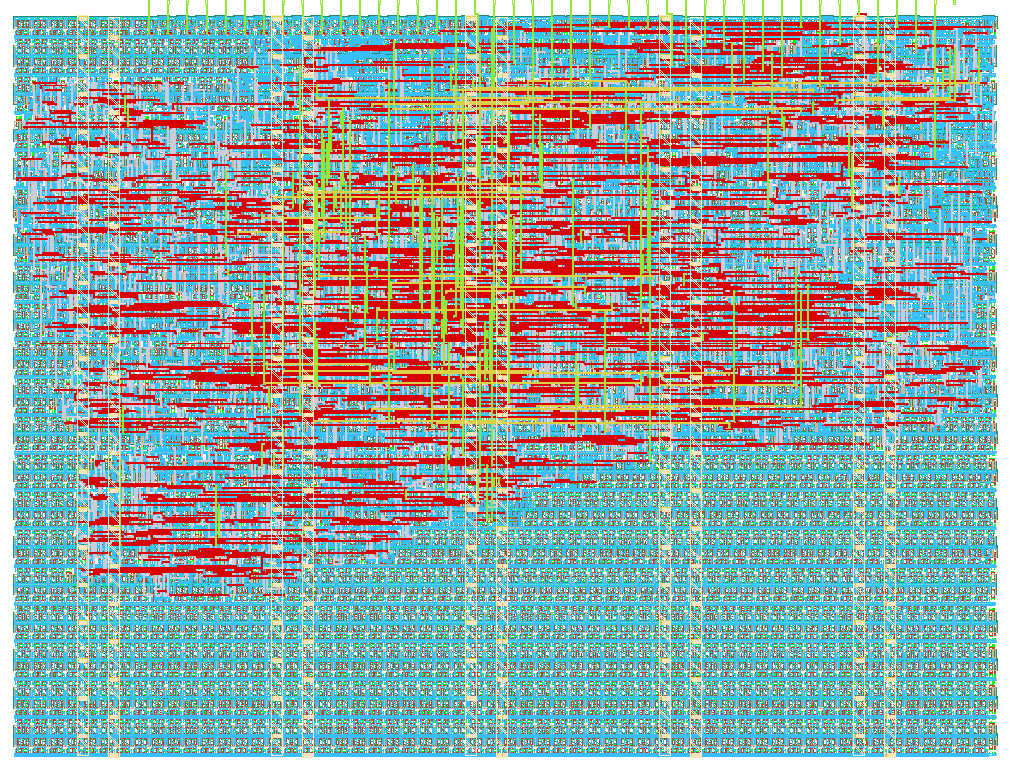
- Author: Eric Shook, Logan Gall
- Description: A 4-bit (teeny) Spatial Processing Unit (SPU) that expresses basic raster data, vector data, and geoAI processing.
- GitHub repository
- Open in 3D viewer
- Open in Tiny Tapeout Explorer
- Clock: 0 Hz
TeenySPU on TinyTapeout Technical Docs
3.22.26 (Eric Shook, Logan Gall)
We developed a TeenySPU for the TinyTapeout architecture. TinyTapeout includes 8-bit input (INP), 8-bit output (OUT), and 8-bit input/output-swappable (UIO). The TeenySPU is a 4-bit architecture, so the 8-bit INP, OUT, and UIO are split into two 4-bit sections, high and low. The high 4-bits of INP provide the 4-bit opcode, the low 4-bits of INP control a Q MUX to select how input data from UIO is routed to inputs A, B, C, and D. The 4-bit outputs M and N are routed to OUT high and OUT low, respectively. For more details on the TinyTapeout specs, see: https://tinytapeout.com/specs
<img src="TeenySPU-1.0.png"/>
Hardware Structure
TinySPU is structured to function within the limitations of the TinyTapeout project spec. In general, this means:
- ~50MHz Clock rate
- 8 bits of Input (designated to OpCode & QMux)
- 8 bits of Output (designated to M and N outputs)
- 8 bits of UIO (designated to ABCD inputs)
How it works
The TeenySPU uses a spatial instruction set architecture (SISA), which is split into two sections:
- Operation Codes -- The operation selection for the TeenySPU chip, set as the high 4 bits of Input
- Q Mux Codes -- The data loading multiplexer code, set as the low 4 bits of Input
Spatial Instruction Set Architecture (SISA)
Spatial instructions are organized into categories to demonstrate the breadth of spatial operations available for a prototypical SPU.
Opcode categories
| Opcode | Category |
|---|---|
00xx |
Control SPU Ops |
01xx |
4-bit Vector Ops |
10xx |
4-bit Raster Ops |
110x |
4-bit Multispec Raster Ops |
111x |
8-bit Double-precision Ops |
16 TeenySPU Opcodes
The following 16 spatial opcodes can be used to create a multitude of spatial methods. Details of each op are included below.
| Opcode | Mnemonic | Category |
|---|---|---|
0000 |
NOP | Control SPU Ops |
0001 |
MinGate | Control SPU Ops |
0010 |
EqGate | Control SPU Ops |
0011 |
ZeroMN | Control SPU Ops |
0100 |
DistDir | 4-bit Vector Ops |
0101 |
BoxArea | 4-bit Vector Ops |
0110 |
BasicBuffer | 4-bit Vector Ops |
0111 |
AttrReclass | 4-bit Vector Ops |
1000 |
FocalMeanRow | 4-bit Raster Ops |
1001 |
FocalSumRow | 4-bit Raster Ops |
1010 |
LocalDiv | 4-bit Raster Ops |
1011 |
FocalMaxPoolRow | 4-bit Raster Ops |
1100 |
NormDiffIndex | 4-bit Multispec Raster Ops |
1101 |
LocalCodeOp | 4-bit Multispec Raster Ops |
1110 |
DoubleDist | 8-bit Double-Precision OUT Ops |
1111 |
DotProduct | 8-bit Double-Precision OUT Ops |
To find more documentation and examples, look at the repository documentation: https://github.com/umn-geocommons.
How to test
The Verilog code can be run in the HDL software of your choice, with src/tt_um_teenyspu.v as the top-level module.
File test/tb_tt_um_teenyspu.v contains a testbench of all operations programmed for the TeenySPU. This can be set as a simulation source.
External hardware
List external hardware used in your project (e.g. PMOD, LED display, etc), if any
IO
| # | Input | Output | Bidirectional |
|---|---|---|---|
| 0 | Q[0] | N[0] | AC[0] |
| 1 | Q[1] | N[1] | AC[1] |
| 2 | Q[2] | N[2] | AC[2] |
| 3 | Q[3] | N[3] | AC[3] |
| 4 | Op[0] | M[0] | BD[0] |
| 5 | Op[1] | M[1] | BD[1] |
| 6 | Op[2] | M[2] | BD[2] |
| 7 | Op[3] | M[3] | BD[3] |