658 Spongent-88 Hash Accelerator
658 : Spongent-88 Hash Accelerator
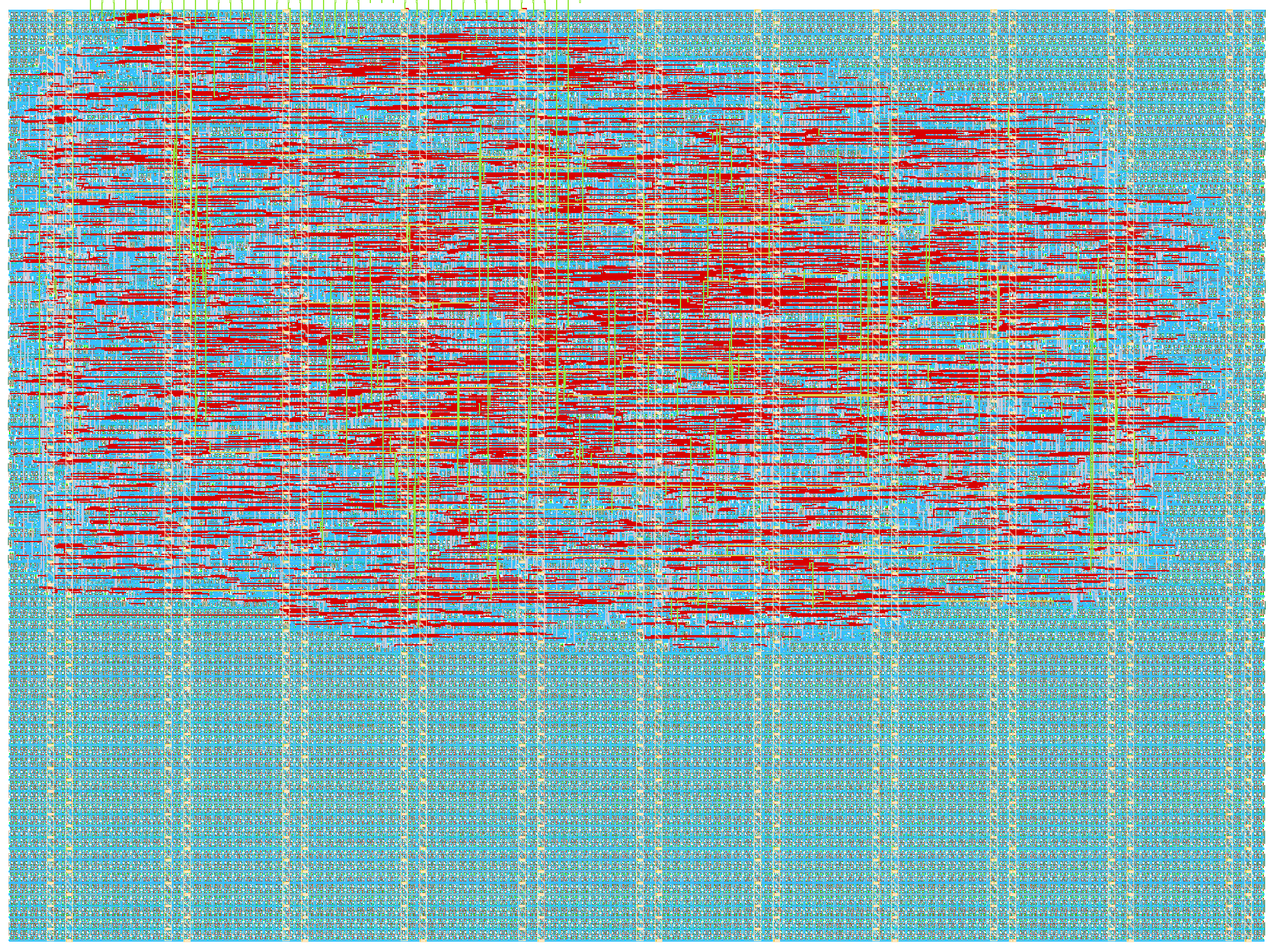
- Author: Stefan Aeschbacher
- Description: Hardware accelerator for the Spongent-88/80/8 lightweight hash function.
- GitHub repository
- Open in 3D viewer
- Open in Tiny Tapeout Explorer
- Clock: 50000000 Hz
How it works
This chip implements the Spongent-88/80/8 lightweight hash function as a hardware accelerator, designed as the cryptographic primitive for Winternitz One-Time Signatures (W-OTS) — a post-quantum secure signature scheme.
Spongent-88/80/8
Spongent is a sponge-based hash function optimised for extremely constrained hardware (Bogdanov et al., CHES 2011). The 88/80/8 variant has:
- 88-bit internal state, split into an 8-bit rate and 80-bit capacity
- 45 permutation rounds per absorption step
- A round function of: round counter injection → S-box layer → bit permutation (pLayer)
Each round applies 22 parallel 4-bit S-box lookups, a zero-gate bit permutation
P(i) = (i × 22) mod 87, and XORs a 6-bit LFSR counter into both ends of the state
(forward into bits [5:0], bit-reversed into bits [87:82]).
The permutation is implemented with 2-round unrolling: two full rounds per clock cycle (22 double-round cycles + 1 single-round cycle for round 44), giving a latency of exactly 23 cycles per permutation call.
Sponge construction
The host absorbs message bytes one at a time: each byte is XORed into the rate portion
(state[7:0]) and the permutation is triggered. After all message bytes plus padding
are absorbed, the full 88-bit state is the digest. Padding follows the pad10*1 rule
(single byte 0x01 to set the first pad bit, 0x80 to set the last — for a
byte-aligned message this collapses to 0x81).
W-OTS use case
W-OTS with Winternitz parameter w=16 uses 25 hash chains of depth up to 15.
Each chain step is one Spongent-88 call. The chip accelerates all 25 × 15 = 375
permutations needed to sign a message; at 50 MHz this takes approximately 190 µs
per signature (25 cycles × 375 calls at 50 MHz). Key management and protocol logic
run in software on the host (RP2040).
Register interface
The chip is controlled through a simple byte-serial register interface over the TinyTapeout bidirectional pins:
| Signal | Direction | Description |
|---|---|---|
ui_in[7:0] |
input | data byte to write |
uo_out[7:0] |
output | current digest byte (LSB-first) |
uio[2:0] |
input | register address |
uio[3] |
input | write strobe (rising-edge triggered) |
uio[4] |
input | read strobe — advances output byte at addr 2 |
uio[0] |
output | busy — high while permutation is running |
uio[1] |
output | out_valid — high after squeeze until next reset |
Register map:
| Addr | Direction | Action |
|---|---|---|
| 0 | write 0 |
Reset: zero the sponge state, clear out_valid |
| 0 | write 1 |
Squeeze: latch 88-bit digest into output shift register |
| 0 | write 2 |
Hash: absorb pad byte 0x81 then auto-squeeze (no manual padding needed) |
| 1 | write b |
Absorb: XOR byte b into state[7:0], run 45-round permutation |
| 2 | read strobe | Advance output shift register to next digest byte |
Timing: one absorb call takes 25 clock cycles (1 load + 23 permutation rounds + 1 capture).
The host must poll busy before issuing the next command.
How to test
Using the RP2040 demo board
Connect the TinyTapeout demo board. The chip runs at 50 MHz.
Hashing a message:
import machine, time

# Pin assignments (TinyTapeout demo board)
# ui_in  → 8 GPIO pins driving the data byte
# uio_in → 5 GPIO pins: [4]=rd_en, [3]=wr_en, [2:0]=addr
# uio_out → 2 GPIO pins: [1]=out_valid, [0]=busy
# uo_out → 8 GPIO pins for reading digest bytes

def write_reg(addr, data):
    set_ui(data)
    set_uio_low(addr)           # wr_en=0, let wr_prev settle
    time.sleep_us(1)
    set_uio_high(addr | 0x08)   # wr_en=1, rising edge
    time.sleep_us(1)
    set_uio_low(addr)           # deassert

def absorb(byte):
    write_reg(1, byte)
    while read_busy():          # poll uio_out[0]
        pass

def squeeze():
    write_reg(0, 1)             # CMD squeeze
    result = []
    for i in range(11):
        result.append(read_uo_out())
        if i < 10:
            set_uio_high(2 | 0x10)  # rd_en=1, addr=2
            time.sleep_us(1)
            set_uio_low(0)
            time.sleep_us(1)
    return bytes(result)

# Hash b'\xAB\xCD\xEF' using hardware padding (CMD=2)
write_reg(0, 0)          # reset
absorb(0xAB)
absorb(0xCD)
absorb(0xEF)
write_reg(0, 2)          # hash: absorbs 0x81 pad byte and auto-squeezes
while read_busy():       # wait for pad permutation
    pass
digest = []
for i in range(11):
    digest.append(read_uo_out())
    if i < 10:
        set_uio_high(2 | 0x10)  # advance output
        time.sleep_us(1)
        set_uio_low(0)
        time.sleep_us(1)
print(bytes(digest).hex())
Using the cocotb simulation
cd test
pip install -r requirements.txt
make          # RTL simulation (iverilog + cocotb)
make WAVES=1  # also dump FST waveform (open with GTKWave or Surfer)
Nine test cases run automatically:
test_single_byte_absorb— absorbs 6 different single bytes, verifies digesttest_multi_byte_absorb— multi-byte sequences up to 11 bytestest_absorb_timing— asserts exactly 25 cycles per absorbtest_out_valid_flag— checksout_validtransitionstest_reset_clears_state— same input after reset gives same digesttest_absorb_while_busy_ignored— writes during busy are silently droppedtest_reference_kat_components— validates Python model against published reference vectors (sBoxLayerandpLayerKATs, full LFSR sequence), then confirms DUT matches the validated modeltest_vs_readable_crypto_reference— cross-checks against the independent joostrijneveld/readable-crypto implementationtest_hash_command— verifies CMD=2 applies pad0x81and auto-squeezes, matchinghash88()from the reference model
Run the Python reference model standalone (no simulator needed):
cd test
python3 spongent88_ref.py
This prints the LFSR sequence, S-box checks, pLayer KAT, and digest values for standard inputs — useful for quickly catching spec mismatches before simulation.
Known-answer test vectors
From the BenchSpongent reference implementation and joostrijneveld/readable-crypto:
| Input | Expected output |
|---|---|
sBoxLayer(0x0123456789ABCDEF012345) |
0xEDB0214F7A859C36EDB021 |
pLayer(0x0123456789ABCDEF012345) |
0x00FF003C3C333333155555 |
| LFSR[0..4] | 0x05, 0x0A, 0x14, 0x29, 0x13 |
Hash KAT vectors (absorb single byte, no padding, squeeze full 88-bit state, LSB first):
| Input byte | Digest (hex, 11 bytes) |
|---|---|
0x00 |
82f3cecf167feb3981c07c |
0x01 |
0842dc1b6c7399eb92f540 |
0x80 |
a0623e32cd5a6bba0b304f |
0xFF |
fe511649a2fa375bf97aa3 |
0xA5 |
82b032622cbefe65b01911 |
External hardware
No external hardware required. The chip is self-contained and communicates entirely through the standard TinyTapeout pin interface.
For W-OTS use, the host microcontroller (RP2040 on the demo board) handles:
- Random private key generation (using its hardware RNG)
- Key and signature storage (external flash or PSRAM recommended for full key sets)
- W-OTS protocol logic (chain iteration, checksum, message formatting)
- Padding bytes before the final absorb
IO
| # | Input | Output | Bidirectional |
|---|---|---|---|
| 0 | data_in[0] | data_out[0] | busy |
| 1 | data_in[1] | data_out[1] | out_valid |
| 2 | data_in[2] | data_out[2] | addr[0] |
| 3 | data_in[3] | data_out[3] | addr[1] / wr_strobe |
| 4 | data_in[4] | data_out[4] | addr[2] / rd_strobe |
| 5 | data_in[5] | data_out[5] | |
| 6 | data_in[6] | data_out[6] | |
| 7 | data_in[7] | data_out[7] |