737 Tsetlin Machine for low-power AI
737 : Tsetlin Machine for low-power AI
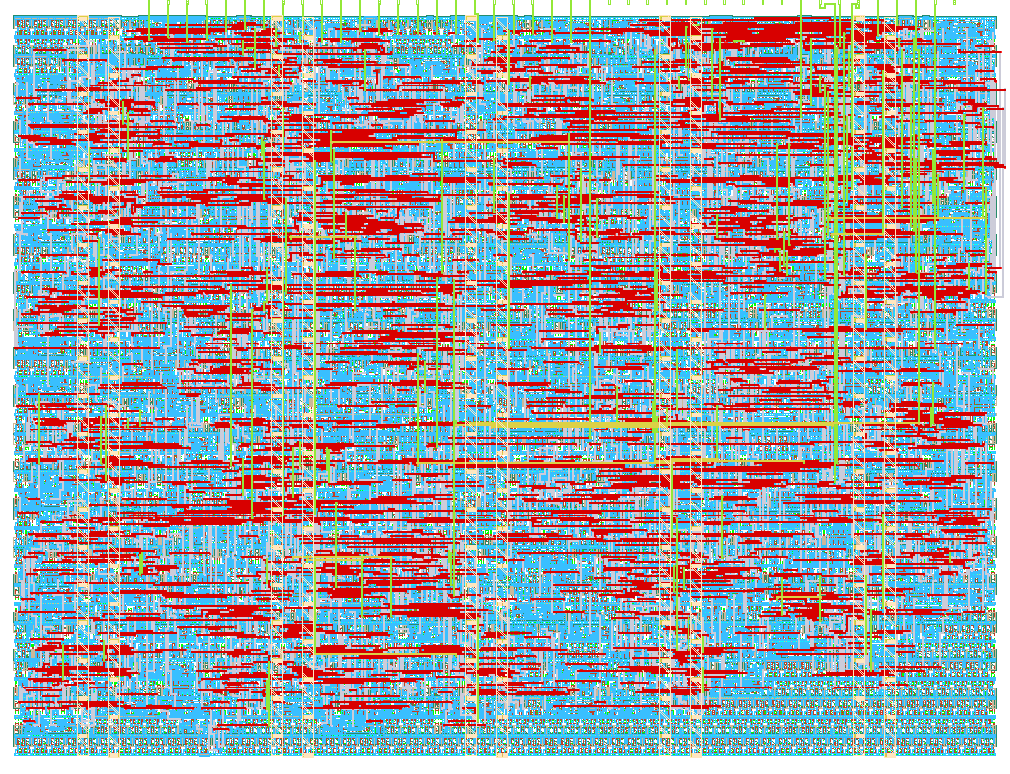
- Author: Pablo MV
- Description: A compact binary classifier using a 4-feature, 4-clause Tsetlin Machine with on-chip training
- GitHub repository
- Open in 3D viewer
- Open in Tiny Tapeout Explorer
- Clock: 50000000 Hz
How it works
This project implements a hardware-efficient Tsetlin Machine (TM) binary classifier optimized for ultra-low-power Edge AI. Unlike traditional neural networks that rely on power-hungry arithmetic multipliers and floating-point weights, this architecture uses pure digital logic and finite state machines to learn and classify data.
The machine processes a 4-bit binary input feature space and outputs a single binary classification. The internal architecture consists of:
- 32 Tsetlin Automata: Each automaton acts as the "memory" of the system, implemented as a 4-bit saturating up/down counter (states 0 to 15).
- 4 Clauses: The logic is divided into 2 positive polarity clauses (which vote for Class 1) and 2 negative polarity clauses (which vote against Class 1).
- Inclusion Threshold: If an automaton's state reaches 8 or higher, its corresponding input literal is "included" in its clause.
The chip operates in two modes, controlled by the Mode pin (ui_in[5]):
- Inference Mode (Mode = 0): The included literals are logically ANDed together within each clause. The final output is decided by a simple majority vote between the positive and negative clauses.
- Training Mode (Mode = 1): The chip updates its internal automata states based on the provided Target signal (
ui_in[4]). It uses a deterministic implementation of Type I feedback (to reinforce correct patterns) and Type II feedback (to break incorrect patterns). The counters update synchronously on every positive clock edge.
How to test
To operate the Tsetlin Machine, you will need to manually toggle the inputs or drive them with a microcontroller.
1. Initialization
- Set
rst_nto0to initialize all 32 internal automata to their default state (8). - Set
rst_nto1to begin normal operation.
2. Training the Machine
- Set the Mode pin
ui_in[5]to1. - Provide a 4-bit input pattern on
ui_in[3:0]. - Provide the desired classification (the "correct answer") on the Target pin
ui_in[4]. - Pulse the
clkpin. The internal counters will increment or decrement based on the learning rules. Repeat this process for your training dataset.
3. Running Inference
- Set the Mode pin
ui_in[5]to0. - Provide a 4-bit input pattern on
ui_in[3:0]. - Read the predicted classification on the output pin
uo_out[0].
External hardware
For basic testing, no specialized external hardware is required.
However, because this chip is designed specifically for ultra-low-power Edge AI, it is ideally suited to be paired with external PMODs or custom sensor boards for real-world applications.
IO
| # | Input | Output | Bidirectional |
|---|---|---|---|
| 0 | feature_0 | predicted_class | |
| 1 | feature_1 | ||
| 2 | feature_2 | ||
| 3 | feature_3 | ||
| 4 | target_class | ||
| 5 | Train_mode (0=inference; 1=train) | ||
| 6 | |||
| 7 |