685 Tiny Perceptron
685 : Tiny Perceptron
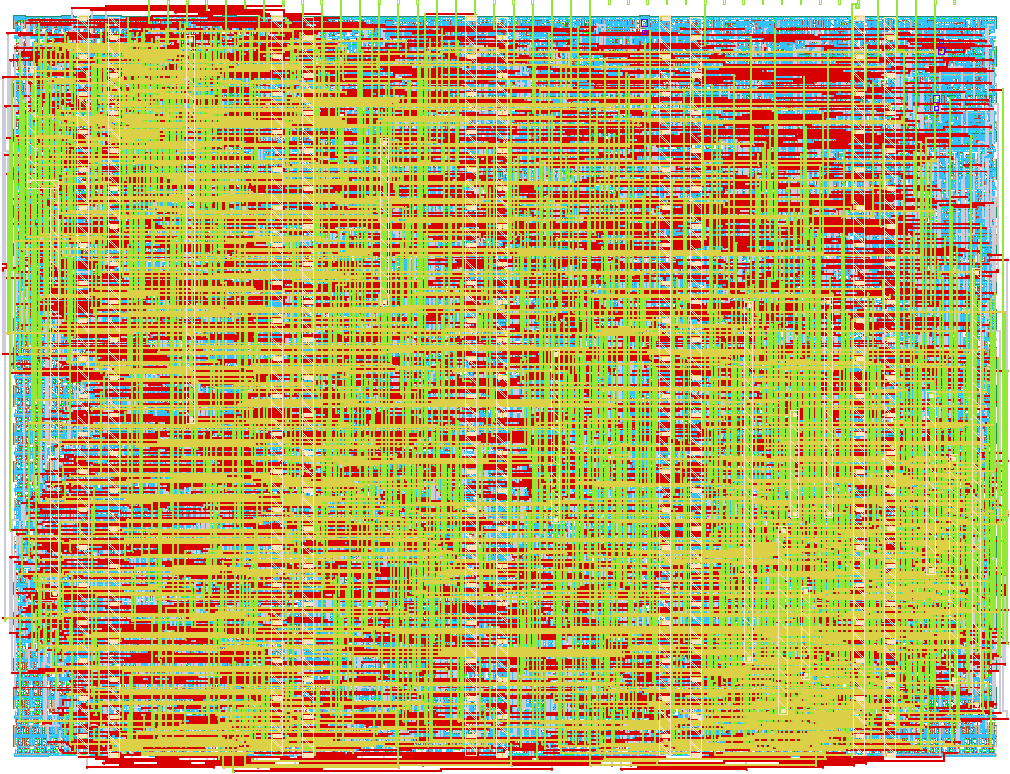
- Author: Karl H. Mose
- Description: An implementation of a hashed perceptron, a branch prediction model
- GitHub repository
- Open in 3D viewer
- Open in Tiny Tapeout Explorer
- Clock: 0 Hz
How it works
This design implements a hashed perceptron, a hardware-friendly predictor often used for branch prediction. It uses external SPI RAM to store signed 8-bit weights, and communicates with a host controller via a 16-bit SPI slave interface.
The typical flow is:
- Send up to 4 weight indices via
OP_ADD(9-bit index each) - Poll with
OP_READuntil the response opcode isRESP_VALID— the payload contains an 11-bit signed sum of the weights - The sign of the sum provides a taken/not-taken prediction
- Send
OP_UPDATEwith a sign bit to increment (taken) or decrement (not taken) all loaded weights with saturation at +127/-128 - Poll with
OP_READuntilRESP_UPDATE_DONEis returned (or it will appear as the response to any subsequent command)
The RAM address space is partitioned into 4 slots (2-bit slot prefix concatenated with the 9-bit index), giving 2048 total weight entries.
Architecture
- pred_slave_spi — SPI slave command decoder (16-bit words, CPOL=0/CPHA=0)
- perceptron — Core logic: index buffer, signed accumulation, and update state machine
- ram_interface — SPI master to external RAM with configurable clock divider and CS wait cycles
Pin mapping
| Pin | Direction | Function |
|---|---|---|
| ui_in[0] | in | Slave SCK |
| ui_in[1] | in | Slave CS (active low) |
| ui_in[2] | in | Slave MOSI |
| uo_out[0] | out | Slave MISO |
| uio[0] | out | RAM SPI CS |
| uio[1] | out | RAM SPI MOSI |
| uio[2] | in | RAM SPI MISO |
| uio[3] | out | RAM SPI SCK |
SPI command protocol
All commands and responses are 16-bit words. Commands use bits [15:12] as the opcode.
Commands (host to device)
| Opcode | Name | Bits [11:0] | Description |
|---|---|---|---|
| 0x1 | OP_ADD | [8:0] = index | Add a weight index to the buffer (max 4) |
| 0x2 | OP_UPDATE | [0] = sign (1=inc, 0=dec) | Update all loaded weights |
| 0x3 | OP_READ | unused | Request prediction result (send twice: command + dummy to clock out response) |
| 0x4 | OP_SET_CS_WAIT | [2:0] = wait value | Set RAM CS wait cycles (default 3) |
| 0x5 | OP_RESET_BUF | unused | Clear the weight index buffer and sum |
| 0x6 | OP_SET_CLK_DIV | [1:0] = divider | Set RAM SPI clock divider (0=div2, 1=div4, 2=div8 default, 3=div16) |
Responses (device to host)
Non-READ commands echo the received opcode in bits [15:12] (for debugging). READ responses use dedicated response codes:
| Opcode | Name | Bits [11:0] | Description |
|---|---|---|---|
| 0x1 | RESP_VALID | [11] = valid, [10:0] = signed sum | Prediction ready |
| 0x2 | RESP_INVALID | 0 | No prediction available (no weights loaded) |
| 0x3 | RESP_UPDATE_DONE | 0 | Weight update completed |
How to test
You will need external SPI RAM connected to the bidirectional IO pins. The SPI RAM emulator on a Raspberry Pi Pico can be used for this.
Basic test sequence:
- After reset, send
OP_READ— expectRESP_INVALID(no weights loaded) - Send
OP_ADDwith an index to load a weight - Send
OP_READ(command word), then send a dummy word (0x0000) to clock out the response — poll untilRESP_VALID - Verify the sum matches the expected signed weight value
- Send
OP_UPDATEwith sign=1 to increment, poll untilRESP_UPDATE_DONE - Read back the weight to verify it incremented
External hardware
SPI RAM emulator on a Raspberry Pi Pico, connected to uio[0:3].
IO
| # | Input | Output | Bidirectional |
|---|---|---|---|
| 0 | SPI slave SCK | SPI slave MISO | RAM SPI CS (output) |
| 1 | SPI slave CS | RAM SPI MOSI (output) | |
| 2 | SPI slave MOSI | RAM SPI MISO (input) | |
| 3 | RAM SPI SCK (output) | ||
| 4 | |||
| 5 | |||
| 6 | |||
| 7 |