Tiny Tapeout > Tiny Tapeout Chips > Tiny Tapeout IHP 26a > 777 MBIST + MBISR Built-In Memory Test & Repair
777 MBIST + MBISR Built-In Memory Test & Repair
777 : MBIST + MBISR Built-In Memory Test & Repair
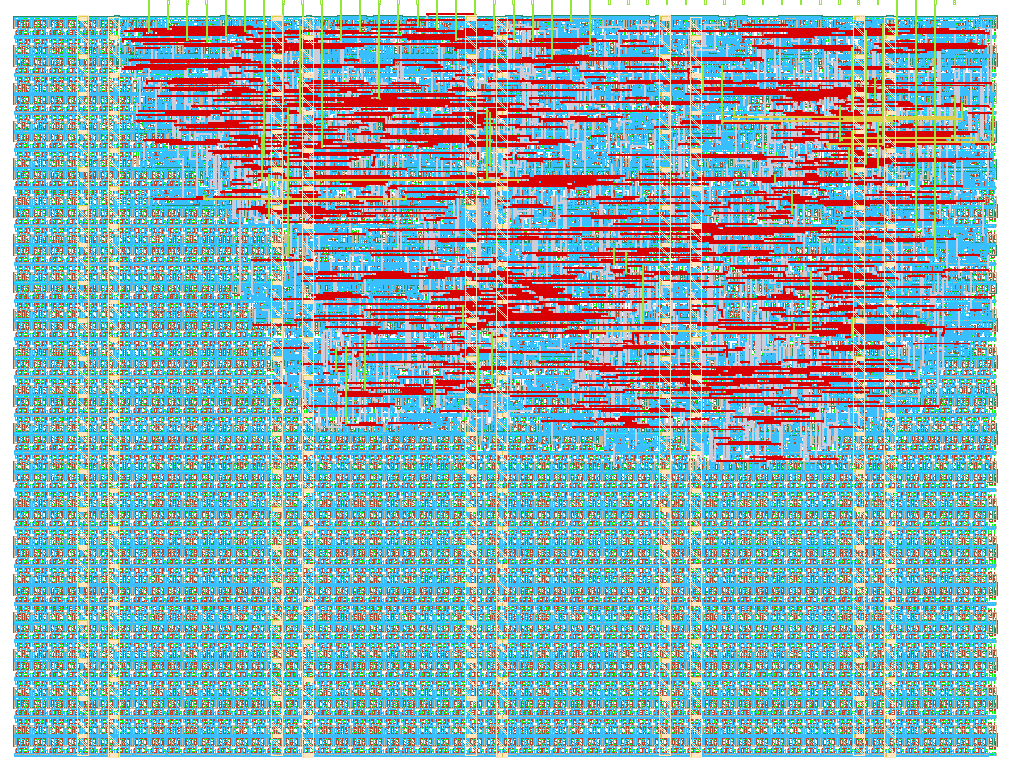
- Author: Dr Aditya Kumar Singh Pundir, Dr Pallavi Singh
- Description: Memory Built-In Self-Test (March C-) and Built-In Self-Repair with CAM-based faulty address remapping.
- GitHub repository
- Open in 3D viewer
- Open in Tiny Tapeout Explorer
- Clock: 10000000 Hz
MBIST with MBISR Memory Test and Repair System
How it works
This project implements a Memory Built-In Self-Test (MBIST) controller with integrated Memory Built-In Self-Repair (MBISR) capabilities. The system automatically tests an embedded 256×8-bit SRAM memory and can repair faulty cells on-the-fly.
Key Components:
-
MBIST Controller (
mbist_marchc_controller.v):- Implements March C- algorithm (simplified variant)
- Tests memory with pattern: {↕(w0); ↑(r0,w1); ↓(r1,w0); ↑(r0)}
- Reports per-address failures via
fail_validandfail_addrsignals
-
MBISR Controller (
mbisr_controller.v):- Content-Addressable Memory (CAM) style repair logic
- Supports up to 16 repair entries
- Automatically remaps faulty addresses to spare memory region (0xF0-0xFF)
- Transparent to user - faulty addresses are automatically redirected
-
Memory Module (
memory.v):- 256×8-bit synchronous SRAM
- Configurable address and data widths
- Supports read/write operations
-
Integration Top (
top.v):- Connects MBIST, MBISR, and memory modules
- Manages test execution and repair coordination
Operation Flow:
- Initialization: Memory is cleared to zero on reset
- Test Start: User asserts
STARTsignal - March C- Execution: MBIST runs through 4 march elements:
- Write 0 ascending (↕w0)
- Read 0, Write 1 ascending (↑r0,w1)
- Read 1, Write 0 descending (↓r1,w0)
- Read 0 ascending verification (↑r0)
- Fault Detection: Any mismatched read triggers failure reporting
- Automatic Repair: MBISR records faulty addresses and remaps to spares
- Completion:
DONEsignal asserted,FAILindicates if faults were found
How to test
Test Interface:
Inputs:
clk: System clock (any frequency up to 1MHz)rst_n: Active-low reset (assert to initialize)START(ui[0]): Begin MBIST test (pulse high)
Outputs:
DONE(uo[0]): Test completion indicator (high when finished)FAIL(uo[1]): Fault detection indicator (high if any faults found)
Test Procedure:
- Apply clock signal (typically 1-10MHz)
- Release reset (set
rst_n = 1) - Start test (pulse
STARThigh for at least 1 clock cycle) - Monitor outputs:
DONE = 0,FAIL = 0: Test in progressDONE = 1,FAIL = 0: Test passed (memory intact)DONE = 1,FAIL = 1: Test completed with faults (repairs applied)
- Repeat test as needed (system resets between runs)
Simulation Testing:
cd test
make          # Run RTL simulation
make GATES=yes # Run gate-level simulation
IO
| # | Input | Output | Bidirectional |
|---|---|---|---|
| 0 | START | DONE | |
| 1 | FAIL | ||
| 2 | |||
| 3 | |||
| 4 | |||
| 5 | |||
| 6 | |||
| 7 |