611 RNG
611 : RNG
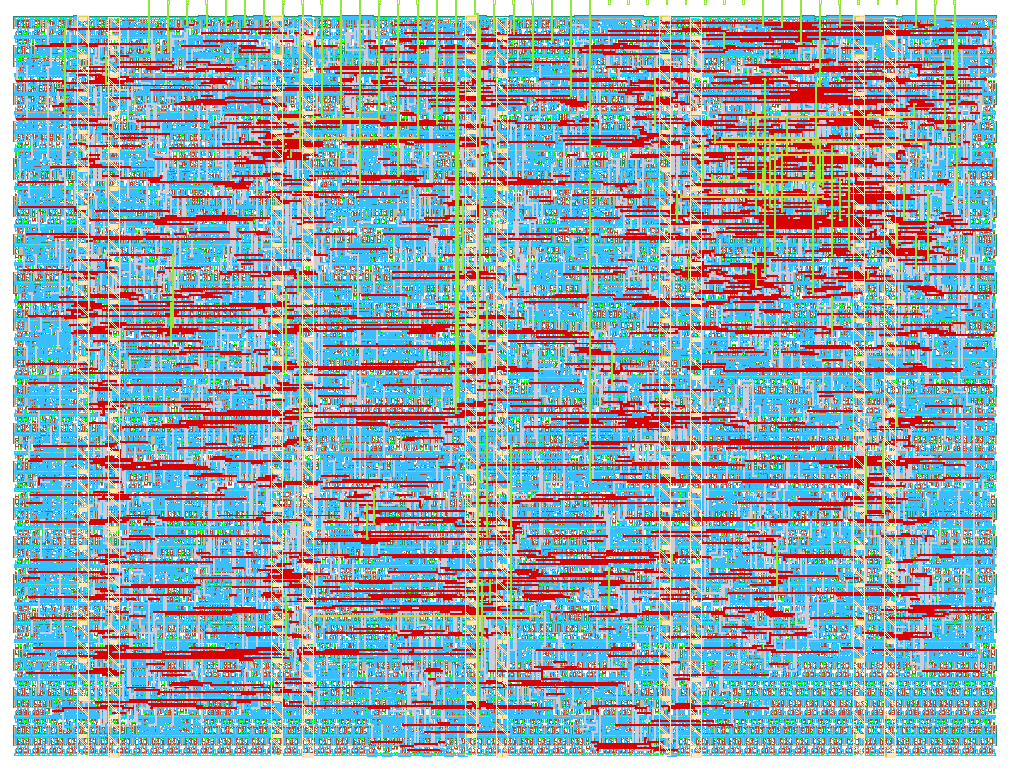
- Author: Felix N
- Description: Ring oscillator based random number generator
- GitHub repository
- Open in 3D viewer
- Open in Tiny Tapeout Explorer
- Clock: 500000 Hz
How it works
This project is a true random number generator.
The core of the TRNG is a set of three ring oscillators of different lengths (5, 11, and 23 inverters). These oscillators produce unstable, jittery signals. The outputs are combined using an XOR gate to create a chaotic bit stream. Here is the ring oscillator frequency estimates:
| Ring Oscillator | Frequency Estimate | Period Estimate |
|---|---|---|
| 5 | ~231 MHz | 4.32 ns |
| 11 | ~117 MHz | 8.52 ns |
| 23 | ~59 MHz | 16.91 ns |
The raw random bitstream may have a bias (more 1s than 0s). To correct this, a Von Neumann corrector is used. It takes pairs of bits from the stream:
- If the bits are 01, it outputs a 0.
- If the bits are 10, it outputs a 1.
If the bits are the same (00 or 11), it outputs nothing.
The debiased bits are collected one by one and shifted into a 32-bit register. Once a 32 bit number has been collected, it is output through the UART.
7-Segment Display Output
The lower 8 bits of the random number are displayed as two hexadecimal digits on a multiplexed 7-segment display. The display uses time-division multiplexing at ~122 Hz to alternate between the lower nibble (bits 3:0) and upper nibble (bits 7:4).
The bidirectional I/O pins output the 7-segment data:
uio_out[6:0]: Segment data (active high, standard gfedcba mapping)uio_out[7]: Digit select (0 = lower nibble, 1 = upper nibble)
Display Update Speed Control
The display update rate is controlled by the dedicated input pins (DIP switches). Only the upper 5 bits (ui_in[7:3]) are used, providing 32 speed levels with exponential scaling. Each step doubles the update speed.
| DIP Setting (ui_in) | Update Interval @ 500kHz |
|---|---|
| 0x00 - 0x07 | ~30 min (slowest) |
| 0x08 - 0x0F | ~15 min |
| 0x10 - 0x17 | ~7.5 min |
| 0x20 - 0x27 | ~1.9 min |
| 0x40 - 0x47 | ~7 sec |
| 0x60 - 0x67 | ~0.4 sec |
| 0x80 - 0x87 | ~27 ms |
| 0xF8 - 0xFF | ~0.8 us (fastest) |
How to test
UART Output
To test the design via UART, connect a UART-to-USB adapter to the uo_out[0] pin (which is the UART TX pin), the ground pin, and the power pin of your board.
Configure the serial terminal to match the UART settings:
- Baud Rate: 9600
- Data Bits: 8
- Parity: None
- Stop Bits: 1
Once connected, you should see a continuous stream of raw binary data appearing in your terminal. This is the 32-bit random numbers being sent from the chip.
7-Segment Display
Connect a dual-digit 7-segment display (common cathode, active high) to the bidirectional I/O pins:
uio_out[0]- Segment auio_out[1]- Segment buio_out[2]- Segment cuio_out[3]- Segment duio_out[4]- Segment euio_out[5]- Segment fuio_out[6]- Segment guio_out[7]- Digit select (directly drives digit enable/common)
Use the DIP switches on ui_in[7:3] to adjust the display update speed. Set to a higher value (e.g., 0x60) for a comfortable ~0.4 second update rate.
Ring Oscillator Outputs
The raw ring oscillator outputs can be monitored on the uo_out[1], uo_out[2], and uo_out[3] pins, which correspond to the 6, 12, and 24 inverter ring oscillators respectively.
External hardware
- A UART-to-USB adapter to connect the chip's UART output to a computer
- A dual-digit 7-segment display (common cathode) with appropriate current-limiting resistors
- 8 DIP switches connected to ui_in for speed control
IO
| # | Input | Output | Bidirectional |
|---|---|---|---|
| 0 | UART TX | SEG_A | |
| 1 | Ring oscillator 6 | SEG_B | |
| 2 | Ring oscillator 12 | SEG_C | |
| 3 | Speed control bit 0 | Ring oscillator 24 | SEG_D |
| 4 | Speed control bit 1 | SEG_E | |
| 5 | Speed control bit 2 | SEG_F | |
| 6 | Speed control bit 3 | SEG_G | |
| 7 | Speed control bit 4 | Digit select |