232 8-bit SEM Floating-Point Multiplier
232 : 8-bit SEM Floating-Point Multiplier
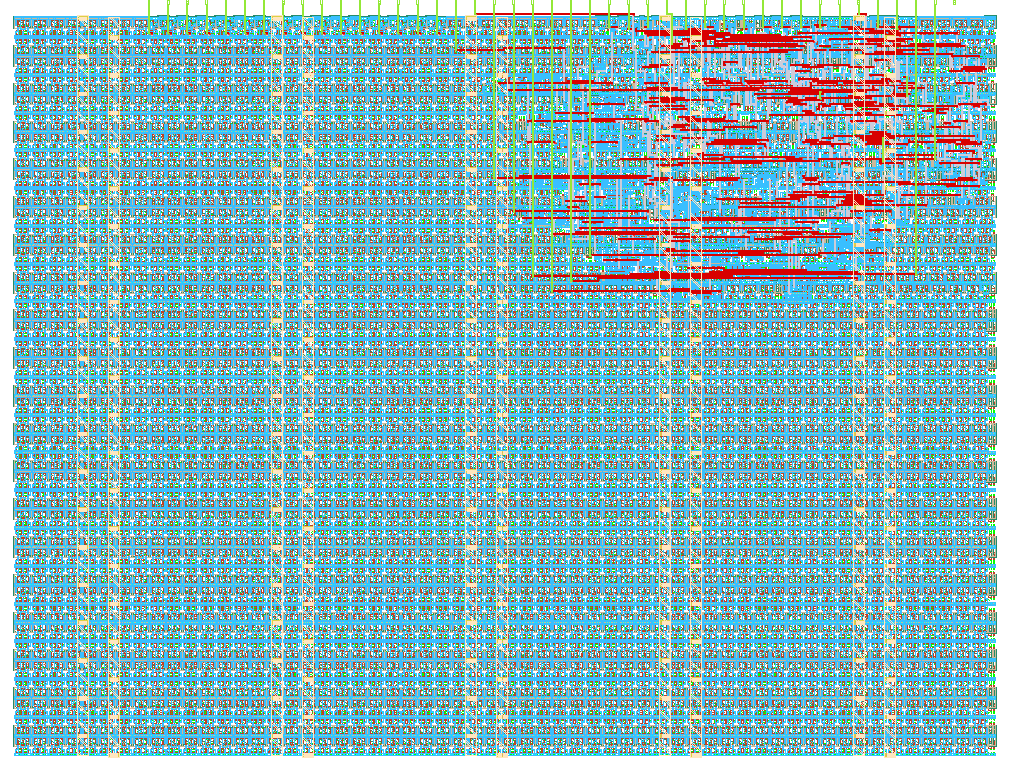
- Author: Jordan Delos Reyes
- Description: Custom 8-bit Sign-Exponent-Mantissa floating-point multiplier with NaN and zero handling.
- GitHub repository
- Open in 3D viewer
- Open in Tiny Tapeout Explorer
- Clock: 50000000 Hz
8-bit SEM Floating-Point Multiplier
What it does
This project implements an 8-bit floating-point multiplier using a custom Sign–Exponent–Mantissa (SEM) format.
Each 8-bit number is structured as:
S EEEE MMM
- 1 sign bit
- 4 exponent bits
- 3 mantissa bits
The design multiplies two SEM numbers and produces an 8-bit SEM result. The architecture is divided into three major blocks:
- Sign computation
- Mantissa multiplication and normalization
- Exponent addition and adjustment
The design also handles two special cases:
-
NaN
If either input equalsS.1111.111, the output is forced to0_1111_111. -
Zero
If either input equalsS.0000.000, the output is forced to0_0000_000.
Priority:
NaN > Zero > Normal multiplication
How to use
Inputs
ui_in[7:0]→ Operand A (SEM format)uio_in[7:0]→ Operand B (SEM format)clk→ Clockrst_n→ Active-low reset
Output
uo_out[7:0]→ Result (SEM format)
Operation
- Apply operands A and B.
- Pulse reset low to initialize the system.
- On the next clock edge, the multiplier produces the result.
The design is fully synchronous and updates on the rising edge of clk.
Example
Input A: 0_0101_010
Input B: 0_0011_001
Output: S_EEEE_MMM (result of SEM multiplication)
If either input is:
x_1111_111 → Output = 0_1111_111 (NaN)
x_0000_000 → Output = 0_0000_000 (Zero)
External hardware
No external hardware is required.
The module is fully self-contained and purely digital.
Design details
The multiplier is implemented using three synchronous submodules:
-
sign
Computes the result sign as the XOR of the input signs. -
mantissa
Multiplies mantissas, normalizes the result, and generates an exponent increment. -
exponent
Adds exponents and applies normalization adjustment.
The final result is registered for synchronous output.
Limitations
- No support for infinities.
- Only a single canonical NaN is supported.
- Exponent overflow behavior depends on internal saturation logic.
Verification
The design was verified through simulation of:
- Normal multiplication cases
- Zero input cases
- NaN input cases
- Sign combinations
IO
| # | Input | Output | Bidirectional |
|---|---|---|---|
| 0 | A_M0 | R_M0 | B_M0 |
| 1 | A_M1 | R_M1 | B_M1 |
| 2 | A_M2 | R_M2 | B_M2 |
| 3 | A_E0 | R_E0 | B_E0 |
| 4 | A_E1 | R_E1 | B_E1 |
| 5 | A_E2 | R_E2 | B_E2 |
| 6 | A_E3 | R_E3 | B_E3 |
| 7 | A_S | R_S | B_S |