111 Two LIF Neurons with STDP Learning
111 : Two LIF Neurons with STDP Learning
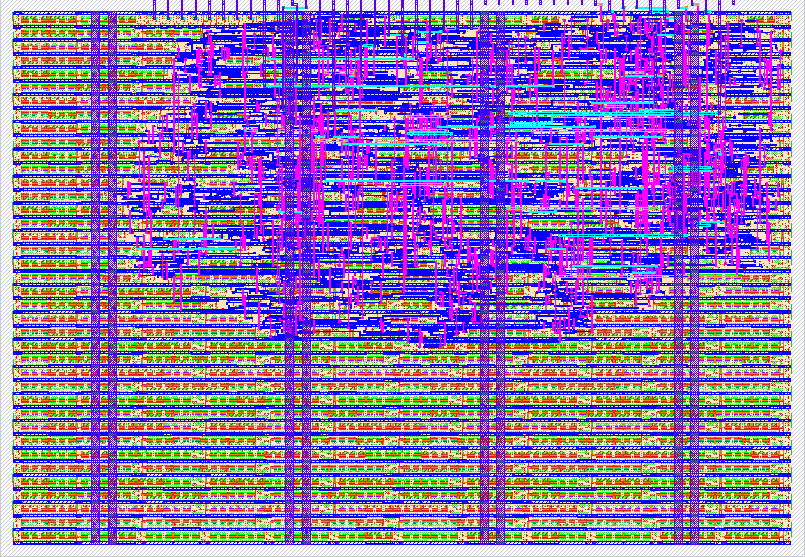
- Author: Sebastian Hernandez
- Description: A compact spiking neural network implementation featuring: - Two Leaky Integrate-and-Fire (LIF) neurons connected via plastic synapse - Spike-timing-dependent plasticity (STDP) for dynamic weight adjustment - 8-bit fixed-point arithmetic for state and weight representation - Real-time monitoring of spikes and synaptic weight
- GitHub repository
- Open in 3D viewer
- Open in Tiny Tapeout Explorer
- Clock: 50000000 Hz
How it works
This design implements a simple spiking neural network using two Leaky Integrate-and-Fire (LIF) neurons connected by a spike-timing-dependent plasticity (STDP) synapse. The system consists of:
Two LIF Neurons:
- Basic integrate-and-fire dynamics with leaky integration
- 8-bit resolution for state and current
- Configurable threshold (default: 150)
- Slower decay rate (state >> 2) for better temporal integration
- First neuron receives direct current input
- Second neuron receives weighted input from first neuron
STDP Synapse:
- Connects the two neurons with plastic weight
- Initial weight: 100
- Potentiation: +20 when pre-spike precedes post-spike
- Depression: -10 when post-spike precedes pre-spike
- Timing window: 10 clock cycles
- Weight bounded between 0 and 255
Implementation Features:
- Simple fixed-point arithmetic
- Synchronous design with clock and reset
- Bounded calculations to prevent overflow
- Modular design with separate neuron and STDP modules
How to test
The design can be tested in several ways:
Basic Functionality
- Apply current through ui_in[7:0]
- Monitor second neuron's state on uo_out[7:0]
- Observe spikes on uio_out[7:6]
- View synapse weight on uio_out[5:0]
Spike Generation Test
// Example test sequence
ui_in = 8'h60;  // Apply strong current
#100;           // Wait for first neuron to spike
ui_in = 8'h00;  // Remove current
#100;           // Observe reset and decay
STDP Learning
- Generate regular spikes in first neuron with steady current
- Observe weight changes on uio_out[5:0]
- Monitor second neuron's response on uo_out[7:0]
External hardware
No external hardware is required for basic operation. For analysis, consider:
Logic Analyzer:
- Monitor spike timing
- Track synaptic weight changes
- Verify state transitions
Signal Generator (optional):
- Generate precise current injection patterns
- Test different input frequencies
- Analyze neuron response characteristics
Target Performance
The design aims to achieve:
- State Resolution: 8-bit (0-255)
- Threshold: 150 (configurable)
- Weight Range: 0-255
- STDP Window: 10 clock cycles
- Decay Rate: state >> 2 (75% retention per cycle)
Resource Usage
The implementation utilizes:
- Minimal combinational logic for state updates
- Three 8-bit registers per neuron (state, threshold)
- 8-bit register for synaptic weight
- Two 4-bit counters for STDP timing
- Basic arithmetic operations (addition, multiplication, shift)
Future Improvements
Possible enhancements:
- Multiple neurons with configurable connectivity
- Variable thresholds and decay rates
- More sophisticated STDP rules
- Inhibitory connections
- Configurable timing windows
- Additional input/output neurons
- Parameter runtime configurability
- More complex neural dynamics (e.g., adaptive thresholds)
IO
| # | Input | Output | Bidirectional |
|---|---|---|---|
| 0 | Input current bit 0 (LSB) | Neuron 2 state bit 0 (LSB) | Synapse weight bit 0 (LSB) |
| 1 | Input current bit 1 | Neuron 2 state bit 1 | Synapse weight bit 1 |
| 2 | Input current bit 2 | Neuron 2 state bit 2 | Synapse weight bit 2 |
| 3 | Input current bit 3 | Neuron 2 state bit 3 | Synapse weight bit 3 |
| 4 | Input current bit 4 | Neuron 2 state bit 4 | Synapse weight bit 4 |
| 5 | Input current bit 5 | Neuron 2 state bit 5 | Synapse weight bit 5 |
| 6 | Input current bit 6 | Neuron 2 state bit 6 | Neuron 2 spike output |
| 7 | Input current bit 7 (MSB) | Neuron 2 state bit 7 (MSB) | Neuron 1 spike output |