578 Balanced Ternary Multiplier

578 : Balanced Ternary Multiplier
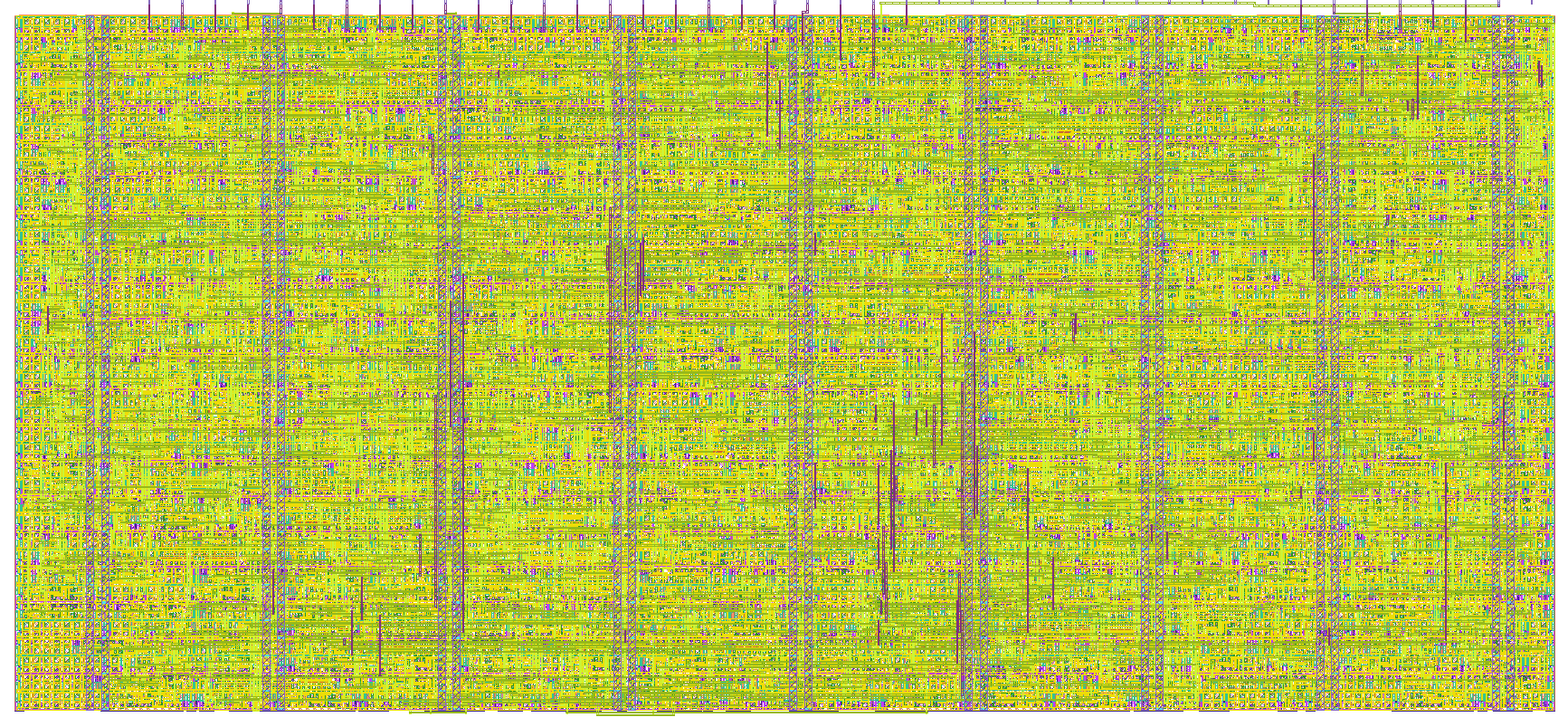
Design render

How it works

tt_um_ttmul is a balanced-ternary integer multiplier. Internally it does not multiply in binary at all — it converts the binary operands to balanced ternary (digits −1, 0, +1), multiplies them with a serial ternary shift-and-add core, then converts the product back to binary. The binary interface makes it a drop-in multiplier for a conventional host, while the arithmetic is done the way the historic Soviet Setun-1958 computer did it.

The datapath reuses building blocks from Serge Rabyking's Amaranth HDL implementation of the Setun-1958 computer (the Setun-HDL project):

 binary serial in                                                  binary serial out
 ui_in[0] sdi_a ─► StreamingBinaryToTernary A ─┐
                                                ├─► TernarySerialMultiplier ─► SerialTernaryToBinary ─► uo_out[0] sdo
 ui_in[1] sdi_b ─► StreamingBinaryToTernary B ─┘     (full 2·w-trit product)
  • Binary → ternary uses Horner's method, one bit per clock — the same on-the-fly converter that fed the Tang Nano SPI-flash boot loader.
  • Ternary multiply is a schoolbook shift-and-add over balanced trits (single full-adder + sign gate), producing the full 2·width-trit product.
  • Ternary → binary uses Horner's method, one trit per clock.

A trit is encoded in 2 bits internally (p,n): 0=00, +1=01, −1=10.

Operands are 8-bit two's complement (−128..+127), converted to 6 trits each:

Quantity Value
Operand load bits 8 (two's complement)
Product trits 12
Result bits 16 (signed; 8×8 products span −16256..+16384)

How to test

The host steps clk and drives the control pins one bit at a time. All control inputs are active-high and sampled on the rising edge of clk.

  1. Reset: hold rst_n low for a few clocks, then release.
  2. Load both operands together: for 8 clocks, present each bit of A on ui_in[0] (sdi_a) and the matching bit of B on ui_in[1] (sdi_b), MSB first, two's complement, with ui_in[2] (wr) high.
  3. Start: pulse ui_in[3] (go) high for one clock. uo_out[1] (busy) stays high while it computes.
  4. Wait until uo_out[2] (ready) goes high.
  5. Read the result: for 16 clocks, read uo_out[0] (sdo) MSB first (two's complement), pulsing ui_in[4] (rd) high to advance to the next bit. uo_out[3] (done) pulses high on the final bit.

The cocotb test in test/test.py exercises this protocol with fixed and random operands, including the corners 127 × 127 = 16129 and −128 × −128 = 16384.

External hardware

None required. Drive the pins directly from the RP2040 on the Tiny Tapeout demo board (or any microcontroller / logic). No external components needed.

Pinout

Pin Direction Function
ui_in[0] in sdi_a — operand A serial data in (MSB first, two's complement)
ui_in[1] in sdi_b — operand B serial data in (MSB first, two's complement)
ui_in[2] in wr — shift-in strobe (shifts one bit of A and B per asserted clk)
ui_in[3] in go — start multiply (pulse after both operands loaded)
ui_in[4] in rd — shift-out strobe (advance to next result bit)
uo_out[0] out sdo — serial data out (result bit, MSB first, two's complement)
uo_out[1] out busy — convert/multiply/convert in progress
uo_out[2] out ready — result available, drive rd to read it out
uo_out[3] out done — high in the cycle the last result bit is shifted out

The bidirectional uio pins are unused (driven as inputs, uio_oe = 0).

IO

#InputOutputBidirectional
0sdi_a - operand A serial data in (MSB first, two's complement)sdo - serial data out (result bit, MSB first, two's complement)
1sdi_b - operand B serial data in (MSB first, two's complement)busy - convert/multiply/convert in progress
2wr - shift-in strobe (shifts one bit of A and B per asserted clk)ready - result available, drive rd to read it out
3go - start multiply (pulse after both operands loaded)done - high in the cycle the last result bit is shifted out
4rd - shift-out strobe (advance to next result bit)
5
6
7

Chip location

Controller Mux Mux Mux Mux Mux Mux Mux Mux Mux Mux Mux Mux Mux Mux Mux tt_um_chip_rom (Chip ROM) tt_um_factory_test (Tiny Tapeout Factory Test) tt_um_utoss_riscv (UTOSS RISC-V core) tt_um_memory_game_top (Number Memory Game) tt_um_danielpenas42 (Ball Display) tt_um_machinelearning (7-Segment Neural Predictor) tt_um_microlane_demo (microlane demo project) tt_um_pixel_processor (Tiny Pixel Processor) tt_um_jpigdon_gps_accelerator_top (GPS_Accelerator) tt_um_rgb_mixer (rgb_mixer) tt_um_bgao43 (Tiny TPU Systolic Array) tt_um_main (Pong in Verilog) tt_um_joannec34_teenytpu (teenytpu) tt_um_apa102_ws2812_squidgeefish (APA102 to WS2812 Translator) tt_um_uacj_bouncing_DVD_screensaver (Custom DVD Screensaver for VGA) tt_um_logoUACJ_MOGA (VGA_screensaver_UACJ) tt_um_grace_spi_led_driver (SPI-Controlled 8-Channel LED Driver) tt_um_rebeccargb_universal_decoder (Universal Binary to Segment Decoder) tt_um_rebeccargb_hardware_utf8 (Hardware UTF Encoder/Decoder) tt_um_happyhop_deadcast2 (happyhop) tt_um_dino7 (Dino-7: 7-Segment Runner Game) tt_um_arty3_mac_engine (Simple MAC Engine w/ Postproc) tt_um_uacj (Custom DVD Screensaver for VGA) tt_um_algofoogle_dottee (DOTTEE VGA demo (TTGF26a)) tt_um_mattvenn_signal_generator (Simple Signal Generator) tt_um_urish_simon (Simon Says memory game) tt_um_tpu (Tensor Processing Unit For GF) tt_um_gojimmypi_ttgf_UART_FSM_TRNG_Lab (Hardware Entropy Explorer: UART/SPI TRNG and PUF) tt_um_wokwi_465483277165299713 (First Tinytapeout) tt_um_prem_pipeline_test (Programmable_Pipeline-RISC-V) tt_um_wokwi_467219410242853889 (Tiny Tapeout testtest 111233) tt_um_wokwi_465549494272929793 (Pacos first design) tt_um_wokwi_465731371445677057 (Arturo's first Wokwi design) tt_um_wokwi_465732744934845441 (Tiny Tapeout Template_1234) tt_um_wokwi_465736492859711489 (Tiny Tapeout Workshop JuanF) tt_um_wokwi_465731430225727489 (Rafa’s first Wokwi design) tt_um_wokwi_465731458365332481 (7 segment Display Fli-Flop Try-out) tt_um_wokwi_465732744245929985 (DiseñoCursoTiny) tt_um_wokwi_465731490568160257 (Matt’s first Wokwi design) tt_um_wokwi_465736691688630273 (test1) tt_um_wokwi_465731458628527105 (Mi copia del Tiny Tapeout) tt_um_wokwi_465731520738845697 (El primer diseño) tt_um_wokwi_465731521356457985 (Tiny Tapeout Template Copy) tt_um_gen1_digital_companion_tile (Gen1 Digital Companion Tile) tt_um_wokwi_465732827753495553 (Tiny Tapeout Template Ayman) tt_um_wokwi_465731394728267777 (Julian_Proyecto) tt_um_wokwi_465731458535202817 (Tiny Tapeout Template Copy) tt_um_wokwi_465732847401723905 (Basic Circuit) tt_um_wokwi_465731452481768449 (El primer diseño de Matt para Wokwi) tt_um_wokwi_465731502018614273 (Tiny Tapeout Template flip flop) tt_um_wokwi_465732616714924033 (Tiny Tapeout RJAP) tt_um_wokwi_465731575275296769 (ocxpkeWokwiDesign) tt_um_wokwi_465732880722332673 (Pedro Template) tt_um_wokwi_465731858252480513 (Paula's first Wokwi design) tt_um_wokwi_465731455677830145 (Tiny Tapeout JMCG) tt_um_wokwi_465737601403996161 (Tiny Number Simon) tt_um_ttmul (Balanced Ternary Multiplier) tt_um_wokwi_465731466664816641 (Tiny Tapeout Workshop Malaga 2jun2026) tt_um_8bit_risc_cpu (8-bit RISC CPU) tt_um_wokwi_451184391728659457 (Simple Sprinkler) tt_um_fhw_appel_spiPWMio (spiPWMio) tt_um_divadnauj_GB_serv_soc_wb (serv_soc_wb) tt_um_8bitcustomcomputer (SAP 8 Bit Computer) tt_um_bioimpedance (Very Low Resource Digital Implementation of Bioimpedance Analysis) tt_um_mgj_bist8 (BIST-8: Built-In Self-Test for 8-bit CLA Adder) tt_um_roberto_tiny_radar_tile (BioPulse Tile) tt_um_systolic_mac_2x2 (2x2 Systolic Array Matrix Multiplier) tt_um_peg_top (2x2 CNN Accelerator PE Grid with UART) tt_um_AlvaroRub_ringcounter (Counter16Outputs) tt_um_wokwi_465731440267947009 (Antonio's first Wokwi design) tt_um_wokwi_465732706576877569 (Guille's first Wokwi design.) tt_um_wokwi_465731481873367041 (MIPS-Lite 8-bit Processor) tt_um_wokwi_465736612213902337 (Juan`s first Worki design) tt_um_wokwi_465731439156454401 (Rhyloo’s first Wokwi design) tt_um_wokwi_465732536551273473 (Tiny Tapeout Marcos Fernandez) tt_um_wokwi_465737290543084545 (Tiny Tapeout Template) tt_um_wokwi_465630130495825921 (ram 1 bit Copy) tt_um_wokwi_465731403724006401 (sdft wokwi 1) tt_um_top (RHD2164-MCU-SPI Bridge) tt_um_line_follower_arvaloez (Line Follower Robot controller) tt_um_xoroshiro64plus_v2 (xoroshiro64) tt_um_ohuettenhofer_tiny_qsim (Tiny Quantum Circuit Simulator) tt_um_santhosh_ring_osc_gf (Ring Oscillator PVT Sensor & TRNG (GF180)) tt_um_santhosh_stoch_stdp_pair_gf (Stochastic neuron + STDP controller (merged, GF180)) tt_um_santhosh_rsd_char_gf (RRAM Characterization Platform (DC sweep + endurance + retention + histogram, GF180)) tt_um_santhosh_xbar_ctrl_gf (Memristive Crossbar Peripheral Controller (GF180)) tt_um_joseph_bf (BF) tt_um_hydrocomms (FSK Modem) tt_um_systolic_array (2x2 MAC Systolic array with DFT) tt_um_kluterirv_rv32e_core (Minimal RV32E SoC with UART Loader) tt_um_algofoogle_ttgf26a_vco (VCO driven by DAC) tt_um_fer_logo_music_vga (UNIZG-FER VGA project) tt_um_maqsudbek_dyadic_pwm (Dyadic PWM) tt_um_waferspace_vga_screensaver (Wafer.space Logo VGA Screensaver) tt_um_htfab_vga_tester (Video mode tester)