613 Dyadic PWM
613 : Dyadic PWM
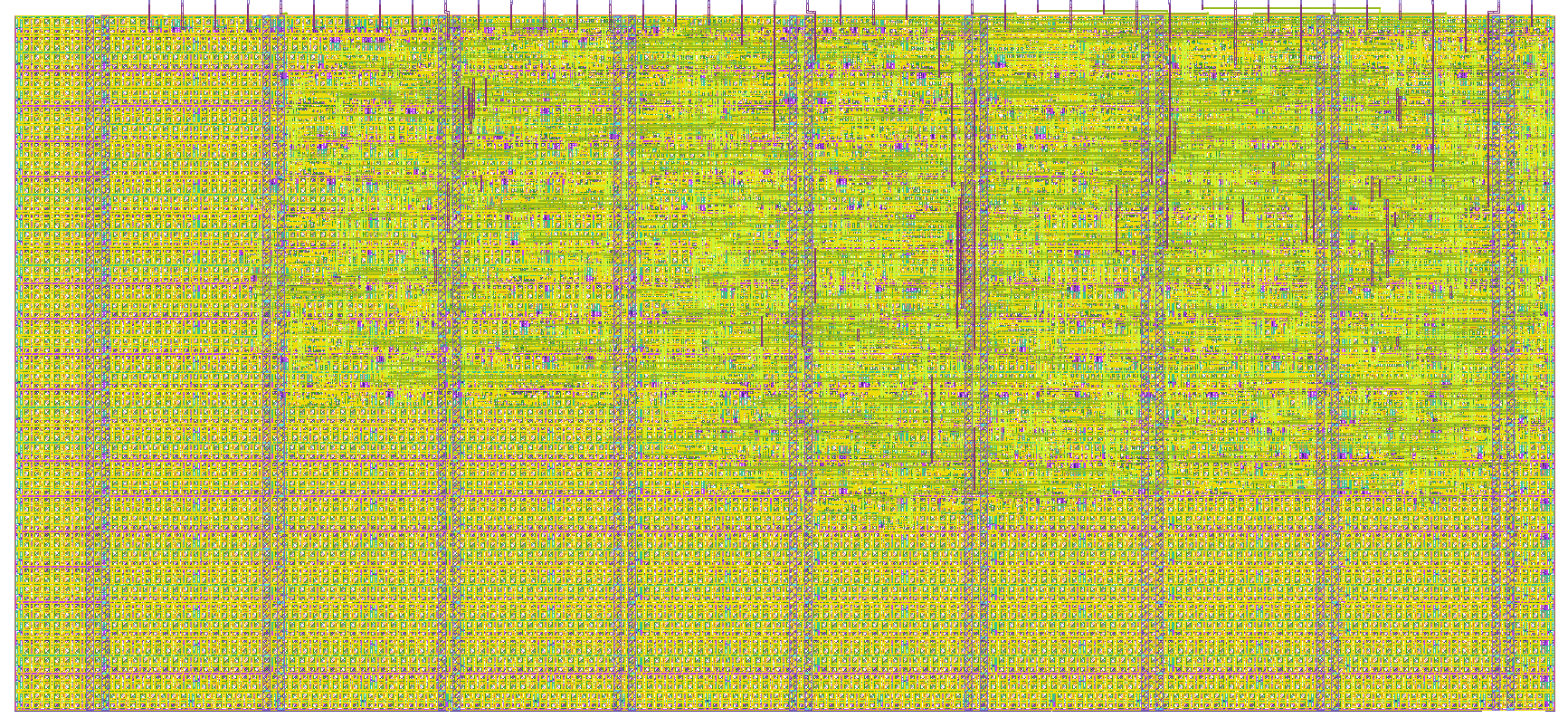
- Author: Maksudjon Usmonov
- Description: Digital PWM generator with selectable width, dyadic and dithering modulation
- GitHub repository
- Open in 3D viewer
- Open in Tiny Tapeout Explorer
- Clock: 50000000 Hz
How it works
This is a digital PWM (DPWM) generator with selectable resolution, dyadic modulation and dithering. A 12-bit control word sets the duty cycle; the design produces complementary high-/low-side outputs with dead-time, plus a sync clock.
Selectable width. The PWM resolution is configurable to 5, 6, 7, 8 or 9 bits. All widths
share the same 513-cycle switching period (~97.5 kHz at a 50 MHz clock); the chosen B-bit duty
is scaled onto that period by scaled = duty·2^(9−B) + max(1, 2^(8−B)).
Modes. Beyond plain Normal PWM, the design adds:
- Dyadic — the lower
mbits of the control word are distributed as a+1sequence across a 2^m-period window (the bit selected each period islsb[highest_set_bit(counter)]), raising the effective resolution by up to ~7 bits without extra base width. - Dithering v1/v2/v3 — a sigma-delta-style
+1decision (lsb ≥ counter); v2 samples the LSB once per 2^m window, v3 also samples the base duty once per window. - A constant dyadic word can replace the control LSBs as the modulation source.
Configuration interface. Static settings live in a small register file written over the pins.
uio_in[7] selects the mode:
uio_in[7] |
Meaning | ui_in[7:0] |
uio_in[6:4] |
uio_in[3:0] |
|---|---|---|---|---|
0 (run) |
drive control word | ctrl[11:4] |
— | ctrl[3:0] |
1 (config) |
write a register | write data | reg address | — |
Config registers (written while uio_in[7]=1):
Addr (uio_in[6:4]) |
Data (ui_in) |
|---|---|
0 |
[2:0]=dyadic_len (0–7), [5:3]=mode (0=Normal,1=Dyadic,2–4=Dither v1–v3), [6]=const_dyadic_flag |
1 |
[2:0]=pwm_bits_sel (0→5-bit … 4→9-bit) |
2 |
[6:0]=dyadic_word (constant modulation word) |
After reset the design defaults to 8-bit Normal PWM (dyadic_len=0), so it behaves as a plain
8-bit PWM until configured. Outputs: uo_out[0]=high-side, uo_out[1]=low-side (complementary,
6-cycle / 120 ns dead-time), uo_out[2]=sync clock, uo_out[7:3]=duty MSBs (debug, normalised to
the 9-bit domain). All uio pins are inputs.
How to test
- Hold
rst_nlow for several clocks, then release. With no configuration the design is an 8-bit PWM: driveui_inwith the duty (e.g.0x80≈ 50 %), keepuio_in = 0x00, and observeuo_out[0]/uo_out[1](complementary) and the ~97.5 kHz sync clock onuo_out[2]. - Configure features by pulsing the config interface: set
uio_in[7]=1, put the register address onuio_in[6:4]and the data onui_in, clock once, then dropuio_in[7]back to 0.- Select 5-bit width: write addr 1 =
0x00. - Dyadic, 4-bit: write addr 0 =
0x0C(mode=1, dyadic_len=4); then run withuio_in[3:0]as the LSB word — the average duty shifts bylsb/16over 16 periods. - Dithering v1: write addr 0 =
0x14(mode=2, dyadic_len=4). - Constant dyadic word: write addr 0 =
0x4C(const flag + dyadic mode, len 4) and addr 2 = the 7-bit word; the modulation then ignores the control LSBs.
- Select 5-bit width: write addr 1 =
- The cocotb testbench (
test/test.py) exercises reset, all five widths, max-duty/dead-time, the sync clock, dyadic mode, the three dithering modes and the constant-word path.
External hardware
None required for bench testing. For power-electronics use, wire uo_out[0] (high-side) and
uo_out[1] (low-side) to a half-bridge gate driver — the built-in dead-time prevents shoot-through
in, e.g., a synchronous buck converter or class-D stage.
IO
| # | Input | Output | Bidirectional |
|---|---|---|---|
| 0 | ctrl[4] / cfg_data[0] | pwm_high | ctrl[0] / - |
| 1 | ctrl[5] / cfg_data[1] | pwm_low | ctrl[1] / - |
| 2 | ctrl[6] / cfg_data[2] | sync_clk | ctrl[2] / - |
| 3 | ctrl[7] / cfg_data[3] | duty[4] | ctrl[3] / - |
| 4 | ctrl[8] / cfg_data[4] | duty[5] | cfg_addr[0] |
| 5 | ctrl[9] / cfg_data[5] | duty[6] | cfg_addr[1] |
| 6 | ctrl[10] / cfg_data[6] | duty[7] | cfg_addr[2] |
| 7 | ctrl[11] / cfg_data[7] | duty[8] | cfg_we (1=config write) |