3 Counter16Outputs
3 : Counter16Outputs
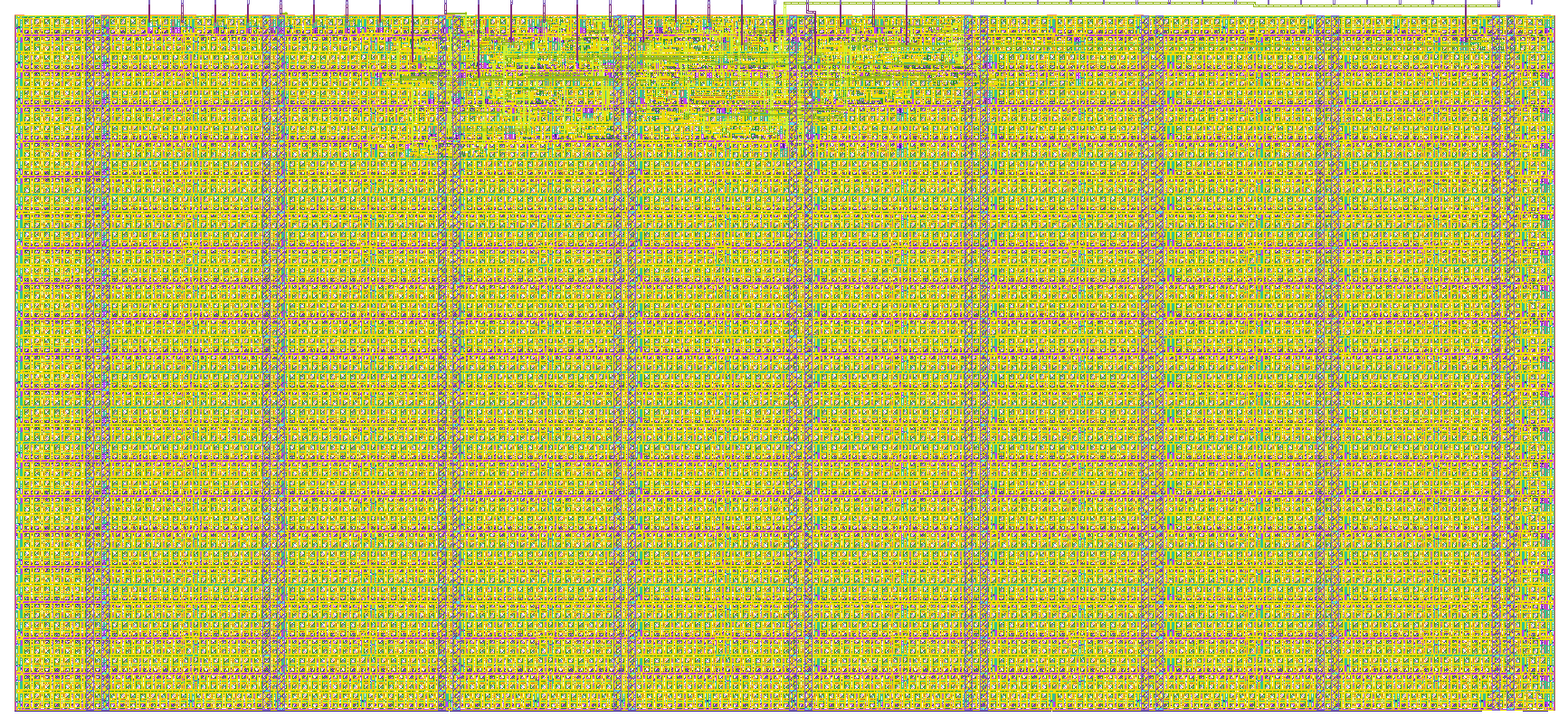
- Author: Alvaro Rubio
- Description: A 16-bit ring counter that sequentially activates its outputs at the clock rate.
- GitHub repository
- Open in 3D viewer
- Open in Tiny Tapeout Explorer
- Clock: 0 Hz
How it works
This project implements a 16-bit "one-hot" ring counter. It consists of a circular shift register where a single high bit (1) advances sequentially across the 16 outputs.
The internal operation is as follows:
- Initialization: Upon activating the reset signal (the
rst_npin in Tiny Tapeout, which is internally inverted to an active-highrstin the counter's logic), the register is loaded with the initial value16'b0000_0000_0000_0001. This turns on only the first output. - Shifting: On every rising edge of the clock signal (
clk), the bits shift one position to the left. The most significant bit (MSB, bit 15) is fed back to the least significant position (LSB, bit 0), creating an infinite loop. - Output mapping: To accommodate the 16 outputs within the Tiny Tapeout architecture, the first 8 bits (0 to 7) are assigned to the dedicated output pins (
uo_out), and the next 8 bits (8 to 15) are assigned to the bidirectional pins (uio_out), which are permanently configured as outputs viauio_oe.
How to test
To test the design on the physical evaluation board (or in the Wokwi/Verilator simulator):
- Clock Configuration: Select a very low clock frequency (e.g., 1 Hz to 10 Hz) using the baseboard configuration or an external pulse generator. This will allow you to see the bit shifting visually.
- Reset: Press the button associated with the reset signal (
rst_non the board is usually active-low). While the reset is held, only the first LED corresponding touo_out[0]should be lit. - Execution: Release the reset button. You should observe the lit LED "traveling" sequentially from
uo_out[0]touo_out[7], and then continuing its path throughuio_out[0]touio_out[7]. Once it reaches the last pin, the cycle starts again atuo_out[0].
External hardware
No special external hardware is required if using the standard Tiny Tapeout demonstration board, as it includes a clock generator, pushbuttons for inputs, and LEDs to visualize the outputs.
If mounted on a custom breadboard, the following will be needed:
- A clock source (e.g., a 555 timer-based oscillator or a microcontroller).
- 16 LEDs connected to the
uo_outanduio_outpins, along with their respective current-limiting resistors (e.g., 330 Ω to 1 kΩ). - A pushbutton with a pull-up resistor for the reset signal.
IO
| # | Input | Output | Bidirectional |
|---|---|---|---|
| 0 | out_0 | out_8 | |
| 1 | out_1 | out_9 | |
| 2 | out_2 | out_10 | |
| 3 | out_3 | out_11 | |
| 4 | out_4 | out_12 | |
| 5 | out_5 | out_13 | |
| 6 | out_6 | out_14 | |
| 7 | out_7 | out_15 |