578 Balanced Ternary Multiplier
578 : Balanced Ternary Multiplier
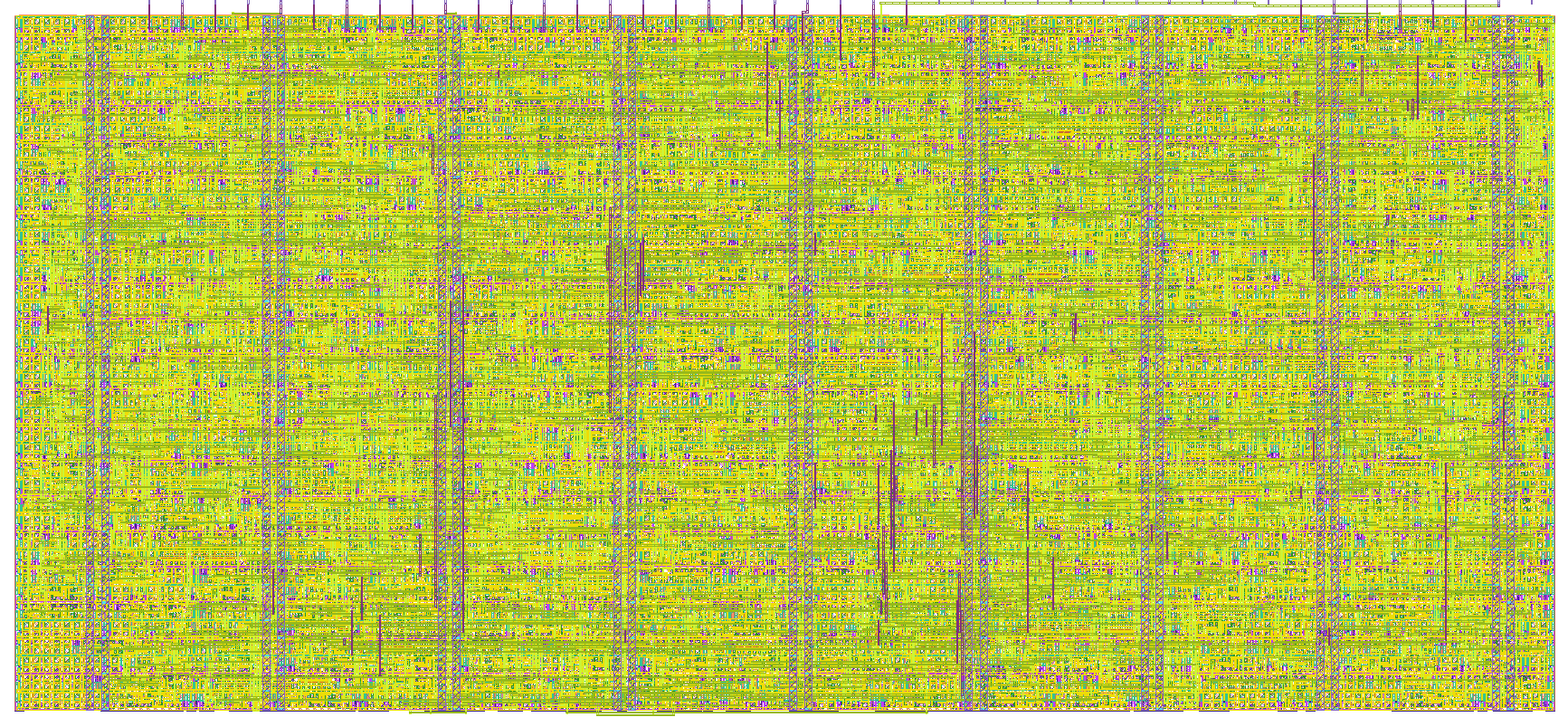
- Author: Serge Rabyking
- Description: Serial balanced-ternary multiplier: two 8-bit signed in, 16-bit signed out
- GitHub repository
- Open in 3D viewer
- Open in Tiny Tapeout Explorer
- Clock: 50000000 Hz
How it works
tt_um_ttmul is a balanced-ternary integer multiplier. Internally it does
not multiply in binary at all — it converts the binary operands to balanced
ternary (digits −1, 0, +1), multiplies them with a serial ternary
shift-and-add core, then converts the product back to binary. The binary
interface makes it a drop-in multiplier for a conventional host, while the
arithmetic is done the way the historic Soviet Setun-1958 computer did it.
The datapath reuses building blocks from Serge Rabyking's Amaranth HDL implementation of the Setun-1958 computer (the Setun-HDL project):
 binary serial in                                                  binary serial out
 ui_in[0] sdi_a ─► StreamingBinaryToTernary A ─┐
                                                ├─► TernarySerialMultiplier ─► SerialTernaryToBinary ─► uo_out[0] sdo
 ui_in[1] sdi_b ─► StreamingBinaryToTernary B ─┘     (full 2·w-trit product)
- Binary → ternary uses Horner's method, one bit per clock — the same on-the-fly converter that fed the Tang Nano SPI-flash boot loader.
- Ternary multiply is a schoolbook shift-and-add over balanced trits
(single full-adder + sign gate), producing the full
2·width-trit product. - Ternary → binary uses Horner's method, one trit per clock.
A trit is encoded in 2 bits internally (p,n): 0=00, +1=01, −1=10.
Operands are 8-bit two's complement (−128..+127), converted to 6 trits each:
| Quantity | Value |
|---|---|
| Operand load bits | 8 (two's complement) |
| Product trits | 12 |
| Result bits | 16 (signed; 8×8 products span −16256..+16384) |
How to test
The host steps clk and drives the control pins one bit at a time. All
control inputs are active-high and sampled on the rising edge of clk.
- Reset: hold
rst_nlow for a few clocks, then release. - Load both operands together: for 8 clocks, present each bit of A on
ui_in[0](sdi_a) and the matching bit of B onui_in[1](sdi_b), MSB first, two's complement, withui_in[2](wr) high. - Start: pulse
ui_in[3](go) high for one clock.uo_out[1](busy) stays high while it computes. - Wait until
uo_out[2](ready) goes high. - Read the result: for 16 clocks, read
uo_out[0](sdo) MSB first (two's complement), pulsingui_in[4](rd) high to advance to the next bit.uo_out[3](done) pulses high on the final bit.
The cocotb test in test/test.py exercises this protocol with fixed and
random operands, including the corners 127 × 127 = 16129 and
−128 × −128 = 16384.
External hardware
None required. Drive the pins directly from the RP2040 on the Tiny Tapeout demo board (or any microcontroller / logic). No external components needed.
Pinout
| Pin | Direction | Function |
|---|---|---|
| ui_in[0] | in | sdi_a — operand A serial data in (MSB first, two's complement) |
| ui_in[1] | in | sdi_b — operand B serial data in (MSB first, two's complement) |
| ui_in[2] | in | wr — shift-in strobe (shifts one bit of A and B per asserted clk) |
| ui_in[3] | in | go — start multiply (pulse after both operands loaded) |
| ui_in[4] | in | rd — shift-out strobe (advance to next result bit) |
| uo_out[0] | out | sdo — serial data out (result bit, MSB first, two's complement) |
| uo_out[1] | out | busy — convert/multiply/convert in progress |
| uo_out[2] | out | ready — result available, drive rd to read it out |
| uo_out[3] | out | done — high in the cycle the last result bit is shifted out |
The bidirectional uio pins are unused (driven as inputs, uio_oe = 0).
IO
| # | Input | Output | Bidirectional |
|---|---|---|---|
| 0 | sdi_a - operand A serial data in (MSB first, two's complement) | sdo - serial data out (result bit, MSB first, two's complement) | |
| 1 | sdi_b - operand B serial data in (MSB first, two's complement) | busy - convert/multiply/convert in progress | |
| 2 | wr - shift-in strobe (shifts one bit of A and B per asserted clk) | ready - result available, drive rd to read it out | |
| 3 | go - start multiply (pulse after both operands loaded) | done - high in the cycle the last result bit is shifted out | |
| 4 | rd - shift-out strobe (advance to next result bit) | ||
| 5 | |||
| 6 | |||
| 7 |