454 Tensor Processing Unit For GF
454 : Tensor Processing Unit For GF
- Author: Mocus Zhang
- Description: multiplies fp8 matrices
- GitHub repository
- Open in 3D viewer
- Open in Tiny Tapeout Explorer
- Clock: 30000000 Hz
How it works
The project is an AI chip inspired by Google's TPU. It multiply 8-bit floating-point valued matrices. It does so by tiling in 2x2 to fit on the chip's tiny area, so expect performance degradation compared to regular chips. However, the chip's I/O bandwidth will be fully utilized and saturated.
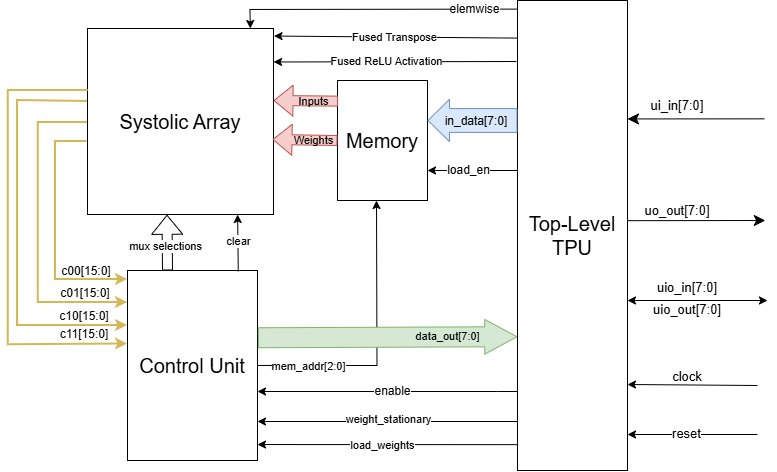
High Level Block Diagram
Architecturally more simple than the previous project. The data moves through the blue, red, yellow, and green arrows.
How to test
Use cocotb and pyuvm to lean towards IEEE-1800.2.
External hardware
Connect the PCB board with the Tiny Tapeout chips (a.k.a. a Raspberry Pi) to a personal computer via USB.
IO
| # | Input | Output | Bidirectional |
|---|---|---|---|
| 0 | IN0 | OUT0 | LOAD (input) |
| 1 | IN1 | OUT1 | TRANSPOSE (input) |
| 2 | IN2 | OUT2 | ACTIVATION (input) |
| 3 | IN3 | OUT3 | INSTRUCTION (input) |
| 4 | IN4 | OUT4 | ENABLE (input) |
| 5 | IN5 | OUT5 | STATION_WEIGHTS (input, reserved) |
| 6 | IN6 | OUT6 | LOAD_WEIGHTS (input, reserved) |
| 7 | IN7 | OUT7 | Unused |