581 SPI-Controlled 8-Channel LED Driver
581 : SPI-Controlled 8-Channel LED Driver
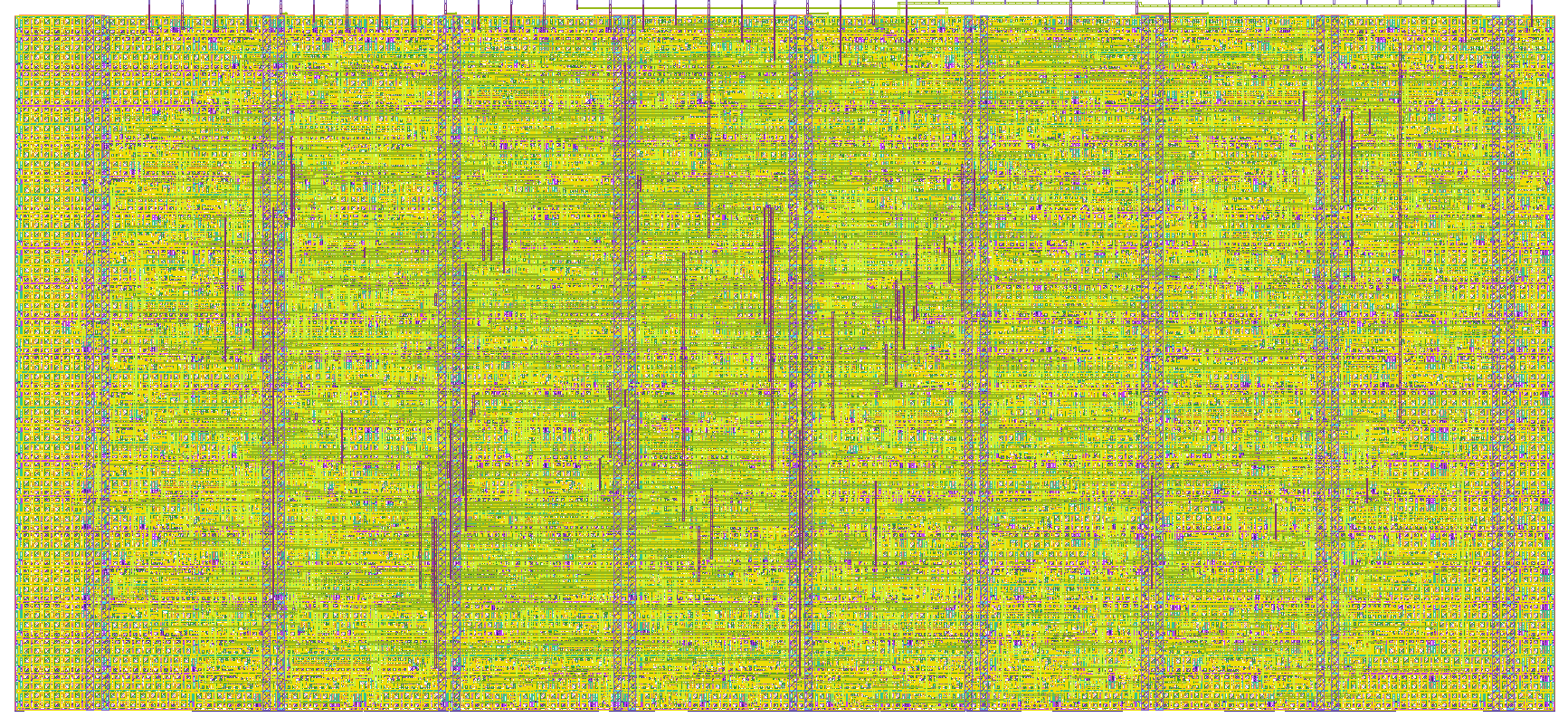
- Author: Grace Eysenbach
- Description: SPI peripheral with addressable 8-bit registers for controlling 8x LEDs
- GitHub repository
- Open in 3D viewer
- Open in Tiny Tapeout Explorer
- Clock: 50000000 Hz
How it works
This chip is an SPI-controlled 8-channel LED driver. An SPI master (such as the RP2040/RP2350 on the Tiny Tapeout dev board) communicates with the chip over a 4-wire SPI interface (CS, SCLK, MOSI, MISO). Each SPI transaction is 16 bits: the first byte selects a register address and direction (read or write), and the second byte carries the data.
Internally, the chip contains a 16-register file (9 read/write, 7 read-only). Eight BRIGHT registers (0x0–0x7) set the PWM brightness of 8 LED outputs on uo_out[0..7].
A shared 8-bit counter (pwm_counter) cycles 0→255, ticking every 2^PRESCALER system clock cycles. Each LED output is: uo_out[n] = ENABLE && (pwm_counter < BRIGHT_n), with two special cases: BRIGHT=0xFF → always on, BRIGHT=0x00 → always off. Intermediate values set duty cycle: e.g. 0x80 = 50%, 0x40 = 25%.
With the default PRESCALER=8 and a 50 MHz system clock, PWM refresh rate ≈ 760 Hz (flicker-free).
SPI input signals (CS, SCLK, MOSI) are passed through 2-flop synchronizers before entering the SPI FSM, safely crossing from the asynchronous SPI clock domain into the chip's 50 MHz system clock domain.
Limitations
- SPI mode: CPOL=0, CPHA=0 only (sample on rising SCLK edge)
- SCLK must be ≤ system clock / 20 (≤ 2.5 MHz at a 50 MHz system clock)
- Single register access per CS assertion — no burst transfers
- Data is MSB first
Connection
| Pin | Direction | Signal | Description |
|---|---|---|---|
uio[0] |
Input | spi_cs_n |
SPI chip select (active low) |
uio[1] |
Input | spi_mosi |
SPI master-out slave-in |
uio[2] |
Output | spi_miso |
SPI master-in slave-out |
uio[3] |
Input | spi_clk |
SPI clock |
uo[0..7] |
Output | LED0..LED7 |
LED drive outputs |
ui_in and uio[4..7] are unused.
Protocol
SPI settings
| Parameter | Value |
|---|---|
| Mode | CPOL=0, CPHA=0 |
| Bit order | MSB first |
| Transaction length | 16 bits |
| CS polarity | Active low |
| Max SCLK | 2.5 MHz (at 50 MHz system clock) |
CS must remain low for the entire 16-bit transaction.
Transaction format
Bit:   [15]    [14:12]      [11:8]    [7:0]
MOSI:  R/W     reserved     addr      data (write) | don't-care (read)
MISO:  0       0            0         0 (write)    | data (read)
R/W: 1 = write, 0 = readreserved: ignored on decodeaddr: 4-bit register address (0x0–0xF)data: value to write, or register contents returned on read
Register map
| Address | Name | Access | Reset | Description |
|---|---|---|---|---|
| 0x0 | BRIGHT_0 |
RW | 0x00 | PWM brightness for LED 0. 0x00=off, 0xFF=always on, 0x01–0xFE=duty cycle (value/256) |
| 0x1 | BRIGHT_1 |
RW | 0x00 | PWM brightness for LED 1 |
| 0x2 | BRIGHT_2 |
RW | 0x00 | PWM brightness for LED 2 |
| 0x3 | BRIGHT_3 |
RW | 0x00 | PWM brightness for LED 3 |
| 0x4 | BRIGHT_4 |
RW | 0x00 | PWM brightness for LED 4 |
| 0x5 | BRIGHT_5 |
RW | 0x00 | PWM brightness for LED 5 |
| 0x6 | BRIGHT_6 |
RW | 0x00 | PWM brightness for LED 6 |
| 0x7 | BRIGHT_7 |
RW | 0x00 | PWM brightness for LED 7 |
| 0x8 | CTRL |
RW | 0x80 | Bits[7:4]: PRESCALER (counter ticks every 2^PRESCALER cycles, default=8). Bits[3:1]: reserved. Bit[0]: ENABLE (1=LEDs active, 0=all off) |
| 0x9 | ID |
RO | 0xA5 | Fixed magic byte — read to verify SPI is working |
| 0xA | VERSION |
RO | 0x01 | Design version |
| 0xB | STATUS |
RO | 0x00 | Bit[0]: mirrors CTRL ENABLE. Bit[1]: 1 after a write, 0 after a read. Bits[7:2]: reserved, read 0 |
| 0xC | COUNTER |
RO | — | Current value of the free-running PWM counter (0–255). Useful for debug |
| 0xD–0xF | RESERVED |
RO | 0x00 | Reserved, always returns 0x00 |
Writes to addresses 0x9–0xF are silently dropped.
External hardware
Pmod 8LD (e.g., Digilent 410-076 or compatible clone) — 8 discrete LEDs on a standard 12-pin Pmod connector. Plug into the output Pmod header on the TT dev board. uo_out[0..7] maps directly to LD0..LD7. No additional components required; the Pmod draws ~1 mA per LED from the signal pins.
How to test
Recommended bring-up sequence (each step must pass before the next is meaningful):
- SPI alive — Read ID register (0x9). Expect
0xA5. If this returns 0x00 or 0xFF, check wiring and CS polarity. - Address decode — Read VERSION (0xA). Expect
0x01. - RW loopback — Write
0xA5to BRIGHT_0 (0x0), read back. Expect0xA5. Repeat with0x5A. - RO protection — Write
0xFFto ID (0x9), read back. Expect0xA5(write was dropped). - ENABLE control — Write
0x81to CTRL (0x8) (PRESCALER=8, ENABLE=1). Read STATUS (0xB), expect bit[0]=1. - LED output — With ENABLE=1, write
0xFFto BRIGHT_0 (0x0).uo_out[0]should go high (always on). Write0x80— 50% brightness. Write0x00— LED off. - All channels — Repeat step 6 for BRIGHT_1–BRIGHT_7 to verify all 8 outputs.
- COUNTER live — Read COUNTER (0xC) twice with a short delay between. Values should differ (counter is free-running).
Example MicroPython (RP2040, SoftSPI):
import time
from machine import SoftSPI, Pin
import random

# Set project Clock Speed + Reset Project
tt.clock_project_PWM(10_000_000)
tt.reset_project(True)
import time
time.sleep_ms(10)
tt.reset_project(False)
time.sleep_ms(10)

spi = SoftSPI(baudrate=100_000, polarity=0, phase=0,
              sck=Pin(28), mosi=Pin(26), miso=Pin(27))
cs = Pin(25, Pin.OUT, value=1)

def spi_write(addr, data):
    cs(0)
    spi.write(bytes([(1 << 7) | addr, data]))
    cs(1)

def spi_read(addr):
    cs(0)
    buf = bytearray(2)
    spi.write_readinto(bytes([addr, 0x00]), buf)
    cs(1)
    return buf[1]

# Verify SPI is alive (read ID + Version registers)
assert spi_read(0x9) == 0xA5    # ID = 0xA5
assert spi_read(0xA) == 0x01    # Version = 0x01

# STATUS register checks
spi_write(0x8, 0x81)                    # write to CTRL
assert spi_read(0xB) & 0x02 != 0       # LAST_OP_WAS_WRITE=1
spi_read(0xB)                           # read STATUS
assert spi_read(0xB) & 0x02 == 0       # LAST_OP_WAS_WRITE=0
assert spi_read(0xB) & 0x01 != 0       # ENABLE=1 mirrors CTRL

# COUNTER register — verify it's live
c1 = spi_read(0xC)
time.sleep_ms(50)
c2 = spi_read(0xC)
assert c1 != c2, "counter not incrementing!"
print(f"counter: {c1} → {c2}")


# Enable LEDs (PRESCALER=8, ENABLE=1) and test channel 0
spi_write(0x8, 0x81)   # CTRL: PRESCALER=8, ENABLE=1
spi_write(0x0, 0xFF)   # BRIGHT_0: always on
spi_write(0x0, 0x80)   # BRIGHT_0: 50% brightness
spi_write(0x0, 0x00)   # BRIGHT_0: off

# Light all 8x LEDs one at a time (full brightness)
for i in range(8):
    spi_write(i, 0xFF)
    time.sleep_ms(500)

# Test PWM Control
spi_write(0x8, 0x81)   # CTRL: PRESCALER=8, ENABLE=1
for brightness in [0x20, 0x80, 0xC0, 0xFF, 0x00]:
    for i in range(8):
        spi_write(i, brightness)
    time.sleep_ms(500)

# Party Mode
spi_write(0x8, 0x81)   # CTRL: PRESCALER=8, ENABLE=1
for _ in range(30):
    for i in range(8):
        brightness = random.choice([0x00, 0x20, 0x40, 0x80, 0xC0, 0xFF])
        spi_write(i, brightness)
    time.sleep_ms(150)
IO
| # | Input | Output | Bidirectional |
|---|---|---|---|
| 0 | LED0 | spi_cs_n | |
| 1 | LED1 | spi_mosi | |
| 2 | LED2 | spi_miso | |
| 3 | LED3 | spi_clk | |
| 4 | LED4 | ||
| 5 | LED5 | ||
| 6 | LED6 | ||
| 7 | LED7 |